Stop Breaking Tools: How to Choose the Right Carbide End Mill Size and Flutes
Table of Contents
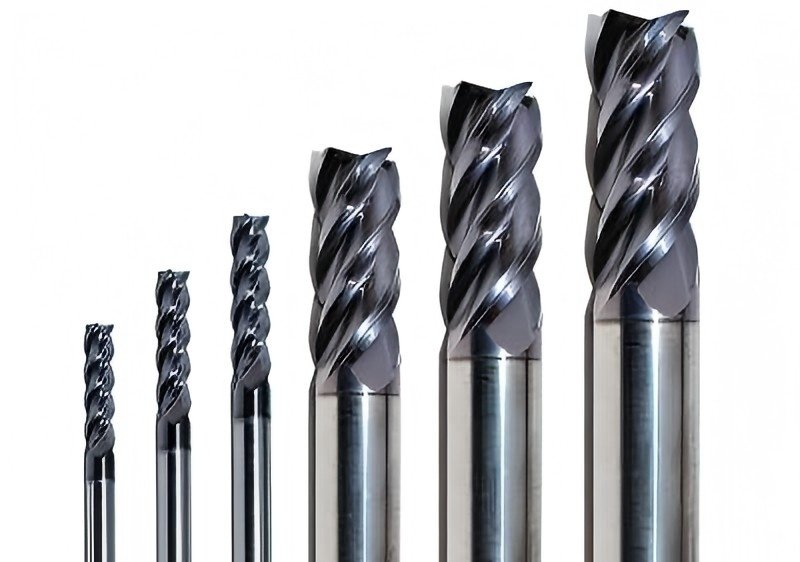
If your milling jobs are leaving chatter marks, packed chips, or broken tools, the problem is often not your machine – it’s the carbide end mill you chose.
Diameter, flute count, length, and inch vs. metric sizes all change how the tool behaves in the cut.
In this guide we’ll walk through a simple, step-by-step way to choose the right solid carbide end mill for your work:
- Inch vs. metric: which standard to stock
- How diameter affects rigidity and metal removal
- When to use 2, 3, 4, 5, or 6 flutes
- How tool length and shank style impact stability
- Practical examples of carbide end mill cutting parameters
You can use this as a reference whenever you select a new tool or build a standard carbide end mill set for your shop.
Inch vs. Metric – Match Your Drawing, Not Your Mood
The first decision is simple: follow the units of your drawing and CAM model.
- In North American shops, inch sizes like 1/4 carbide end mill, 3/8 carbide end mill, and 1/2 carbide end millare still very common.
- In many European and global shops, metric sizes such as 6mm, 10mm carbide end mill, and 12mm carbide end millare the default.
Trying to “convert on the fly” usually leads to wrong slot widths or broken tolerances.
For example:
- 1/4″ = 6.35 mm, not 6 mm
- 3/8″ = 9.525 mm, not 10 mm
Common Inch vs. Metric Sizes at a Glance
Category | Inch Examples | Metric Examples | Typical Use Case |
Micro / small | 1/32″, 1/16″, 3/32″, 1/8″ | 1 mm, 1.5 mm, 2 mm, 3 mm | Engraving, tiny pockets, PCB |
General-purpose | 1/4″, 5/16″, 3/8″, 7/16″, 1/2″ | 4 mm, 5 mm, 6 mm, 8 mm, 10 mm, 12 mm | Most 2D/3D milling tasks |
Heavy roughing | 5/8″, 3/4″, 1″ | 16 mm, 20 mm | High MRR, facing, large pockets |
Practical tip:
Pick one system (inch or metric) for a job and stay with it from CAD → CAM → tooling. If you mostly use inch drawings, build your standard tungsten carbide end mill inventory around a few key imperial sizes. If you mostly use metric models, do the opposite.
How Diameter Changes Rigidity, Feed and Metal Removal
Diameter is much more than “how wide the slot is.” It directly affects:
- Tool rigidity and tendency to deflect
- Maximum safe chip load
- Possible step-down and metal removal rate
Small Diameters (≈ 1–3 mm / 1/32″–1/8″)
Small tools such as a 1 mm or 1/16″ carbide end mill are great for:
- Fine details in molds
- Engraving logos or tiny pockets
- PCB routing and micro-machining
But they are:
- Very sensitive to runout
- Limited in chip load and depth per pass
- Easy to break if clamped poorly or overloaded
When using very small solid carbide end mill sizes, spend extra time on:
- Clean, high-precision toolholders
- Short stick-out
- Conservative feed rates, especially in harder materials
Medium Diameters (≈ 4–12 mm / 3/16″–1/2″)
This range includes workhorses like:
- 1/4 carbide end mill
- 3/8 carbide end mill
- 1/2 carbide end mill
- 10mm carbide end mill
- 12mm carbide end mill
You’ll use these tools for most:
- Pocketing
- Slotting
- Profiling
- Adaptive or high-efficiency milling (HEM)
They’re rigid enough to take useful step-downs but still small enough to reach tighter features.
Large Diameters (≈ 16–20 mm / 5/8″–3/4″–1″)
Larger tools like a 3/4″ or 20mm carbide end mill are ideal when you need:
- High metal removal rates in roughing
- Facing large areas
- Machining thick plates or blocks
Here the limiting factor is usually spindle power and machine rigidity. The tool can handle big chips and depths of cut – if the machine can.
Choosing Flute Count: 1, 2, 3, 4, 5 or 6?
Flute count is how many cutting edges are on the tool. It’s a balance between:
- Chip space (room for chips to leave)
- Core strength
- Surface finish
- Potential feed rate (more flutes = more chips per revolution)
Quick Flute Selection Guide
Flute Count | Typical Materials | Key Benefits | Limitations |
1 flute | Aluminum, plastics, composites | Huge chip space, good on light routers | Weak core, not for hard steels |
2 flute carbide end mill | Aluminum, non-ferrous, wood | Great chip evacuation, simple choice | Less strength in heavy steel cuts |
3 flute carbide end mill | Aluminum, stainless, general-purpose | Balance of chip space and strength | Slightly less chip room than 2 flutes |
4 flute carbide end mill | Steel, stainless, tool steel | Strong core, good finish, versatile | Limited for full-slotting in gummy materials |
5 flute carbide end mill, 6 flute carbide end mill | Hardened steel, high-temp alloys | Excellent finish, strong in side cuts | Needs good chip evacuation strategy |
When to Use Single-Flute and 2-Flute End Mills
A single flute carbide end mill or a small 2 flute carbide end mill shines in:
- High-speed routing in aluminum
- Lightweight CNC routers with limited spindle power
- Plastics and other soft materials where chip evacuation is critical
Because there is so much chip space per flute, they’re less likely to pack chips in deep slots.
3-Flute End Mills – The “In-Between” Workhorse
A 3 flute carbide end mill gives you:
- More teeth than 2 flutes → higher possible feed at the same chip load
- Better core strength
- Still plenty of space for chips in aluminum and many stainless grades
They are very popular for small to medium diameters in aluminum, stainless, and general-purpose work.
4-, 5-, and 6-Flute End Mills for Steels
For steels and stainless steels:
- A 4 flute carbide end millis often the standard choice for side milling and finishing.
- A 5 flute carbide end millor 6 flute carbide end millis common for high-efficiency milling, semi-finishing, and finishing in harder materials.
When you get into higher hardness (tool steels, hardened dies), many shops move to specialized carbide end mill for hardened steel with 4–6 flutes, corner radii, and advanced coatings.
Length, Overhang and Shank – Why “Short and Fat” Wins
Even the best geometry will fail if the tool is hanging out too far.
General Rules for Length
- Use the shortest flute lengththat still reaches the work.
- Keep the overall length (OAL) as short as practical.
- Reduce stick-out from the collet or holder whenever you can.
Short, rigid setups resist chatter, hold size better, and dramatically increase tool life.
Reduced Shank and Reach Tools
Sometimes, deep pockets or tall walls force you to extend the tool. This is where a reduced shank carbide end mill helps:
- Cutting diameter is, for example, 10 mm, but the shank is turned down so the tool can pass deeper into a pocket without rubbing.
- The relieved neck gives wall clearance while keeping the cutting portion as short as possible.
You still have to reduce radial engagement and be more gentle with feeds, but this geometry is safer than using a long, uniformly thick tool.
Matching Size and Flutes to Real Jobs
Let’s put this together with typical tasks you might run in your shop.
Slotting and Pocketing in Aluminum
Good choices:
- Single flute carbide end millfor light machines and routers
- 2 flute carbide end millfor general slots
- 3 flute carbide end millwith high helix for aggressive roughing
Sizes like 1/4 carbide end mill and 3/8 carbide end mill cover a lot of work in 6061 or similar alloys.
For a modern carbide end mill for aluminum, look for:
- High or variable helix angles
- Polished flutes or specific aluminum coatings
- Generous flute volume for chip evacuation
Side Milling in Steel and Stainless
For mild steel, alloy steel, and common stainless grades:
- Use a 4 flute carbide end millor 5 flute carbide end millwith a tough coating (e.g., TiAlN/AlTiN).
- Diameters like 10mm carbide end millor 12mm carbide end millare ideal for wall finishing and adaptive toolpaths.
If you’re cutting more difficult grades (e.g., 304, 316), move to a dedicated carbide end mill for stainless steel with optimized geometry for chip thinning and heat control.
Finishing Hardened Steel
When finishing hardened tool steel:
- Choose a solid carbide end millwith 4–6 flutes and a small corner radius or ball nose.
- Use light step-over and smaller depths of cut.
- Look for tools marketed specifically as carbide end mill for hardened steelor high-hardness series.
Here, good fixturing and stable toolholding are just as important as the tool itself.
Deep, Narrow Pockets and Cavities
For deep, narrow pockets:
- Use smaller diameters (e.g., 6 mm, 8 mm, or 10mm carbide end mill) with extended reach and reduced neck.
- Combine this with high-efficiency milling (small radial engagement, deeper axial cuts).
- If possible, rough with a shorter tool and use the long tool only for finishing passes.
A carefully selected tungsten carbide end mill with reduced neck will help you reach depth while keeping chatter under control.
Example Cutting Parameters – How Speeds and Feeds Change
Exact carbide end mill speeds and feeds depend on the tool geometry, coating, and machine, but it’s helpful to see how different materials compare.
Below is a typical starting point for a 1/2″ (12.7 mm) 4-flute solid carbide end mill in a rigid vertical machining center. Values are approximate and should always be adjusted using the manufacturer’s carbide end mill speeds and feeds calculator or charts.
Example Starting Parameters for a 1/2″ Solid Carbide End Mill
Material | Surface Speed (SFM) | Approx. RPM | Chip Load per Tooth (inch) | Feed Rate (IPM, 4 flutes) |
Aluminum 6061 | 600–800 | 4,600–6,100 | 0.003–0.005 | 55–120 |
Low Carbon Steel | 200–300 | 1,500–2,300 | 0.002–0.003 | 12–28 |
Alloy / Tool Steel | 160–220 | 1,200–1,700 | 0.0015–0.0025 | 7–17 |
Stainless Steel | 140–180 | 1,050–1,400 | 0.0015–0.0020 | 6–11 |
These numbers are not a substitute for the toolmaker’s data, but they give you a sense of how carbide end mill cutting parameters change with material hardness.

Conclusion
A good carbide end mill choice is rarely about one parameter alone.
It’s the combination of:
- Correct unit system
- Right diameter for the feature and rigidity
- Flute count that matches the material and chip behavior
- Proper length and shank design
- Realistic cutting data
If you build your tooling strategy around a small, well-chosen carbide end mill set – with a few key diameters and flute configurations for aluminum, steel, stainless, and hardened materials – you’ll spend less time fighting chatter and broken tools, and more time making good parts.