Single-Flute vs Two-Flute Spiral End Mills: Where Each Works Best
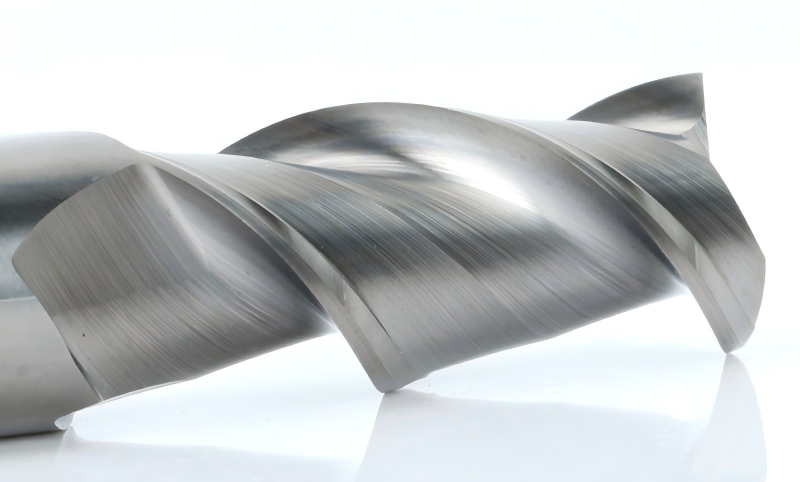
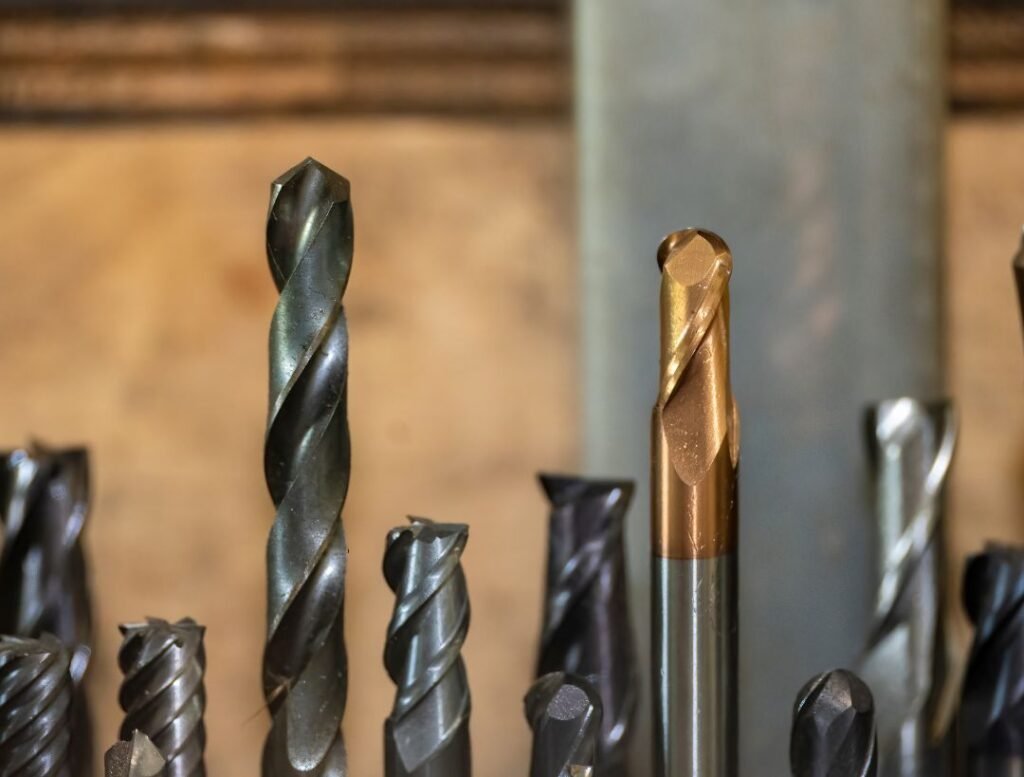
Choosing between a single-flute and a two-flute spiral end mill looks simple until a job starts producing melted acrylic edges, packed aluminum chips, chatter marks, or a cycle time that is too slow for production. Both tools can cut slots, profiles, pockets, and contours. The difference is how each tool manages chip space, cutting load, heat, and stability.
For a CNC shop, flute count is not just a catalog detail. It affects whether chips leave the cut or recut against the wall, whether the edge looks polished or torn, and whether the spindle has enough speed to maintain a proper chip load. A single-flute tool gives the chip a large open path to escape. A two-flute tool gives the machine more cutting edges per revolution, so it can remove material more efficiently when chip evacuation and rigidity are under control.
This guide explains where single-flute and two-flute spiral end mills fit in real machining work, especially for acrylic, plastics, wood, aluminum, copper alloys, steels, stainless steel, flat milling, slotting, deep pockets, and fine engraving.
The Core Difference: Chip Space vs Cutting Edges
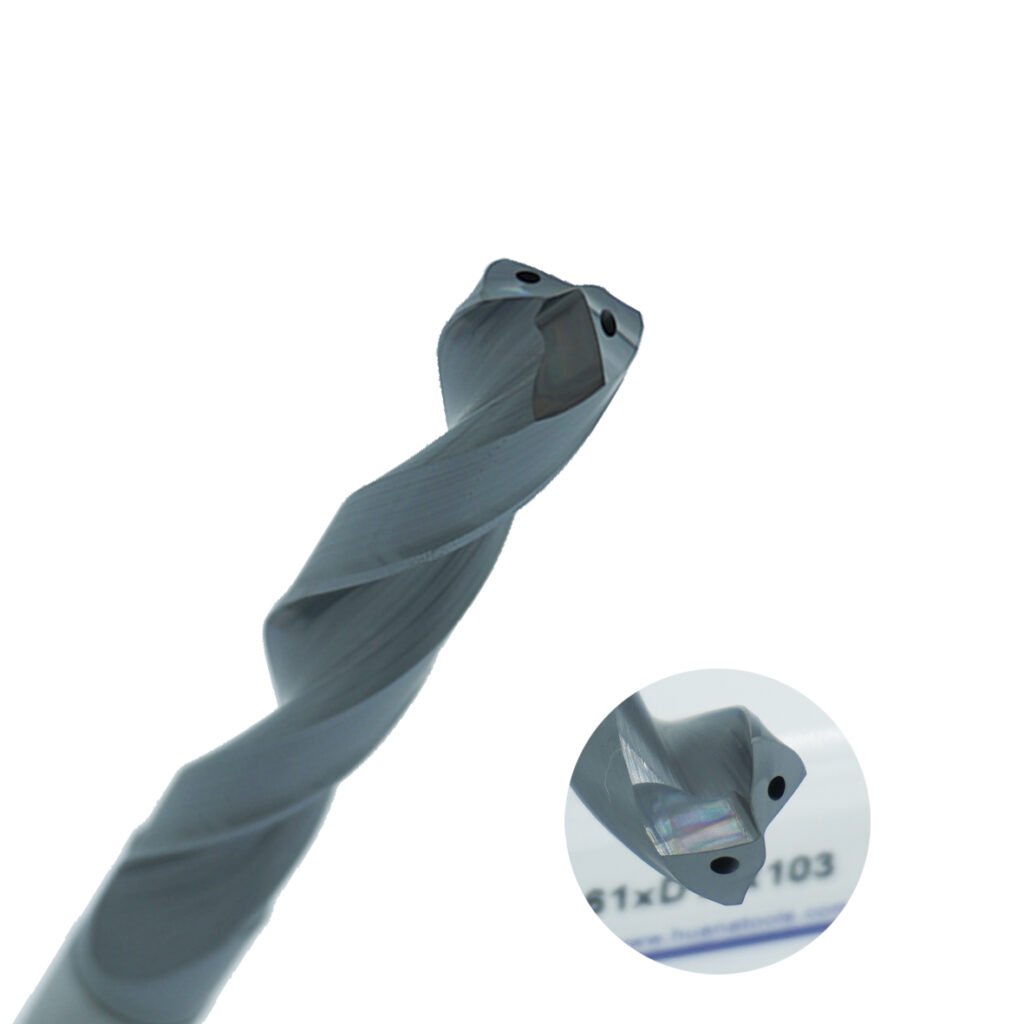
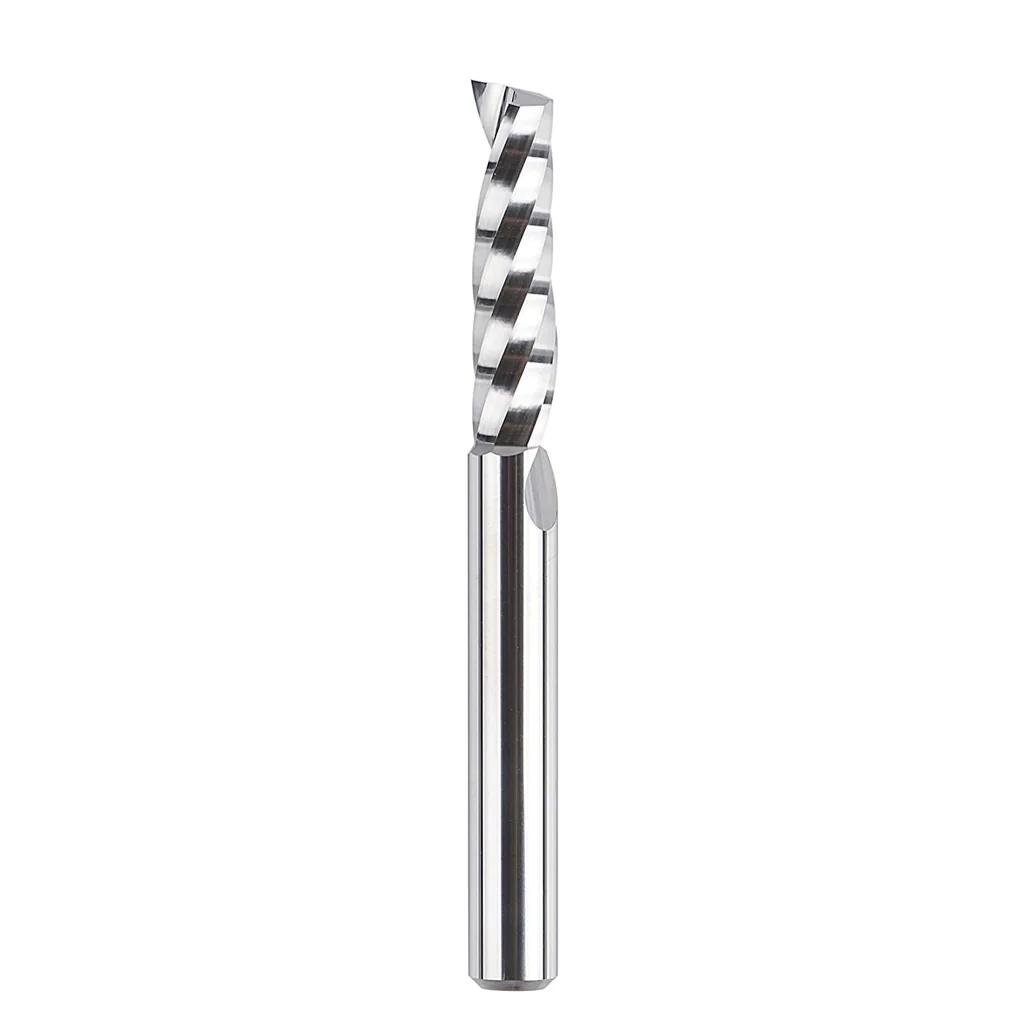
The easiest way to compare these tools is to look at the space between cutting edges. A single-flute end mill has one cutting edge and one large flute. That large flute gives chips room to curl, move, and leave the cutting zone. In soft materials, that matters more than it sounds. Plastic chips can melt and weld back onto the workpiece. Aluminum can smear onto the cutting edge and form built-up edge. Wood and composite chips can pack inside a narrow slot.
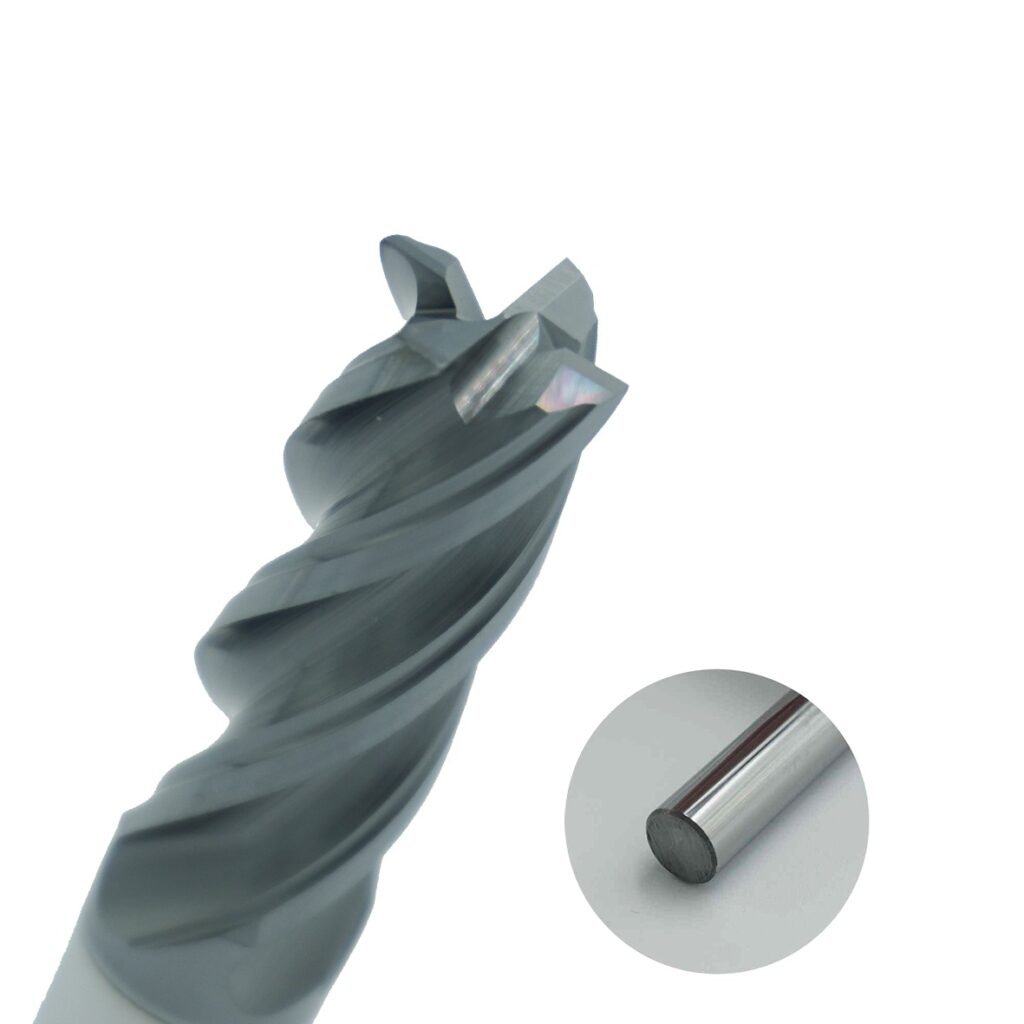
A two-flute end mill has two cutting edges. It cuts twice per revolution, which improves feed capacity and helps balance the tool during general milling. The tradeoff is smaller flute space. That smaller chip gullet is usually fine in steel, cast iron, and many controlled aluminum operations, but it can become a problem in gummy, stringy, or heat-sensitive materials.
Selection Factor | Single-Flute Spiral End Mill | Two-Flute Spiral End Mill |
Chip evacuation | Excellent, especially in deep slots and soft materials | Good for general work, but less chip space than single flute |
Cutting efficiency | Lower number of cutting edges, often lower MRR | Higher feed potential with two cutting edges |
Heat control | Strong when chips evacuate cleanly | Depends more on coolant, air blast, chip load, and slot depth |
Surface finish | Very good in plastics, acrylic, and non-ferrous finishing when parameters are correct | Good general finish; can leave marks if flute runout or tool balance is poor |
Best machine fit | High-speed routers, engraving machines, light-duty CNCs, high-rpm spindles | CNC mills, VMCs, rigid routers, manual mills, general production setups |
Common risk | Rubbing if chip load is too low | Chip packing in sticky materials or deep full-width slots |
Where Single-Flute End Mills Work Best
Single-flute spiral end mills are strongest when chip evacuation is the main challenge. They are common in CNC routing, sign making, plastics machining, aluminum profile cutting, and high-speed finishing of non-ferrous materials.
Acrylic, PVC, Plastics, and Other Soft Materials
If a shop is cutting acrylic display panels, PVC sheet, ABS covers, engineering plastics, foam board, or MDF, a single-flute cutter is often the first tool to test. The open flute helps remove chips before they rub against the wall and generate heat. That is important because plastic does not forgive poor chip evacuation. Once the edge gets hot, chips can soften, smear, or weld back to the part.
For clear acrylic, the goal is often a clean, transparent edge with minimal post-polishing. A sharp single-flute tool, proper chip load, stable workholding, and air blast can produce a much cleaner edge than a multi-flute cutter that recuts chips in the slot. In routing work, the single-flute design also reduces cutting pressure, which helps thin sheets and small parts stay in place.
Aluminum and Other Non-Ferrous Metals
Single-flute carbide end mills are also used in aluminum, copper alloys, magnesium alloys, and other non-ferrous materials where chips tend to be larger or more adhesive. The large flute gives aluminum chips room to leave the cut instead of packing into the slot. A polished flute can further reduce chip sticking and built-up edge.
This does not mean a single-flute cutter is always the fastest aluminum tool. On a rigid CNC mill with good coolant, a two-flute or three-flute aluminum end mill may remove material faster. Single flute becomes attractive when the spindle is very high speed, the machine is a router, the slot is deep relative to tool diameter, or the shop is chasing a cleaner wall finish in a sticky alloy.
Deep Grooves, Pockets, and Difficult Chip Evacuation
Deep narrow slots are hard on any end mill because the chips have limited room to escape. A single-flute tool gives the cut more open volume, which can reduce chip packing in deep grooves, pockets, and cavities. That is useful in aluminum fixtures, plastic housings, mold sidewalls, and parts where coolant cannot reach the bottom of the cut easily.
The key is to avoid thinking of single flute as simply “slower.” In a slot where a two-flute tool packs chips and forces repeated stops, the single-flute tool may be the more productive option because the cut stays stable.
Fine Contouring, Engraving, and Small Features
For high-speed contouring, 3C components, mold sidewall finishing, lettering, logo engraving, and small decorative details, a single-flute end mill can be easier to control. With only one cutting edge engaged at a time, cutting force is more concentrated and often lower in average load. That can help reduce vibration on small-diameter tools and light machines.
There is a limit. If the material is hard, abrasive, or the job needs heavy side milling, a single-flute tool may wear quickly or deflect. But for soft materials and non-ferrous finishing, it can be a very practical choice.
Where Two-Flute End Mills Work Best
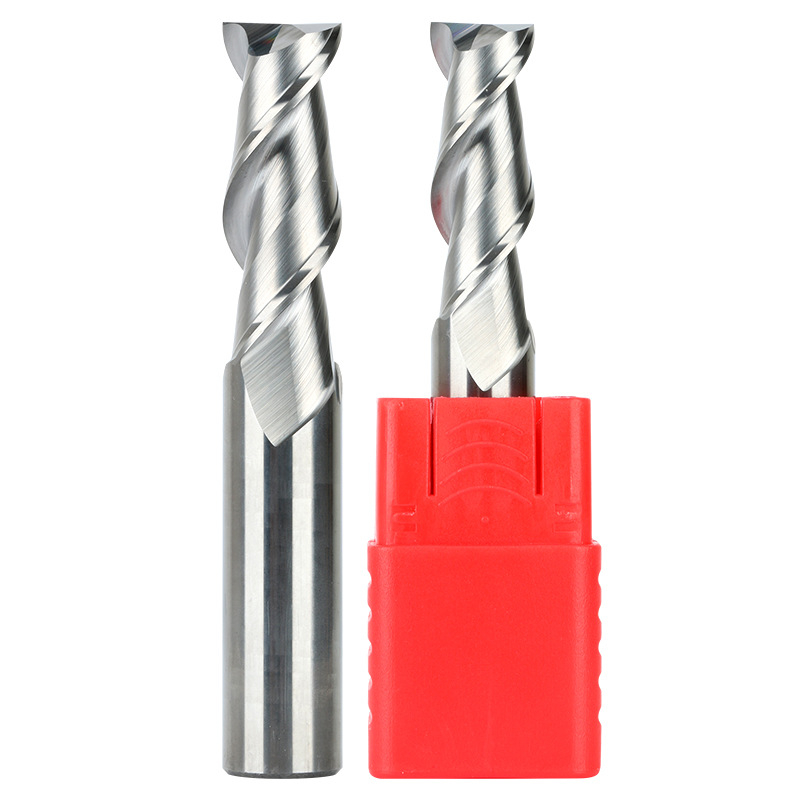
Two-flute spiral end mills are the everyday middle ground. They are used for general milling because they combine decent chip clearance with better feed potential than a single-flute tool. For many shops, a two-flute square end mill is the default tool for slots, pockets, steps, shoulder milling, and light finishing.
General Metal Milling
Two-flute end mills are widely used in steel, cast iron, stainless steel, aluminum, brass, and general structural components. In steels and cast irons, chips are often smaller and less gummy than plastic or soft aluminum chips, so a two-flute tool can run productively without needing the large chip space of a single-flute cutter.
In stainless steel, the setup must be more careful. The material work-hardens easily, so rubbing is a problem. A two-flute tool can work well when the machine is rigid, the tool is sharp, radial engagement is controlled, and coolant or air clears chips from the cut. Poor chip evacuation, long overhang, or light rubbing cuts can shorten tool life quickly.
Flat Milling, Shoulders, and Step Features
Two-flute tools make sense when the operation benefits from balanced cutting and higher feed per revolution. Plane surfaces, step milling, shoulder milling, and pocket floors often run better with two cutting edges than with one. The cutter contacts the work more frequently, so the feed can be increased without pushing chip load per tooth too high.
If the part needs a good floor finish, check center cutting, corner geometry, and tool runout. A two-flute tool with uneven flute height or poor runout can leave visible feed marks. That is not a reason to avoid two flutes; it is a reason to inspect tool quality and holding accuracy.
Straight Slots, Keyways, and Plunge-Capable Slot Drills
Two-flute end mills are commonly used for straight slots and keyways, especially when the cutter is center cutting. A center-cutting two-flute tool can plunge into the material and then cut a slot without a pre-drilled entry hole. This makes it useful for keyseat work, rectangular pockets, light roughing, and general toolroom milling.
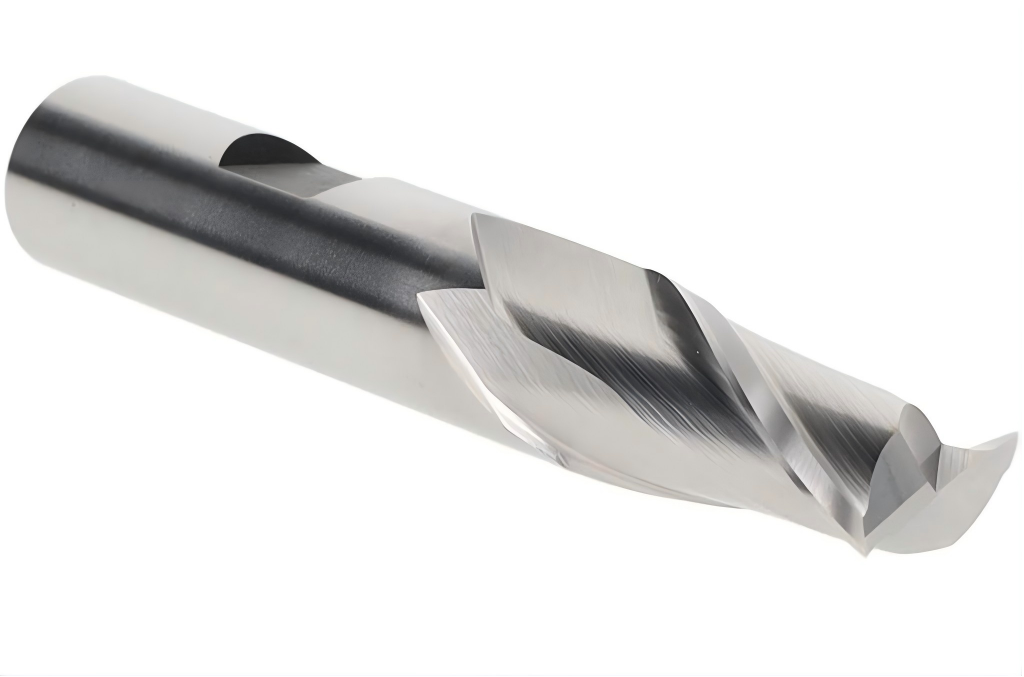
Two-flute tools are not automatically better for every slot. If the slot is deep, the material is gummy, or chips cannot escape, the larger chip space of a single-flute tool may win. In steel or controlled aluminum slotting, two flutes usually give the better balance.
Material-Based Selection
Material behavior should lead the decision. The same flute count can behave very differently in acrylic, 6061 aluminum, stainless steel, and cast iron.
Workpiece Material | Better First Choice | Why |
Acrylic, PMMA, PVC, ABS, plastic sheet | Single flute | Large chip space reduces melting, smearing, and chip recutting |
MDF, wood, signage board | Single flute | Clears bulky chips and lowers cutting pressure on routed sheets |
6061 aluminum, soft aluminum profiles | Single flute or two flute | Single flute for routers/deep slots; two flute for rigid mills and higher output |
Copper and brass | Single flute or two flute | Choose by chip behavior; gummy copper often needs more chip space |
Carbon steel | Two flute | Better productivity and stability for general slotting and profiling |
Cast iron | Two flute | Chips are short and powdery, so chip space is less restrictive |
Stainless steel | Two flute | Works with rigid setup, correct chip load, and reliable coolant |
Hardened steel | Usually more than two flutes, application-specific | Flute count depends on hardness, coating, engagement, and rigidity |
How Operation Type Changes the Answer
The right flute count can change between roughing and finishing on the same part. A shop may rough an aluminum pocket with a single-flute cutter to prevent chip packing, then finish a wall with a two-flute tool if the setup is rigid and the finish target is moderate. Another shop may do the opposite: use a two-flute tool for efficient roughing in steel, then switch to a finishing end mill with more flutes for a smoother wall.
For full-width slotting, chip space matters more because the cutter is engaged on both sides. For side milling with lighter radial engagement, a two-flute tool has more room to breathe. For contour finishing, tool runout, sharpness, and cutting edge consistency can matter more than flute count alone.
Operation | Single-Flute Advantage | Two-Flute Advantage |
Deep slotting in acrylic or aluminum | Clears chips and reduces heat buildup | May pack chips unless air/coolant is strong |
General pocketing in steel | Usually limited productivity | Good balance of feed, stability, and chip control |
High-gloss acrylic edge finishing | Often cleaner when chip load is correct | Higher risk of heat and cloudy edges |
Aluminum profile cutting on CNC router | Strong choice at high rpm | Works if chip evacuation and feed are tuned |
Plunge slotting/keyway work | Possible only if tool is designed for it | Common when center cutting geometry is present |
Fine engraving in soft materials | Low cutting load and clean chip exit | Can work, but small chips may recut in narrow features |
Facing or step milling | Lower feed potential | More efficient and balanced in stable setups |
Feed, Speed, and Chip Load: The Common Mistake
Many flute-count problems are really chip-load problems. A single-flute tool often needs a higher feed per revolution than shops expect because there is only one cutting edge. If the feed is too low, the tool rubs instead of cutting. Rubbing heats the edge, dulls the cutter, and can make acrylic or aluminum look worse, not better.
A two-flute tool spreads the feed across two teeth. At the same spindle speed and feed rate, chip load per tooth is half of what it would be with a single-flute tool. That can be useful for controlled finishing, but it can also cause rubbing if the shop simply swaps tools without recalculating feed.
A practical rule is to adjust feed when changing flute count. Moving from one flute to two flutes usually requires increasing feed rate to maintain the same chip load per tooth. Moving from two flutes to one flute usually requires reducing feed rate or confirming the machine can carry the larger chip load without chatter.
Troubleshooting Symptoms
When the wrong flute count is selected, the machine usually gives clear clues. The part edge, chips, sound, and spindle load tell the story before the tool fails.
Symptom | Likely Cause | Practical Fix |
Melted acrylic edge | Too much rubbing, chips staying in the cut, spindle speed too high for feed | Try single flute, increase chip load carefully, add air blast, use sharper tool |
Aluminum welded to cutting edge | Built-up edge from heat and chip adhesion | Use polished single flute or aluminum geometry, improve lubrication/air, reduce recutting |
Chatter marks on wall | Tool runout, long overhang, poor flute balance, weak workholding | Shorten stickout, check holder, reduce radial engagement, use higher-quality two-flute tool |
Chip packing in deep slot | Flute space too small or evacuation too weak | Use single flute, peck/step down, add air/coolant, reduce slot depth per pass |
Low productivity in steel | Too few cutting edges or conservative feed | Test two-flute or higher-flute tool, increase feed within machine limits |
Burrs on soft aluminum | Dull edge, poor chip evacuation, wrong helix/coating | Use sharp carbide, polished flute, proper chip load, check tool wear |
Buyer Checklist for B2B Tool Selection
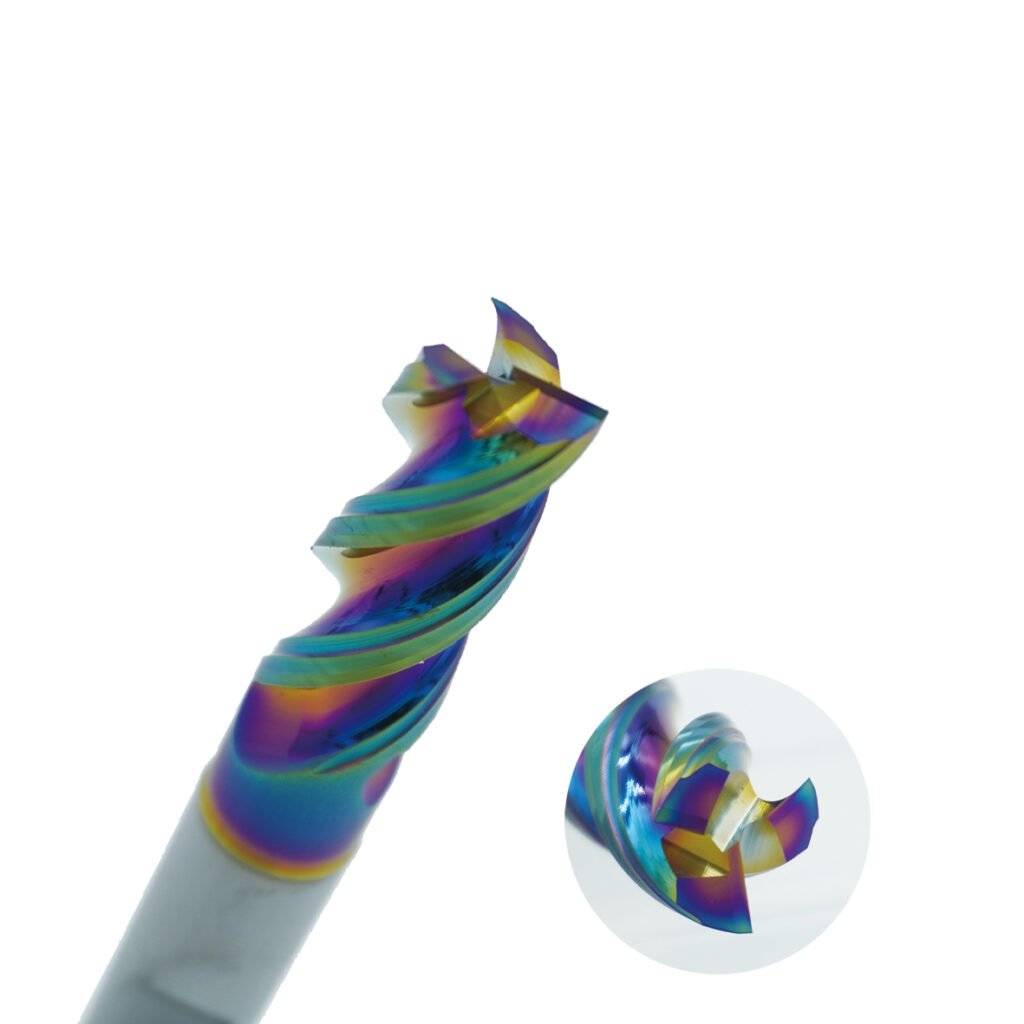
Tool buyers should not choose only by diameter and flute count. Ask for the geometry details that affect production results: carbide grade, coating or polished flute, helix angle, center-cutting ability, corner protection, tolerance, runout control, flute length, and recommended starting parameters.
For single-flute tools, pay attention to edge sharpness, flute polish, and whether the tool is built for aluminum, acrylic, wood, or a broader soft-material range. For two-flute tools, confirm whether the tool is designed for aluminum, steel, stainless steel, or general-purpose milling. A two-flute aluminum cutter and a two-flute steel cutter may look similar in a catalog but behave very differently in the spindle.
For production purchasing, it is also worth asking the supplier for batch consistency. A single trial tool can look excellent, but repeated orders need stable edge prep, diameter tolerance, coating quality, and packaging protection. This is where a reliable carbide tooling supplier can save more money than a slightly cheaper tool.
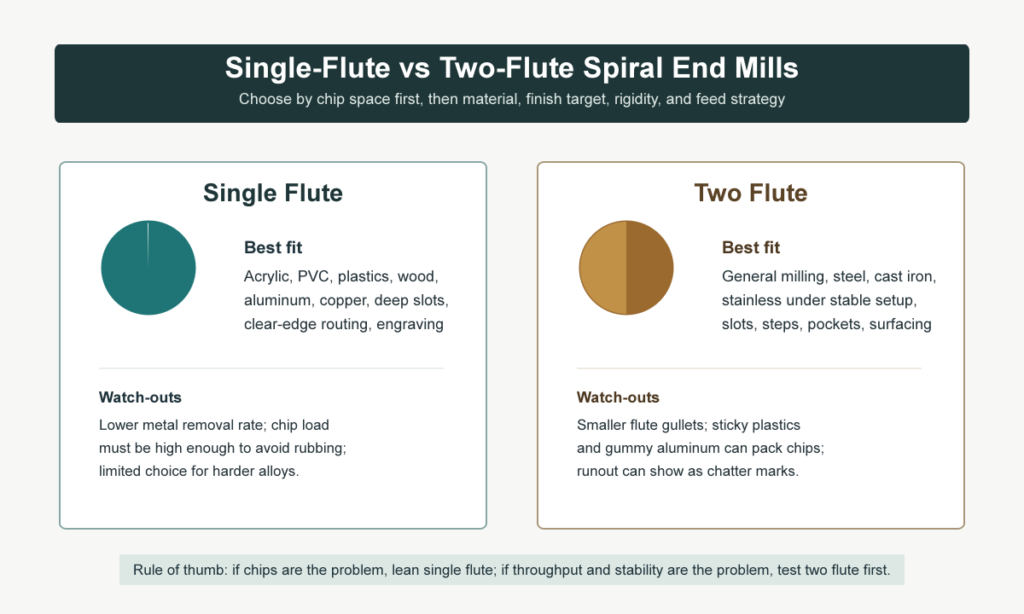
Quick Rule of Thumb
Use a single-flute spiral end mill when the job involves soft materials, plastics, acrylic, PVC, wood, soft aluminum, gummy non-ferrous metals, deep grooves, chip evacuation problems, high-speed routing, or clean-edge finishing where heat must be controlled.
Use a two-flute spiral end mill when the job involves general metal cutting, steel, cast iron, stainless steel under a rigid setup, slotting, step milling, pocketing, flat milling, and production work where feed efficiency and tool balance matter.

Conclusion
Single-flute and two-flute spiral end mills are not competing versions of the same tool. They solve different machining problems. Single flute is the chip-evacuation specialist, especially for soft, sticky, heat-sensitive, and non-ferrous materials. Two flute is the practical production choice for general milling, slots, steps, and many metal parts where the machine is rigid enough to use the extra cutting edge.
For buyers and shop engineers, the best decision starts with the material and the failure mode you are trying to avoid. If chips are melting, welding, or packing, give the single-flute tool serious attention. If the cut is stable and the goal is higher output, a two-flute end mill is often the better starting point.
HNCarbide supplies carbide end mills for different materials, flute counts, and machining conditions. If you are comparing tools for acrylic, aluminum, steel, or mixed CNC production, share the workpiece material, spindle speed range, tool diameter, and operation type so the selection can be matched to the real cut.