Single-Flute vs Double-Flute End Mills: How to Choose for Real Machining Jobs
Table of Contents
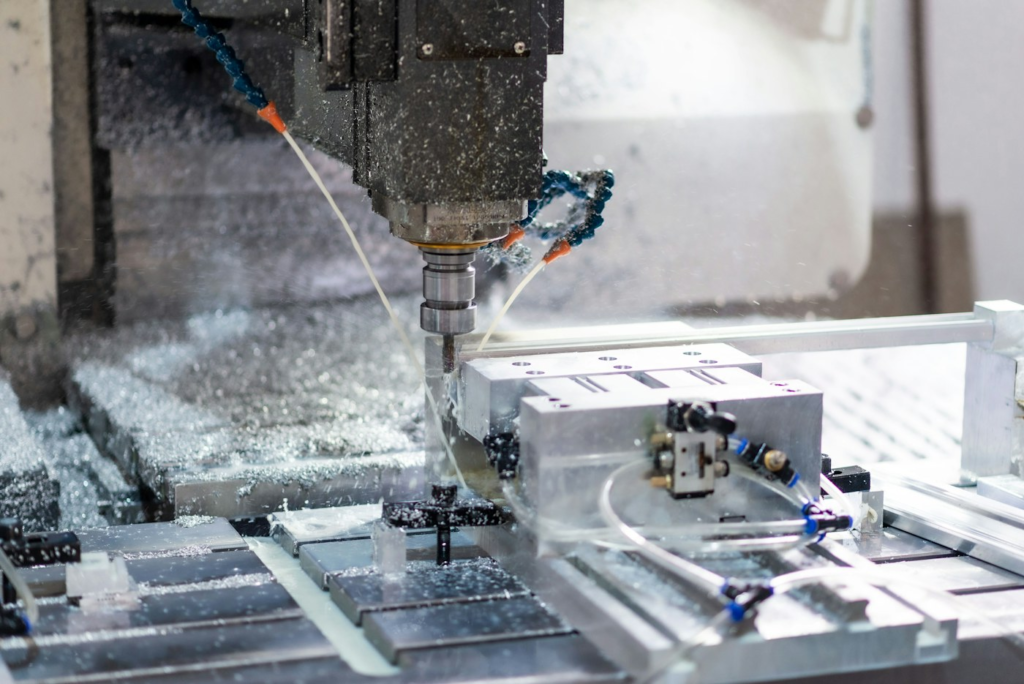
The difference between a single-flute and a double-flute end mill looks small on a tool list. At the spindle, it changes how much room the cutter has for chips, how often an edge enters the cut, how the feed rate must be programmed, and how stiff the tool can be.
That is why a cutter that leaves a clear edge in acrylic can load up in the wrong aluminum slot, while a stable two-flute tool can start rubbing or melting plastic when the programmed feed is copied from a single-flute job. The flute count is part of a system. Material, tool diameter, spindle speed, feed per tooth, depth of cut, toolpath, workholding, and chip removal all matter.
This guide focuses on the practical choice between one and two flutes. It also explains when neither option is the best answer.
The basic tradeoff: chip space versus cutting edges
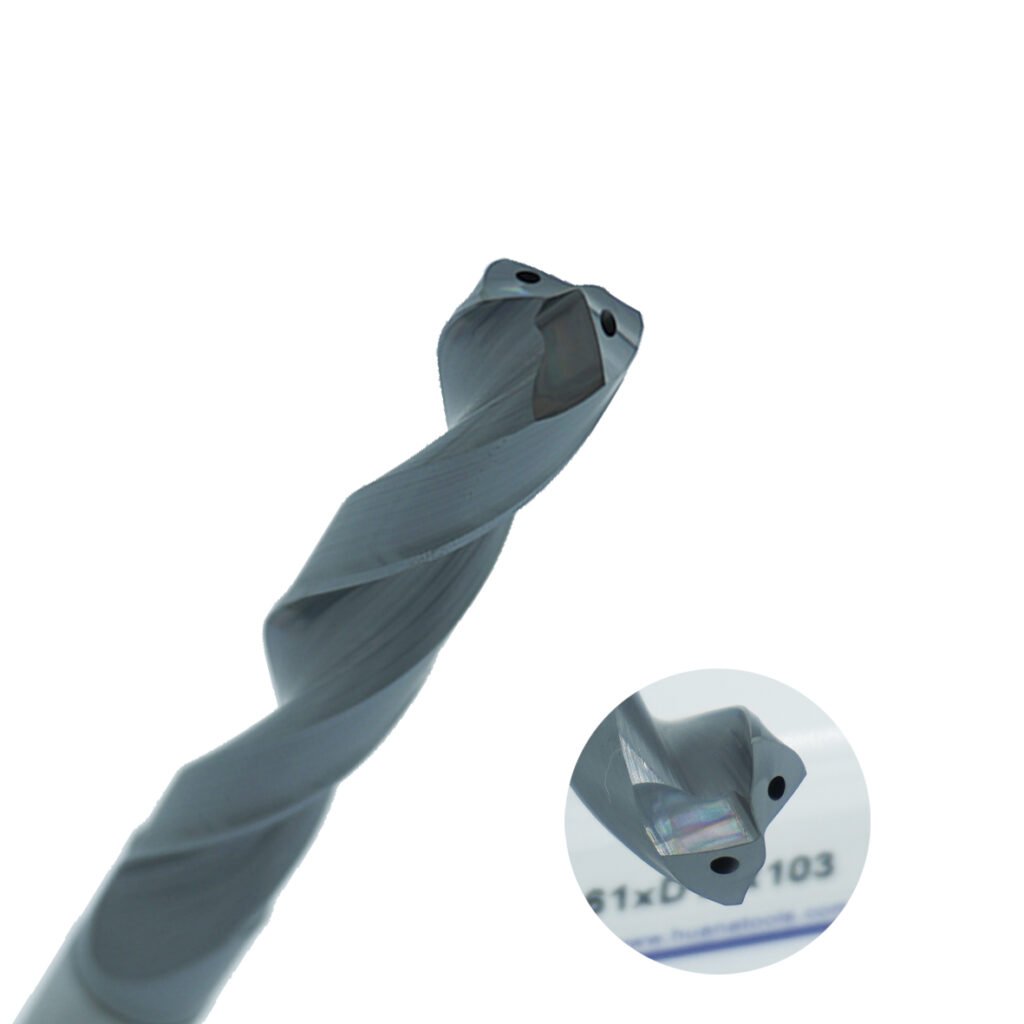
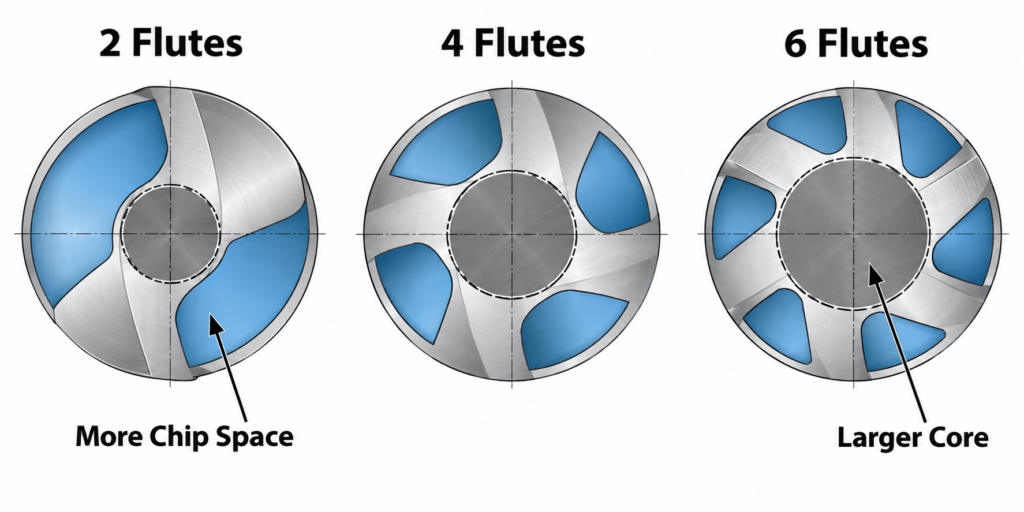
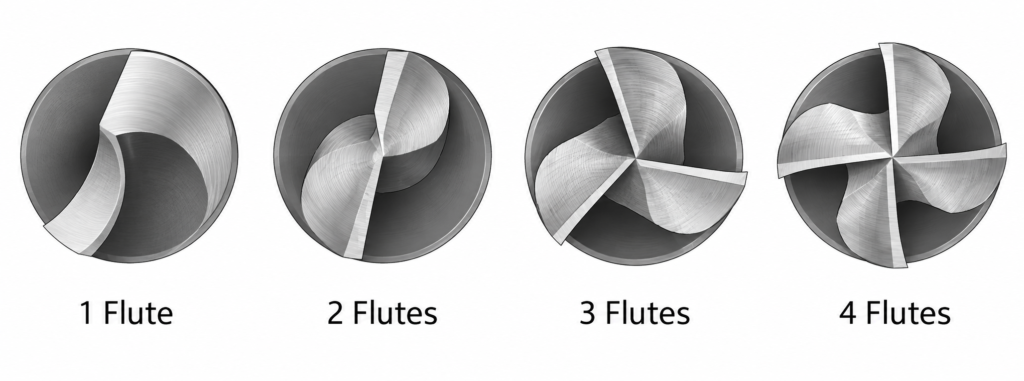
At the same diameter, a single-flute cutter can devote more of its cross-section to one large flute valley. That extra space helps a bulky chip leave the cutting zone before it is recut. It is especially useful on high-speed routers, small-diameter tools, full-width slots, and gummy materials such as soft aluminum or thermoplastics.
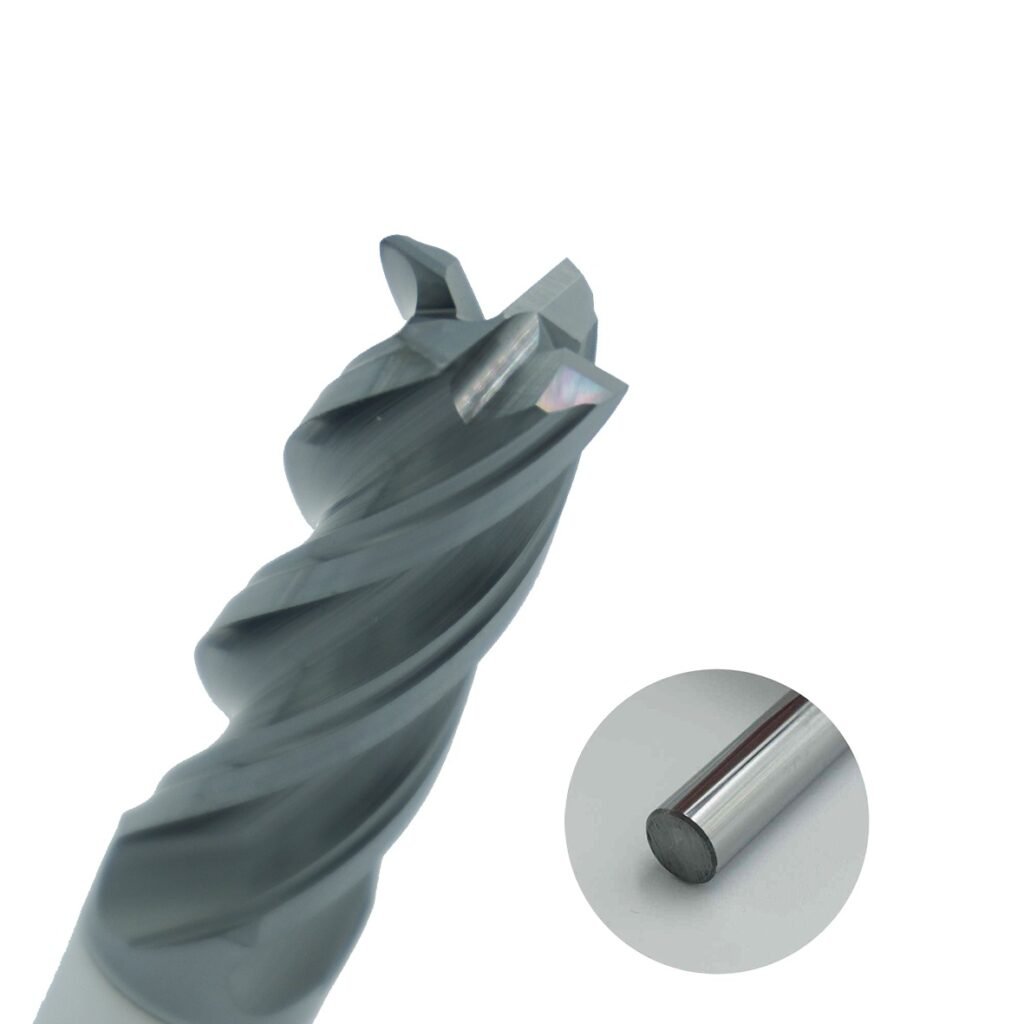
A double-flute cutter has two cutting edges per revolution. It can produce more cutting engagements at the same spindle speed and often has a larger core than a comparable single-flute design. The tradeoff is less chip space per flute. Whether that is an advantage depends on the chip volume and the machine’s ability to clear it.
Decision factor | Single flute | Double flute |
Chip space | Largest possible flute valley for the diameter | Less space per flute, but still generous compared with higher flute counts |
Cutting engagements | One per revolution | Two per revolution |
Feed at the same chip load and rpm | Lower programmed feed | Approximately twice the feed, if power, rigidity, chip evacuation, and geometry allow |
Tool core and stiffness | Geometry-dependent; often less core support than a comparable two-flute tool | Often stiffer at the same diameter and reach |
Common strength | Evacuating large, soft, or heat-sensitive chips | Balancing chip room, stability, and productivity |
Typical risk | Imbalance, deflection, or visible once-per-revolution marks on a weak setup | Chip packing or heat when the flute is too small for the cut |
The word “often” matters in this table. A flute count does not define rake angle, helix, edge polish, core diameter, coating, or end geometry. Two cutters with the same number of flutes can behave very differently.
When a single-flute end mill is the better starting point
High-speed spindles that cannot feed fast enough
Chip load is calculated as:
Chip load per tooth = feed rate / (spindle speed × number of flutes)
Suppose a router runs at 18,000 rpm and the tool maker recommends a 0.05 mm chip load. A single-flute cutter requires a feed of 900 mm/min. A two-flute cutter requires 1,800 mm/min for the same chip load. If the machine cannot maintain that feed through corners, short segments, or acceleration-limited moves, the two-flute cutter may rub instead of cutting a healthy chip.
This is one reason single-flute tools work well on compact CNC routers with very high spindle speed but modest feed capability. Reducing the flute count can bring the programmed feed into a range the machine can actually hold.
Soft aluminum and other non-ferrous materials
Aluminum produces relatively large chips and can weld to a cutting edge when heat, lubrication, edge geometry, or evacuation is poor. A polished single-flute cutter creates room for the chip and can reduce recutting in slots and deep pockets. This tool family is generally intended for aluminum, brass, plastics, composites, and other soft materials rather than steel.
That does not make one flute universally faster. On a rigid machining center with strong air blast or coolant, a purpose-built two- or three-flute aluminum end mill may deliver higher material removal. The single-flute advantage is strongest when chip space or attainable feed is the limiting factor.
Acrylic, PVC, and other thermoplastics
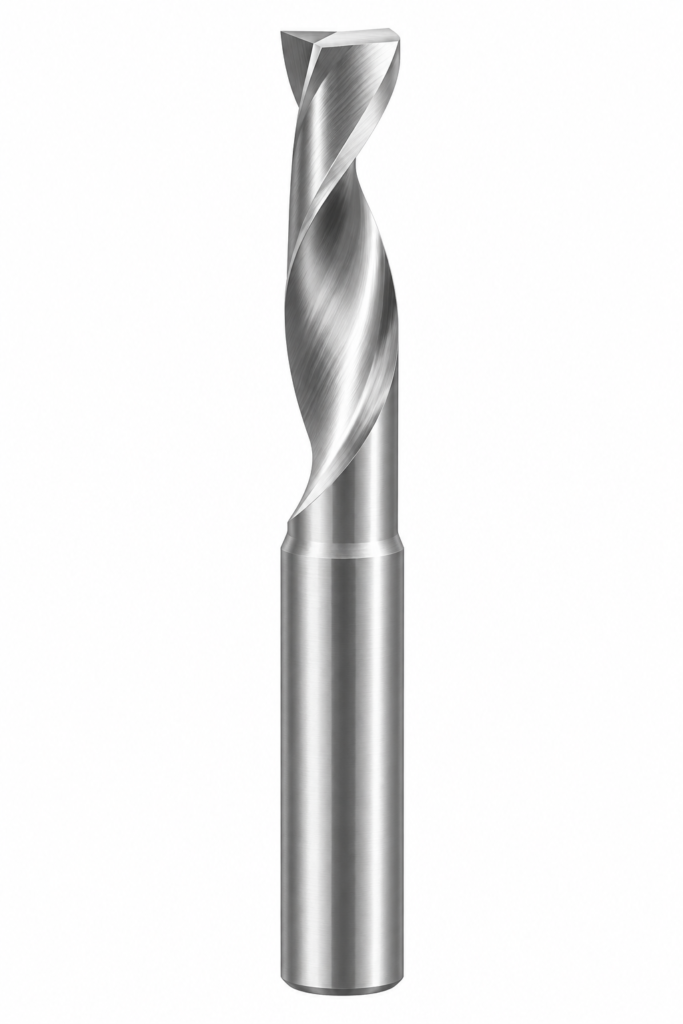
Plastics punish rubbing. Heat can soften the cut edge, smear the surface, and weld chips back onto the tool. A sharp, polished O-flute with a large chip gullet is a common starting point because it shears cleanly and moves the chip away.
Material grade still changes the answer. Single- or double-edge O-flute tools work well for many flexible plastics, while rigid plastics may also suit double-edge V-flutes or two- and three-flute finishing tools. Acrylic finish is particularly sensitive to chip load, fixturing, runout, and machine condition. A single flute cannot compensate for a loose collet or a part that moves under vacuum.
Choose the spiral direction deliberately. An upcut helps lift chips out of a sheet but can pull a lightly held part upward. A downcut pushes the top surface and part downward, which can reduce top-edge chipping, but it also drives chips into the cut. Deep downcut slots need a proven escape path for chips.
Small tools, narrow slots, and chip-congested pockets
As cutter diameter shrinks, the flute valley becomes small quickly. A single flute preserves usable chip space. It is often a sensible choice for full-width slots, small lettering, narrow channels, and deep features in soft material, provided the cutter has the correct reach and the setup controls runout.
Long reach is not free. The cutter becomes easier to deflect, regardless of flute count. Use the shortest tool that clears the feature, reduce radial engagement where possible, and do not assume that a large flute automatically prevents chip packing at the bottom of a deep pocket.
When a double-flute end mill makes more sense
General routing in wood and sheet materials
Two flutes offer a useful balance for plywood, MDF, hardwood, and many engineered boards. With two edges sharing the cut, a router can raise feed rate while maintaining chip load. The larger core and more frequent cutting engagements can improve stability, especially when the tool is reasonably short and the workholding is solid.
Cut direction may matter more than the difference between one and two flutes. Upcut geometry clears chips well but can lift fibers at the top face. Downcut geometry protects the top surface but sends chips downward. Compression cutters combine opposite helix directions to protect both faces of laminated sheet; they are often the better production choice for through-cuts in veneered or melamine-faced panels.
Productive aluminum machining with reliable chip control
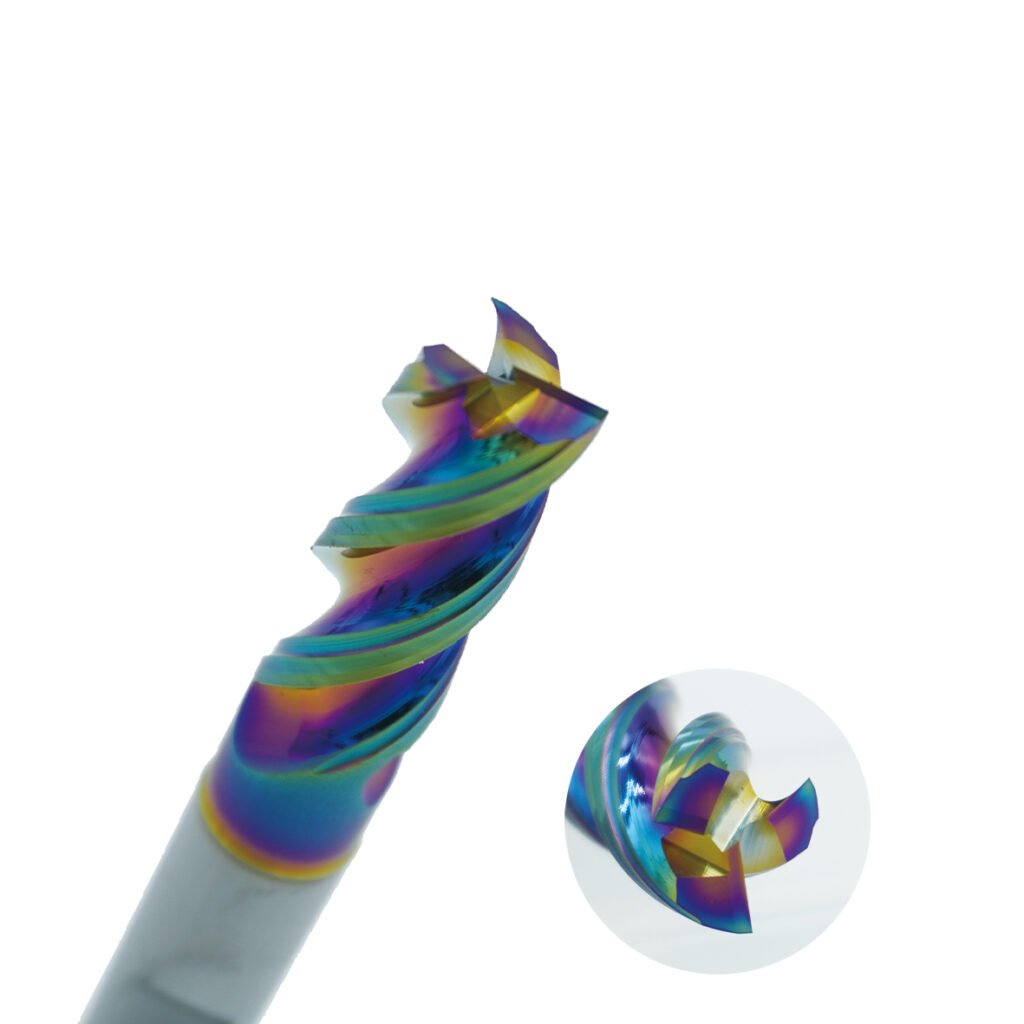
A purpose-designed two-flute aluminum end mill is a workhorse on many CNC mills and routers. It retains relatively large flute valleys while providing two cutting edges. If the machine can reach the required feed and the process has effective air blast, mist, or coolant, two flutes may increase output without sacrificing chip evacuation.
The practical test is not “Does aluminum require one flute?” It is “Can this tool evacuate the chip at the programmed engagement, and can the machine maintain the required feed per tooth?” Full-width slotting and deep pockets demand more chip space than light peripheral finishing.
Finishing passes and continuous contours
With two engagements per revolution, a double-flute tool can reduce the distance between feed marks at the same feed rate and rpm. On a rigid setup, this may improve wall consistency. The benefit disappears if runout causes one flute to carry most of the load, or if feed is reduced so far that both edges rub.
For a finishing pass, leave a controlled amount of stock, shorten tool overhang, check collet condition, and keep the cutting edge appropriate for the material. In clear acrylic, a polished plastic-specific tool and correct chip load matter more than the flute number printed on the box.
Operations that need more stiffness at a small diameter
A two-flute design can provide a stronger core than a comparable single-flute cutter, which helps resist bending. This is useful in small-diameter profiling, moderate axial engagement, and repeated production cuts. Geometry must still be checked on the actual drawing; some high-performance single-flute cutters use eccentric relief or counterbalanced grinding, while some two-flute tools sacrifice substantial core area for large gullets.
A material and application selection table
Material or operation | Better starting point | Why | Check before release |
Cast acrylic edge routing | Polished single-flute O-flute | Large chip space and low edge count help control heat | Chip load, runout, workholding, flame-polish requirement |
Flexible plastic | Single- or double-edge O-flute | Both can work; geometry and chip formation decide | Grade, melting tendency, spiral direction |
Rigid engineering plastic | Two flute is often viable | More edges can improve productivity and finish | Maker recommendation; do not assume all plastics behave alike |
Aluminum on a high-rpm router | Single flute | Keeps chip load attainable at a manageable feed | Air blast or mist, corner slowdown, tool balance |
Aluminum on a rigid VMC | Two or three flutes often outperform one | Machine can exploit more edges while controlling chips | Radial engagement, coolant, spindle power, toolpath |
MDF or plywood routing | Two flute or compression cutter | Stable production cutting and higher potential feed | Face quality, dust extraction, tool direction |
Deep full-width slot in soft material | Single flute | Maximum flute volume for chip evacuation | Pecking or stepdown, air blast, reach-to-diameter ratio |
Light finishing pass | Two flute | More engagements can reduce feed-mark spacing | Runout, remaining stock, edge sharpness |
Steel or cast iron | Usually compare 3–6+ flute metal-cutting tools | Higher core strength and more edges often suit smaller ferrous chips | Material hardness, coating, engagement, machine rigidity |
Do not use flute count as a shortcut for surface finish
The original temptation is simple: one flute for a glossy finish, two flutes for speed. Shop-floor results are less tidy.
A single-flute tool can produce an excellent aluminum or acrylic wall because its polished edge and open flute remove chips cleanly. It can also leave visible periodic marks if the spindle, toolholder, balance, or workholding is poor. A double-flute tool can produce a smoother theoretical cusp pattern, but only when both edges cut evenly. Runout turns a two-flute cutter into an overloaded one-flute cutter with an idle passenger.
Bottom finish is another issue. A standard end mill may leave swirl marks from its point geometry. If the pocket floor is cosmetic, use a bottom-surfacing or wiper-style tool designed for the task instead of expecting flute count alone to solve it.
Troubleshooting: what the cut is telling you
Symptom | Likely cause | What to change first |
Melted or smeared plastic edge | Chip load too low, dull edge, poor chip evacuation | Increase true chip load within maker limits; use a sharp polished plastic cutter; improve air flow |
Aluminum welded to the flute | Recutting, heat, inadequate lubrication, unsuitable coating or edge | Clear chips, review coolant/mist, shorten engagement, use polished non-ferrous geometry |
Chips packed in a deep slot | Insufficient flute volume or evacuation | Try fewer flutes, smaller stepdown, air blast, or a toolpath that opens chip space |
Chatter or wavy wall | Excess overhang, weak workholding, excessive engagement, poor spindle condition | Shorten tool, stiffen fixture, reduce engagement, inspect holder and bearings |
Two-flute tool leaves alternating marks | Runout or unequal edge loading | Clean and inspect collet, measure runout, replace damaged toolholder or cutter |
Tool rubs despite a clean path | Feed per tooth is too low, often after changing flute count | Recalculate feed using actual rpm and number of flutes; account for machine acceleration |
Top face splinters or lifts | Wrong helix direction or weak hold-down | Consider downcut/compression geometry and improve fixturing |
A five-question selection method
Start with the chip. Is it bulky, stringy, adhesive, or heat-sensitive? If yes, protect flute space first. That usually moves the decision toward a single flute or a very open two-flute geometry.
Next, calculate the feed that each option requires. Use the tool maker’s chip-load range, not a generic number from a forum. Confirm that the machine can maintain that feed through the actual toolpath, including small arcs and corners.
Then look at engagement. A full-width slot generates and traps more chip volume than a 10% radial finishing pass. The same two-flute tool may be comfortable in the second cut and overloaded in the first.
Check rigidity and runout before blaming the cutter. Measure tool overhang, inspect the collet and holder, and verify that the part cannot move. On small tools, a small runout error is a large percentage of chip load.
Finally, run a controlled test. Record tool geometry, rpm, feed, axial and radial engagement, coolant or air settings, cycle time, edge quality, sound, spindle load, and tool wear. Change one variable at a time. That record is more useful than a shop rule that says one flute is always for finish and two flutes are always for roughing.
What buyers should specify to a tool supplier
A useful RFQ includes the workpiece material and grade, cutter diameter, flute length, maximum reach, operation type, radial and axial engagement, spindle-speed range, available feed rate, coolant or air delivery, required edge or surface quality, tolerance, and expected batch size. If top- and bottom-face quality matters on sheet goods, state that explicitly.
Ask for the complete geometry recommendation rather than flute count alone: rake, helix direction and angle, edge preparation, coating or polished flute, core design, and whether the cutter is intended for slotting, profiling, or finishing. For repeat production, request a starting parameter window and a regrind or replacement policy.

Final recommendation
Choose a single-flute end mill when chip space and achievable feed per tooth are the constraints, particularly on high-speed routers cutting aluminum, acrylic, PVC, and other soft or heat-sensitive materials. Choose a double-flute tool when the machine can support the higher feed, chip evacuation is under control, and the job benefits from more cutting engagements or a stiffer core.
For steel and cast iron, widen the comparison. Modern three-, four-, five-, and higher-flute tools are often more appropriate than either option discussed here.
HNCarbide can help buyers match carbide grade, edge geometry, flute count, coating, and reach to a defined material and toolpath. The most useful starting point is a real application sheet, not a request for a generic “single-flute” or “double-flute” cutter.