Skip to content
Semi-Finishing After Roughing: How to Stabilize Stock Before Finish Milling
Table of Contents
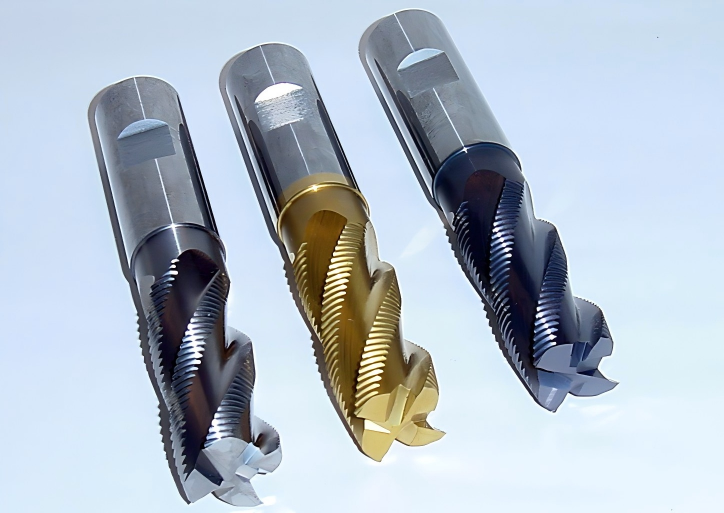
Many finish milling problems start before the finishing tool ever touches the part.
A shop roughs the cavity, loads a smaller finishing cutter, presses cycle start, and then the trouble appears: chipped edges, steps on the wall, chatter marks in the corners, or a sudden gouge where the cutter meets a pocket radius. It is tempting to blame the finishing pass, the coating, or the tool brand. In many cases, the real cause is simpler: the finishing tool was asked to clean up roughing stock that was never made consistent.
Semi-finishing is the bridge between high-removal roughing and accurate finishing. It removes local heavy stock, cleans rest material, and leaves a more even allowance so the finishing tool can cut instead of survive.
Why Directly Finishing After Roughing Causes Trouble
Roughing and finishing have different jobs. Roughing is judged by material removal rate, machine load, chip evacuation, and whether enough stock remains for a clean final pass. Finishing is judged by size, form, surface quality, and repeatability. Semi-finishing sits between them because the roughing pass rarely leaves a perfect finishing condition.
The first issue is uneven stock allowance. Large roughing cutters, bull nose cutters, and high-feed tools do not remove material equally in every feature. Flat open areas may be close to the planned allowance, while internal corners, steep walls, fillets, and pocket floors may carry far more stock. When a finishing tool enters those zones, radial and axial engagement can change sharply. The result is unstable cutting force, deflection, poor surface finish, and sometimes edge chipping.
The second issue is rest material. A roughing cutter cannot reach every narrow slot, inside corner, deep rib, or root radius. The material left behind may look small in the CAM view, but to a finishing cutter it can be a serious interrupted cut. A finishing tool that expects 0.2 mm of stock may suddenly meet 1.5 mm or more in a corner. That is not finishing anymore. It is accidental roughing with a small tool.
This is especially important in mold, die, aerospace, medical, and precision component work, where hard materials, thin tools, long reach, and tight surface requirements often appear together.
Roughing Condition | What the Finishing Tool Sees | Likely Result |
Heavy material left in internal corners | Sudden radial engagement increase | Chipped edge, deflection, corner marks |
Uneven allowance on steep walls | Load changes along the Z direction | Wall steps, taper error, chatter |
Rest material in narrow slots or roots | Interrupted cut with a small tool | Short tool life, broken cutter |
Scallops or cusps from a large tool | Variable chip thickness | Uneven gloss and poor surface consistency |
Unchecked stock after roughing simulation | Unknown high-load zones | Unexpected alarms, hand polishing, rework |
What Semi-Finishing Actually Does
Semi-finishing is not a cosmetic pass. Its purpose is to prepare the workpiece for a stable final cut.
In practical terms, semi-finishing does three things. It brings the workpiece closer to the intended shape, removes rest material that roughing tools could not reach, and leaves a controlled finishing allowance across the critical surfaces. The target is not a perfect surface. The target is predictable stock.
Think of a mold cavity. Roughing with a large cutter is efficient, but the cutter radius leaves extra material in tight corners. A direct finishing pass with a small ball nose or corner-radius end mill must then handle both finishing and local heavy cutting. A semi-finishing pass with an intermediate tool clears those high-stock zones first. The finishing cutter then sees a smaller, more uniform chip load, which makes surface quality and dimensional control much easier.
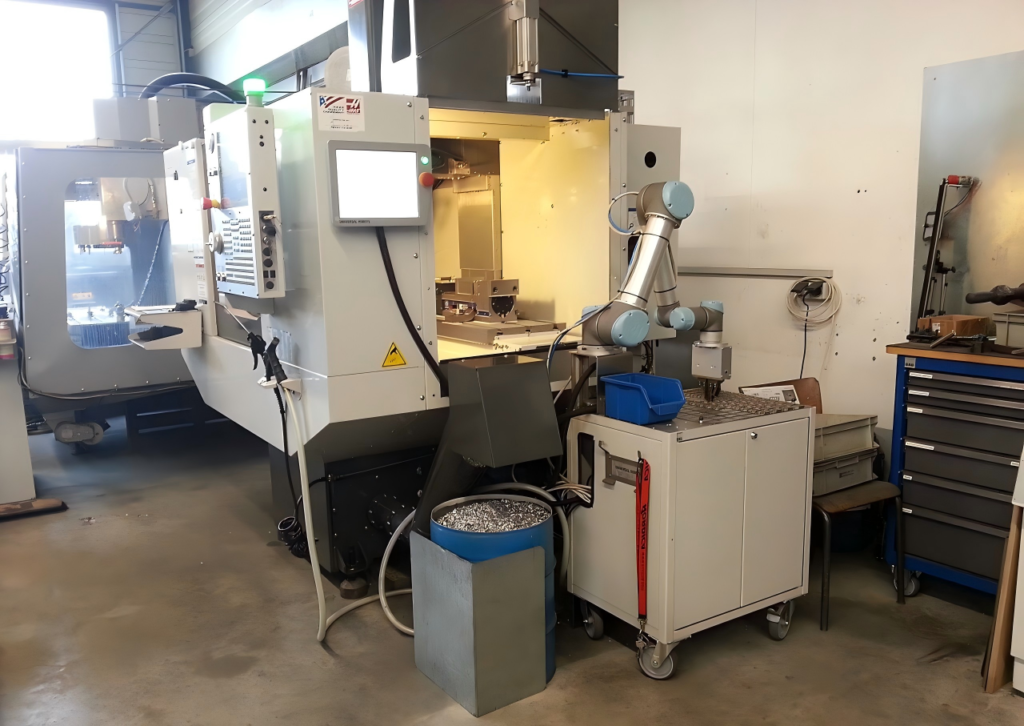
For tool steel molds, this matters because cutting force is not only about feed rate and spindle speed. It also depends on how much of the cutter is engaged at each moment. If engagement changes violently, the tool bends, rubs, vibrates, or overheats. A semi-finishing pass reduces those changes before the final toolpath begins.
Rest Material Machining Is the Core Task
The most valuable semi-finishing operation is often rest material machining. Rest material is the stock left by the previous tool because of cutter diameter, corner radius, tool length, holder clearance, or toolpath limits.
After roughing with a large tool, rest material commonly remains in:
Feature Area | Why Roughing Leaves Material | Practical Semi-Finishing Response |
Internal corners | Large cutter radius cannot enter the corner | Use a smaller end mill with corner or rest machining paths |
Narrow slots and ribs | Roughing tool is too large or toolholder clearance is limited | Use an intermediate diameter before the final small cutter |
Pocket floors near wall transitions | Tool nose radius leaves cusps or steps | Apply floor semi-finishing or shallow Z cleanup |
Deep cavity bottoms | Reach limits and chip evacuation reduce roughing aggressiveness | Use controlled engagement and shorter stepdowns |
Fillets and 3D surfaces | Ball nose scallops vary with surface angle | Use rest finishing or pencil-style cleanup before final surfacing |
Modern CAM systems can calculate rest material based on the previous tool and stock model. This is worth using. Guessing where leftover stock might be is risky, especially on complex 3D parts. A rest machining toolpath can avoid air cutting, focus on actual high-stock areas, and keep engagement more controlled.
There is also a tooling reason to avoid jumping from a large rougher straight to a very small finishing tool. The diameter change may be too aggressive. A middle-size tool often removes the bulk of leftover material faster and more safely. Then the final tool can concentrate on geometry and surface finish.
Choosing the Right Semi-Finishing Strategy
There is no single semi-finishing path that fits every part. The right strategy depends on geometry, remaining stock, material, tool reach, and the final surface requirement. Most production programs use a combination.
Constant-Z Semi-Finishing
Constant-Z, or contour semi-finishing, works well on steep walls, vertical faces, deep cavities, and mold sidewalls. The cutter steps down in Z and follows the part contour at each level. This keeps wall stock more consistent and reduces the chance that the finishing pass will find a heavy band of material near a shoulder or corner.
Use it when the part has steep surfaces, straight walls, deep pockets, or sidewall tolerance requirements. Watch the stepdown, cutter engagement, and chip evacuation in deep areas.
Parallel Semi-Finishing
Parallel semi-finishing is useful on flatter regions and gently sloped surfaces. The cutter travels along a repeated linear path and removes stock over a broad surface. It is common in 3D surfacing work when the goal is to reduce scallops and leave an even allowance before a finer finishing pass.
Use it on open surfaces, shallow slopes, and large mold areas. It is less effective in tight corners unless paired with rest or pencil cleanup.
Corner Cleanup and Root Semi-Finishing
Corner cleanup targets the material left where walls, floors, ribs, and fillets meet. This is where finishing tools are most likely to experience surprise load. A smaller tool, a pencil path, or a dedicated rest machining cycle can remove the corner stock before the final cutter enters.
Use it when simulations show high stock in inside corners, small radii, rib roots, narrow grooves, or local detail features.
Rest Machining From the Stock Model
Rest machining uses the CAM stock model from the previous operation to generate toolpaths only where material remains. It is one of the best ways to reduce wasted cycle time while protecting the finishing cutter.
Use it when the part has mixed geometry, multiple cutter sizes, complex 3D shapes, or any feature where manual visual judgment may miss leftover material.
Strategy | Best Fit | Main Benefit | Common Mistake |
Constant-Z semi-finishing | Steep walls, pockets, deep cavities | More uniform sidewall allowance | Stepdown too large near hard corners |
Parallel semi-finishing | Flat or gently curved surfaces | Smooth stock across wide areas | Ignoring steep zones and transitions |
Corner/root cleanup | Fillets, roots, narrow internal corners | Removes high-load leftover material | Waiting until final finishing to clean corners |
CAM rest machining | Complex parts with mixed features | Cuts only where stock remains | Using an inaccurate previous stock model |
Intermediate tool sizing | Big rougher to small finisher transitions | Reduces load on small tools | Skipping the middle tool to save cycle time |
How Much Stock Should Semi-Finishing Leave?
The best allowance depends on the material, tool diameter, cutter geometry, machine rigidity, and final tolerance. The rule is not “leave as little as possible.” The rule is “leave enough for a clean finishing cut, but not so much that the finishing tool becomes overloaded.”
For many milling jobs, semi-finishing should leave a consistent light stock allowance on walls and floors. Harder materials, slender tools, and long-reach finishing may require a smaller and more carefully controlled allowance. Softer materials may tolerate more, but burrs, chip welding, and surface variation still matter.
The key word is consistent. A finishing allowance that ranges from 0.15 mm on an open wall to 1.2 mm in a corner is not a finishing allowance. It is an unstable cutting condition waiting to happen.
When programming, check these items before releasing the finishing operation:
Checkpoint | What to Verify | Why It Matters |
Stock model accuracy | Previous roughing and semi-finishing tools are represented correctly | Wrong stock data creates false safe zones |
Allowance uniformity | Walls, floors, corners, and fillets carry similar finishing stock | Stable load improves finish and tool life |
Rest material pockets | Deep corners, narrow slots, roots, and ribs are not overloaded | Prevents shock loading on small tools |
Tool reach and holder clearance | Semi-finishing cutter can access the feature safely | Avoids collisions and excessive stickout |
Surface condition | No obvious steps, vibration marks, or uncut bands remain | Reduces hand polishing and finishing rework |
Inspection After Semi-Finishing Is Part of the Process
Semi-finishing should not be treated as a blind pass between two important operations. It deserves its own check.
Start with CAM simulation. Compare the stock model after roughing with the stock model after semi-finishing. Look for color-map areas where leftover material is still heavy. Pay special attention to deep cavity bottoms, wall-floor intersections, slots, ribs, and inside radii. These are the areas that often punish the finishing cutter.
Then review the toolpath motion. Long air cuts, sudden engagement, sharp direction changes, and tight corner feeds can all reduce the value of the semi-finishing operation. A good semi-finishing path should make the final operation calmer, not simply add cycle time.
Finally, inspect the first physical part when the process is new or the material is difficult. You do not need a full dimensional report at this stage, but you do need to know whether obvious steps, chatter, leftover stock, or access problems remain. Fixing them before finishing is usually far cheaper than polishing or scrapping a finished part.
Where Tool Choice Fits In
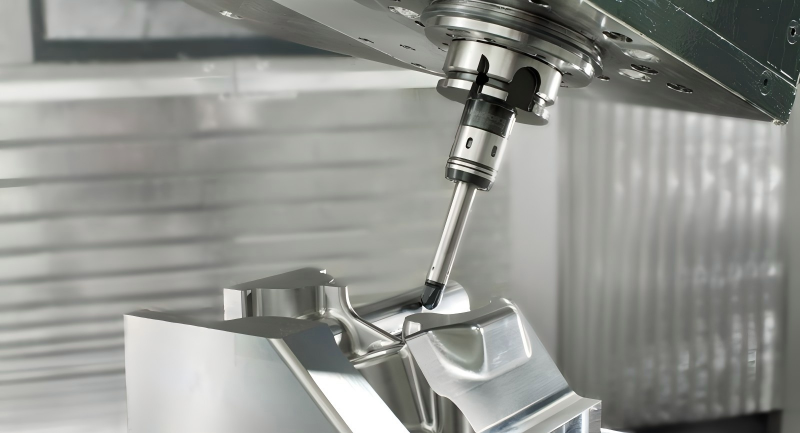
Semi-finishing strategy and tool selection should be planned together. A stable toolpath cannot fully compensate for a tool that is too weak, too long, or poorly matched to the material.
For carbide end mills, consider diameter, flute count, corner radius, coating, neck relief, and effective cutting length. A larger intermediate tool may clear rest material faster, but it may still miss tight details. A smaller tool reaches farther into corners, but it needs lighter engagement and better runout control. For mold work, ball nose and corner-radius tools are common, but the tool shape should match the surface and the stock left by the previous operation.
Coolant and chip evacuation also matter. Semi-finishing can generate chips in partially enclosed features, where packing and recutting can damage the surface before finishing begins. Air blast, through-spindle coolant, or a revised cutting order may be needed depending on the material and cavity shape.
A Practical Programming Sequence
A reliable sequence is usually more important than a clever isolated toolpath.
For a mold cavity or precision pocket, a practical order may look like this:
- Rough with a large tool to remove bulk material while leaving enough stock for cleanup.
- Run rest roughing or semi-roughing with an intermediate cutter in corners and narrow features.
- Use constant-Z semi-finishing on steep walls and pocket sides.
- Use parallel or surface-based semi-finishing on flatter 3D surfaces.
- Run corner/root cleanup where simulation still shows heavy local stock.
- Verify stock allowance and toolholder clearance in CAM before finishing.
- Finish with a toolpath designed for surface quality, not heavy material removal.
This sequence may add operations, but it often saves time overall. Broken tools, repeated trial cuts, hand blending, and reworked surfaces cost far more than a well-planned semi-finishing pass.

Conclusion
When roughing is followed directly by finishing, the finishing tool often pays for every problem left behind: uneven allowance, rest material, poor access, and unstable engagement. Semi-finishing prevents that by turning a rough stock condition into a predictable finishing condition.
For CNC shops and tooling buyers, the lesson is straightforward. Do not judge finishing performance until the stock before finishing is under control. Constant-Z cleanup, parallel semi-finishing, corner/root cleanup, and CAM-based rest machining all have a place when the part geometry calls for them.
HNCarbide supports machining teams with carbide end mills for roughing, semi-finishing, and finishing applications. If your finishing tools are failing early or surface quality is inconsistent, the next improvement may not be a more aggressive final pass. It may be a better semi-finishing plan.