How to Choose best Cutting Tools for CNC Machining ?(2025 Manufacturer’s Guide)
Table of Contents

Selecting appropriate CNC cutting tools is one of the most critical decisions in CNC machining. It directly determines cycle time, surface finish, dimensional accuracy, and overall workshop competitiveness. The challenge lies in scale—large manufacturers alone may offer over 40,000 different tooling SKUs.
This guide transforms this complexity into a standardized, auditable process, helping you unify standards across programming, procurement, and production.
Starting with the most critical CNC cutting tools is essential
As not all tools have equal impact on machining outcomes. CNC cutting tools that spend the most time on the spindle significantly influence machining cycle time and costs, thus requiring prioritized optimization.
Secondly, focus on the following types of CNC cutting tools:
- CNC cutting tools handling the most stringent tolerances or critical features;
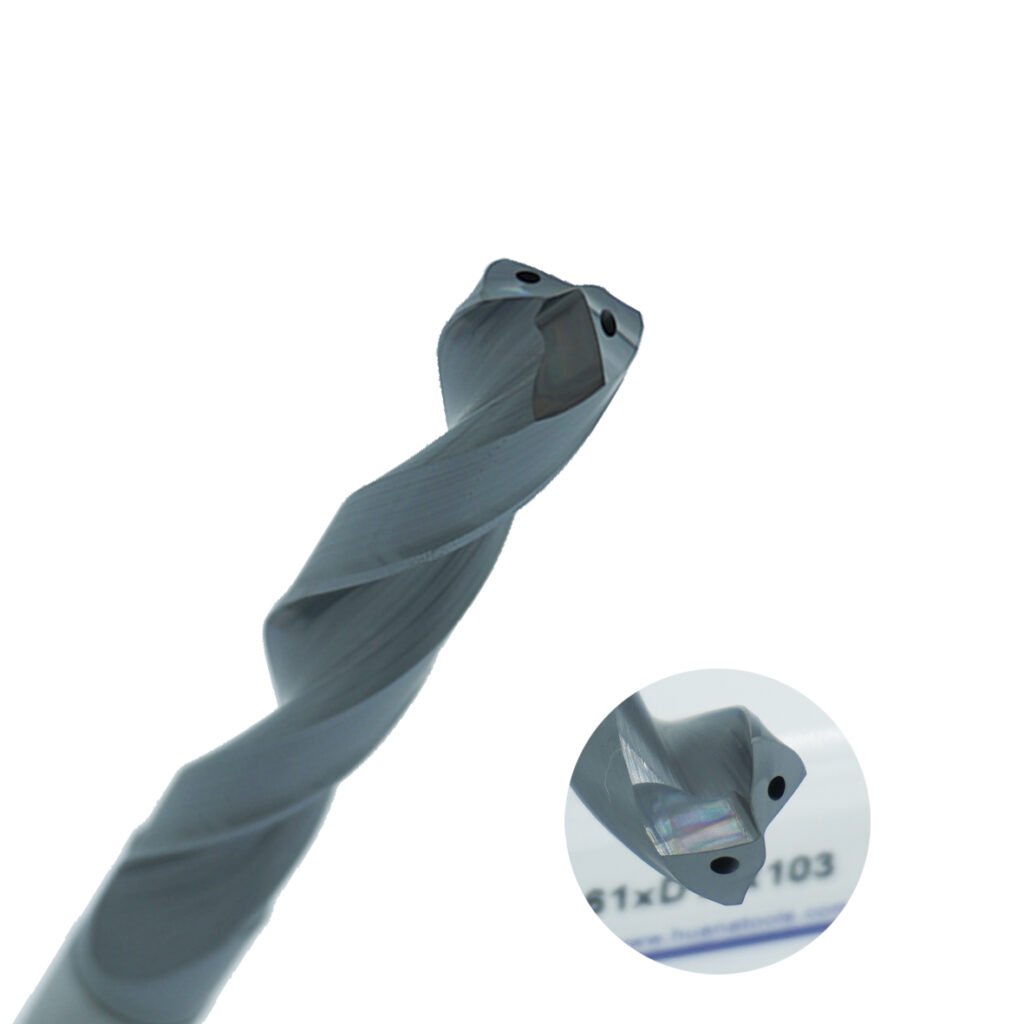
- CNC cutting tools prone to chip breakage (e.g., carbide drill bits, slotting tools, thread cutters);
- CNC cutting tools with the highest collision risks (such as long tool lengths, tools with limited clamping clearance, or complex feed paths).
When time is limited, optimizing a long rough machining path or key finishing tools is more rewarding than fine-tuning numerous small CNC cutting tools.
Aligning CNC Cutting Tool Spinning Direction with Machine Kinematics
CNC cutting tools are categorized as left-hand or right-hand.
Most machining centers have a spindle that rotates counterclockwise from top to bottom, requiring right-hand tools for conventional milling operations. However, some machines or processes may require reverse rotation.
Key considerations include:
- Aligning spindle rotation direction with tool spinning direction;
- Ensuring tool magazine weight and length limitations are met;
- Verifying machine support for internal cooling systems (TSC). If applicable, select compatible CNC cutting tools and tool holders.
Effective extension length (Gauge Length): Excessive length reduces rigidity, increases deflection, forces reduced feed rates, and heightens vibration risks.

How to select appropriate CNC cutting tools based on workpiece material and machining type?
While most catalog parameters use steel as a benchmark, achieving profitable machining requires precise matching of the CNC cutting tools’ base material, geometric structure, and coating.
Match CNC cutting tools for different materials
Workpiece Material | Recommended Tool Substrate | Key Geometry Features | Coating / Surface Treatment | Notes |
Low / Medium Carbon Steel | Micrograin Carbide | 4–5 flutes, 38–42° helix, strong core | AlTiN Coating/ AlTiSiN Coating | Suitable for heavy cutting; ensure sufficient coolant. |
Alloy Steel / Pre-hardened Tool Steel | Carbide / CBN (for >55 HRC finishing) | 4 flutes, corner radius, slight edge hone | AlTiN Coating/ AlCrN Coating | Maintain low runout and short overhang. |
Stainless Steel (304 / 316) | Carbide | 5–6 flutes, variable pitch, rigid core | AlTiN Coating/ AlCrN Coating | Maintain stable temperature; continuous cutting preferred. |
Titanium Alloy (Ti-6Al-4V) | Sharp Carbide | 4–5 flutes, low helix, large chip gullet | AlTiN Coating/ TiAlN Coating | Use high-pressure coolant; small width of cut. |
Nickel-based Alloy (Inconel 718) | Tough Carbide | 4–5 flutes, reinforced core, gradual entry | AlTiN Coating/ AlCrN Coating | Forced cooling; minimize friction and rubbing. |
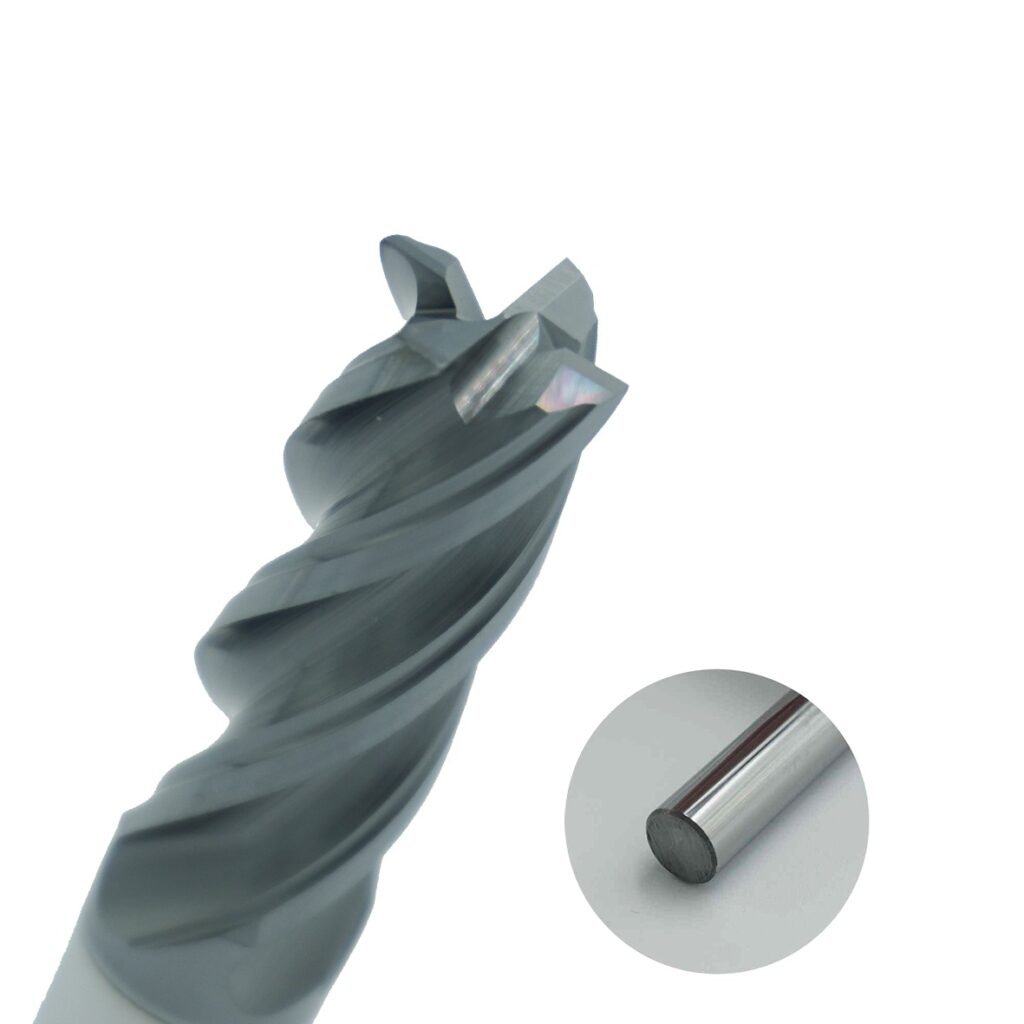
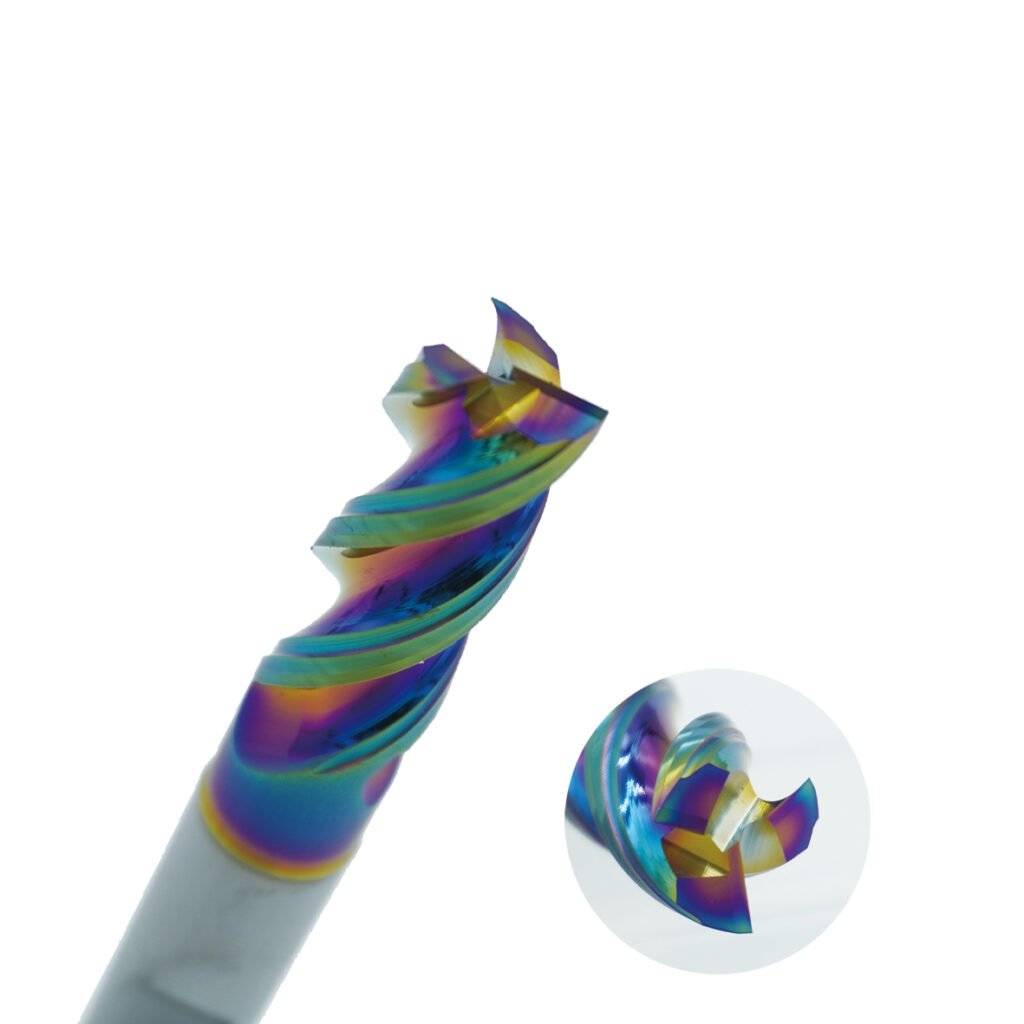
Aluminum Alloy (6000 / 7000) | Carbide / PCD | 3 flutes, 45–55° helix, mirror-polished flute | TiB₂ Coating/ DLC Coating/ PCD Coating | Air or MQL cooling; ensure efficient chip evacuation. |
Composites (CFRP / GFRP) | PCD / Diamond-coated | Specialized abrasion-resistant router geometry | Diamond | Dry cutting with dust extraction. |
Plastics (POM, UHMW, PC) | Sharp Carbide | High helix, polished flute | Uncoated / DLC Coating | Prevent melting; increase feed per tooth. |
How to select CNC cutting tool dimensions? Achieve a balance between rigidity and cost-effectiveness.
Common mistakes include using undersized carbide turning tools and oversized carbide end mills. While large turning tools enhance rigidity, oversized milling cutters waste cutting time (idle cutting) and increase spindle load.
When selecting CNC cutting tool dimensions, choose the minimum diameter that meets the following criteria:
- Achieves the required material removal rate (MRR) with acceptable deflection;
- Allows entry into the minimum internal corner radius;
- Ensures minimum tool overhang while accommodating fixture clearance.
Before purchasing CNC cutting tools, calculate cutting forces, deflection, and chip removal to balance speed and stability.
Indexable vs. Re-sharpenable CNC cutting tools
Except for a few types like carbide drill bits, carbide reamers, and cemented carbide milling cutters, indexable CNC cutting tools generally offer higher efficiency and consistency. Blade replacement is faster and more stable compared to re-sharpening.
Re-sharpenable tools are suitable for:
- Small-diameter or high-precision finishing;
- Special geometries where alternatives are unavailable;
- Workshops with precise control over re-sharpening dimensions and compensation capabilities.

CNC cutting tool grade and coating selection
Select tool grades that cover your primary material groups and match machine speed/torque requirements.
Modern coatings (AlTiN, AlCrN, TiB₂, diamond) enhance durability and heat resistance, provided they maintain effective cutting performance (not through friction).
Always consult the latest manufacturer data and document your own wear patterns and parameter curves.
How to make good use of your spindle? What are the practical cases?
For a 37 kW (50 HP) spindle, maintain over 70% power during rough machining. Idle horsepower is a waste when clamping is stable.
Refer to the spindle power curve to plan tool load within optimal speed ranges. In finish machining, prioritize process stability and surface quality.

Does more effective blades equal higher productivity?
Modern indexable inserts and multi-edge milling cutters typically feature twice as many effective cutting edges as older models, with additional edges enabling higher total feed rates at the same feed per tooth.
However, during machining, it is essential to ensure the machine maintains the set feed without chip clogging or overload.
Single-function CNC cutting tool vs multi-function CNC cutting tool
For small-batch complex parts, a multi-functional CNC cutting tool (carbide drill bits, slotting tools, thread cutters) is ideal, as it minimizes tool change and idle time. For long-cycle or high-precision components, specialized CNC cutting tools are recommended to ensure stability and longevity.
When calculating Takt time, reducing tool changes often proves more valuable than slightly decreasing cutting time.
Standard CNC cutting tool vs Special use CNC cutting tool
Even in the CNC era, 10–20% of high-volume production processes still warrant dedicated CNC cutting tools. These specialized tools enable precise dimensional control, integrate multiple operations, and significantly reduce cycle times.
With advancements in modular designs and on-demand grinding, the cost and lead time gap between standard and custom solutions is narrowing. For stable, repeatable production runs, dedicated CNC cutting tools typically pay for themselves quickly.

Chip control: first-order constraint
“Good” chips do not interrupt cutting, while “bad” chips may jam the tool, stick to the surface, or scratch the workpiece.
Different blades feature chip-breaking grooves designed for light to heavy cutting. Tough materials (aluminum, stainless steel) require special attention.
Common methods to improve chip evacuation include:
- Adjusting cutting width/depth (WOC/DOC);
- Increasing feed per tooth (thicker chips are more prone to breakage);
- Optimizing feed/withdrawal paths (spiral feed, bevel cutting);
- Optimizing edge and tip curvature;
- Adjusting cooling methods and directions (especially for deep holes and grooves).
How to program correctly?
After defining CNC cutting tools, materials, and machine tools, CAM converts geometric data into motion.
The greatest benefits typically come from two types of toolpaths:
- High-speed Machining (HSM): shallow cutting with wide, high linear speeds to control heat and chip thickness;
- Adaptive/Cost-Effective Roughing: maintaining constant load in corners and intermittent cutting zones, enabling deeper cuts while reducing chatter.
Key considerations during programming:
- Employ end milling, smooth transitions, and rest machining;
- Verify no interference between CNC cutting tool holders and fixtures;
- Ensure post-processing compatibility with CNC toolscontrollers (including arc formatting, plane settings, and pre-read configurations).
Practical CAM parameter starting point (must be verified on the machine)
Machining Type | Initial WOC (% of Diameter) | Initial DOC (×D) | Notes |
Adaptive Roughing – Steel | 10–25% | 1.0–2.0× | Constant tool load; ensure adequate coolant. |
Adaptive Roughing – Aluminum | 20–40% | 1.0–3.0× | Air or MQL cooling; ensure efficient chip evacuation. |
Slot Milling (when necessary) | ≤40% | 0.5–1.0× | Reduce cutting speed; prevent chip clogging. |
Wall Finishing | 3–8% | 0.2–0.5× | Use variable-pitch tools; control runout. |
Bottom Finishing | 5–10% | 0.1–0.3× | Use small corner radius; light cutting load. |
When to seek on-site support?
Professional tool application engineers are your ultimate multiplier. Most manufacturers provide on-site or remote technical support to test cutting tools and fine-tune parameters based on machine tools, CNC cutting tool holders, and materials.
This is particularly crucial in the following scenarios:
- When entering new material fields (nickel alloys, hard steels, CFRP, etc.);
- When integrating multi-functional or specialized tooling processes;
When encountering unresolved issues like tool chatter or thermal problems.

Conclusion
Selecting the right CNC cutting tools isn’t a one-time decision, but a continuous process integrating tool selection, programming, and execution.
Start with critical CNC cutting tools, matching materials and processes with appropriate substrate, geometry, and coatings. Ensure proper dimensions for rigidity, adopt constant load toolpaths in CAM, and verify safety clearance. Protect the machining process with defensive G-code, continuously optimizing through trial cuts and data tracking. Focus on tool life and surface quality, not just price. With long-term commitment, you’ll reduce unit costs, stabilize delivery schedules, and significantly enhance milling quality limits.
Use the above table as a conservative starting point, and always verify and adjust according to the latest CNC cutting tool manufacturer data, machine tool rigidity and cooling capacity, as well as the actual situation of fixture and part structure.