How Cobalt Content, WC Grain Size, and TRS Shape the Real-World Life of Cemented Carbide Tools
Table of Contents
Transverse Rupture Strength (TRS) is the single most useful “first look” number for comparing substrate resistance to bending/fatigue in carbide tools.
More cobalt (Co) → higher toughness and often higher TRS until excessive binder lowers stiffness and hot strength; less Co → higher hardness/wear resistance but lower toughness.
Finer WC grains → higher hardness and (for dense, defect-lean grades) higher TRS, but typically lower fracture toughness; coarser grains do the reverse.
The sweet spot for long tool life in most chip-forming machining is submicron WC with mid-range Co (≈8–12 wt%), often with modern PVD/CVD coatings.
Why TRS matters (and what it isn’t)
TRS (three-point bend strength) tells you how well a carbide resists catastrophic bending and early-life fatigue. It’s sensitive to binder volume, WC grain size, porosity/Co pools, and eta-phase. In dense, well-processed grades, TRS for WC–Co typically spans ~1500–4000+ MPa, with submicron, well-inhibited grades reaching the upper end—and even higher when minor carbides are added judiciously.
Reality check: TRS is not toughness (K_IC) and not wear resistance. It correlates imperfectly with both. Use TRS to screen candidates; then confirm with workpiece group, cutting speed, chip thickness, coolant, and edge geometry.
The microstructural levers
1) Cobalt content (binder volume)
Increasing Co raises the plastic “cushion” around WC particles → higher fracture toughness and, within a range, higher TRS. But go too high and the composite’s stiffness/hot strength fall, so TRS and wear resistance suffer at speed/temperature.
Decreasing Co raises hardness and abrasion resistance but lowers toughness and fatigue tolerance; not ideal for interrupted cuts or chatter-prone setups.
2) WC grain size (mean WC particle size)
Finer grains (submicron/ultrafine) boost hardness and, when porosity/Co-pooling are minimized, also raise TRS—useful for precision/high-speed finishing. Toughness, however, tends to drop with grain refinement.
Medium–coarse grains trade some hardness for better crack blunting and impact resistance—typical for heavy roughing, interrupted cuts, and rock drilling.
3) Temperature & hot properties
Hardness (and strength) decreases with temperature, and does so faster at higher Co and coarser grains. That’s why “hot hardness” matters for stainless/superalloys.
How these knobs change tool life
Wear-dominated regimes (stable finishing, thin chips, constant engagement).
Submicron WC + lower/mid Co maximizes flank wear resistance; high TRS helps resist micro-chipping that seeds notch wear. Numerous datasets and industry guides show that submicron WC with 6–10 wt% Co sustains ≥ 4 GPa TRS in well-processed grades—ideal for small-diameter end mills and micro-drills where edge chipping kills life.
Impact/interrupted regimes (roughing, entry/exit shocks, poor fixturing).
Medium/coarse WC with higher Co (12–15 wt%) gives better crack tolerance and TRS stability under bending/impact. At the extreme (mining/rock tools), very high Co is common, but beware hot strength drop at high cutting speeds.
Thermal regimes (stainless, Ti, Ni alloys).
At high temperature, TRS and hardness fall; grades with slightly coarser WC and/or alloyed binders can retain strength better. (Example: Re/Cr-modified binders can slow hot softening.)
A simple map: choose hardness vs. toughness without losing TRS
Target behavior | Typical Co (wt%) | WC grain size | Substrate expectations | Where it shines |
Max wear resistance & edge stability | 6–10 | 0.2–0.6 µm | Very high hardness; TRS can reach ≥ 4 GPa if porosity is controlled | Finishing steels, stainless (M), non-ferrous (N), micro-tools |
Balanced roughing/finishing | 8–12 | 0.5–1.0 µm | Strong TRS + usable toughness; best “default” window | General-purpose steel (P), tool steel (H up to ~52 HRC) |
Impact/interrupted, unstable setups | 12–15 | 1.0–2.5 µm | Higher fracture toughness, good TRS in shock; lower wear resistance | Roughing, interrupted cuts; cast iron (K), some drilling |
ISO workpiece groups: P (steels), M (stainless), K (cast irons), N (non-ferrous), S (superalloys), H (hardened). Use them to anchor grade selection and coatings.
Defects decide the outliers
Two grades with the same Co% and grain size can live very different lives because of defects:
Porosity & Co pools: act as crack initiators; TRS and fatigue life plummet. Post-sinter HIP and robust grain-growth inhibition (e.g., Cr₃C₂/TiC) help.
Eta-phase & carbon imbalance: η-phase embrittles and slashes TRS; tight C control is essential. (Designers’ guides highlight this risk.)
Abnormal grain growth: even a small population of oversized WC grains degrades bend strength and consistency.
What the literature says
TRS vs. Co%: With grain size held constant, TRS generally rises with Co up to a point, then drops when the binder volume undermines stiffness/strength—especially at temperature.
Grain refinement: Submicron WC raises hardness and can raise TRS in dense, clean microstructures; however, fracture toughness usually declines, so edge prep and runout control matter more.
Typical TRS numbers: Commercial submicron grades routinely list ~3.8–4.5 GPa TRS; tables from major suppliers show this across multiple PCB/micro-drill and router grades.
Temperature effects: Hardness decreases with temperature, faster for higher Co and coarser WC. Co-modified binders (e.g., Co-Re) can retain hot hardness better.
Drill Bit Product
Catalog
Click the button below to view our DIN milling cutters catalog and explore detailed product specifications to make the best choice.

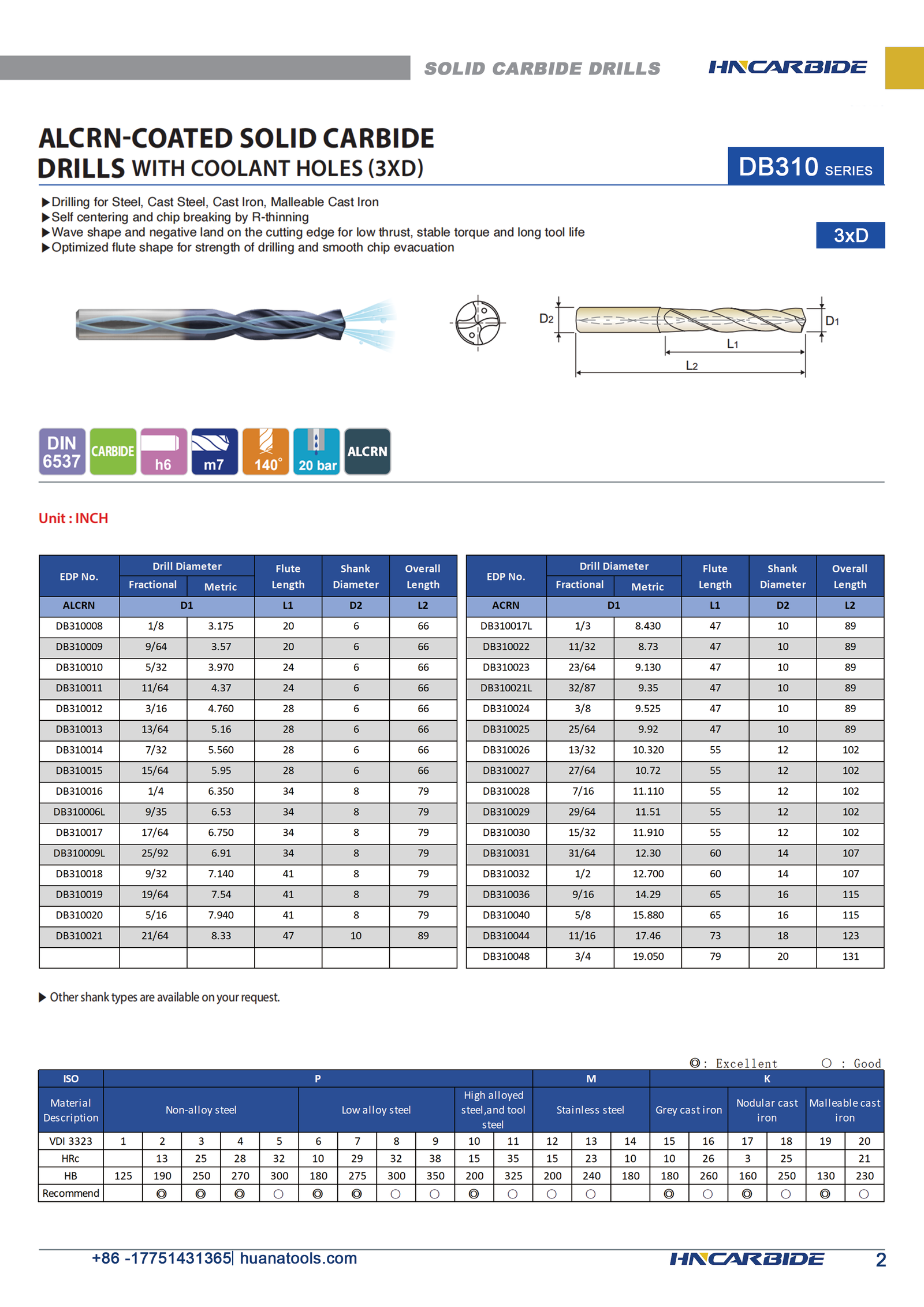
HNCarbide product selections
Below are representative HNCarbide families and how their Co% × WC grain size choices map to tool life. All values are typical targets; final grade codes and data sheets govern.
1) HNCarbide UNEQ5 — 5-Flute Unequal-Pitch Flat End Mill (Weldon shank)
Substrate: Submicron WC (≈0.5 µm) with ~10 wt% Co
Why: The 5-flute, unequal pitch controls vibration; the substrate balances high TRS with usable toughness for austenitic stainless (M) and steels (P) at higher surface speeds.
Coating options: PVD AlTiN/TiAlN for dry or MQL finishing; AlCrN for hot oxidation resistance.
Use cases: Semi-finishing/finishing where edge micro-chipping, not bulk fracture, limits life. (Mid Co + submicron WC mitigates chipping while preserving wear resistance.)
2) HNCarbide SFU — Single-Flute Spiral Upcut for Aluminum (N)
Substrate: Ultrafine WC (0.4–0.6 µm) with 6–8 wt% Co
Why: Thin chips + high RPM favor hardness and edge stability; TRS in the ~4 GPa class keeps tiny edges intact under bending.
Coating options: ZrN/DLC-like for adhesion control in sticky Al-Si alloys.
Use cases: High-speed aluminum slotting and finishing, router-style machining of non-ferrous.
3) HNCarbide XR-Rough — Heavy Rougher for Interrupted Cuts
Substrate: Medium WC (≈1.0–1.5 µm) with 12–15 wt% Co
Why: Coarser grains and higher Co tolerate entry/exit shocks, keyway interruptions, and heavy chip loads; pair with robust hone/radiused edges.
Use cases: Cast iron (K) and structural steels (P) in less-than-perfect fixtures.
Practical tables you can save
Substrate choice by job condition
Job condition | Main failure you see | Substrate prescription | Notes |
High-speed stainless finishing (M), thin chips | Micro-chipping → notch | Submicron WC, 8–10% Co | PVD AlTiN/AlCrN; keep runout ≤ 5 µm |
Aluminum finishing (N), burr control | Built-up edge, edge rounding | Ultrafine WC, 6–8% Co | ZrN or uncoated polished rake |
Cast iron roughing (K), interrupted | Edge chipping, corner breakage | Medium WC, 12–15% Co | Larger hone; CVD on larger bodies |
Tool steel HRC 45–52 (H) | Flank wear + micro-chipping | Submicron WC, 8–10% Co | PVD AlTiN; stable holder critical |
Nickel superalloy (S), light depths | Thermal softening, notch | Submicron–medium WC, 10–12% Co | Heat-resistant PVD; small feeds |
What your TRS “really” tells you
TRS listed (MPa) | Likely microstructure | What it means for life |
1500–2500 | Coarse WC and/or low density | OK for low-speed, heavy impact (mining); not great at speed |
3000–3800 | Medium WC, 10–12% Co | General-purpose rough/finish; sensitive to edge prep |
≥ 4000 | Submicron WC with tight Co pools/porosity control | Excellent chipping resistance for small tools & finishing; watch toughness in heavy shocks |
Case-style examples (how life changes when you move the knobs)
From 6% Co / 0.8 µm → 10% Co / 0.5 µm
A shop finishing 304 stainless saw premature micro-chipping on a small (Ø6 mm) end mill. Moving to higher TRS submicron substrate with ~10% Co cut edge chipping and extended life at the same SFM. Literature supports higher TRS in submicron grades and better fatigue tolerance with slightly higher binder—without a huge hardness penalty.
From 15% Co / 2.5 µm → 10% Co / 0.8 µm for a semi-finisher
In cast steel roughing, a high-Co coarse grade resisted breakage but wore fast when repurposed for semi-finishing. Switching to finer WC / moderate Co raised hardness and slowed flank wear; TRS remained adequate for the lighter engagement. This follows the well-documented hardness/toughness “banana curve.”
High-speed Al finishing: 8% Co / 0.5 µm vs. 6% Co / 0.4 µm
For a thin-wall part at 30k RPM, the lower-Co, ultrafine variant delivered longer life by improving hardness and keeping TRS in the ~4 GPa class common to micro-drill/router blanks.
Coatings & edge prep: multipliers on a good substrate
Edge hone: Submicron grades tolerate smaller hones (e.g., 5–15 µm) to preserve sharpness; coarse/high-Co grades often benefit from larger hones/radii to suppress chipping.
PVD vs. CVD: PVD keeps edges sharp (stainless, superalloys); CVD excels in hot wear on larger, tougher bodies (steel/cast iron roughing).
Runout & chatter: Finer grains + low Co magnify the penalty of poor runout; invest in holders and balance if you choose these grades.

HNCarbide recommendations by ISO group
ISO Group | Typical materials | HNCarbide family | Substrate (indicative) | Why it works |
P | Low/med alloy steels | UNEQ5 Weldon | 0.5–0.8 µm WC, 10% Co | Balances TRS & hardness for chatter-resistant finishing |
M | Austenitic/duplex | UNEQ5 Weldon (small hone) | 0.5 µm WC, 10–12% Co | Micro-chipping control + PVD AlCrN in heat |
K | Gray/ductile iron | XR-Rough | 1.0–1.5 µm WC, 12–15% Co | Impact tolerance outweighs max hardness |
N | Al, Cu, plastics | SFU single-flute | 0.4–0.6 µm WC, 6–8% Co | High hardness & TRS for razor edges; ZrN keeps edges clean |
S | Ni/Ti superalloys | UNEQ5 (robust hone) | 0.5–0.8 µm WC, 10–12% Co | Thermal stability with PVD; control notch wear |
H | 45–52 HRC | UNEQ5 | 0.5 µm WC, 8–10% Co | Submicron hardness + adequate TRS; runout critical |
Use these as starting points; specific grade cards and trials should finalize selection.

FAQs
Q: Is a higher TRS always better?
No. Very high TRS often comes with finer grains/lower Co—great for finishing—but if your job is shock-heavy, a slightly lower-hardness grade with more Co/coarser WC may live longer.
Q: My data sheet shows 92–93 HRA and ~4 GPa TRS—is that normal?
Yes for submicron grades made well; supplier data for PCB/micro-drill/router blanks commonly report ~3.8–4.5 GPa.
Q: How does temperature change the decision?
Hot cutting penalizes high-Co and coarse-grain grades more strongly; hardness falls faster with temperature when Co% and grain size are high.