Skip to content
End Mill Shapes, Types, and Applications: A Practical CNC Selection Guide
Table of Contents
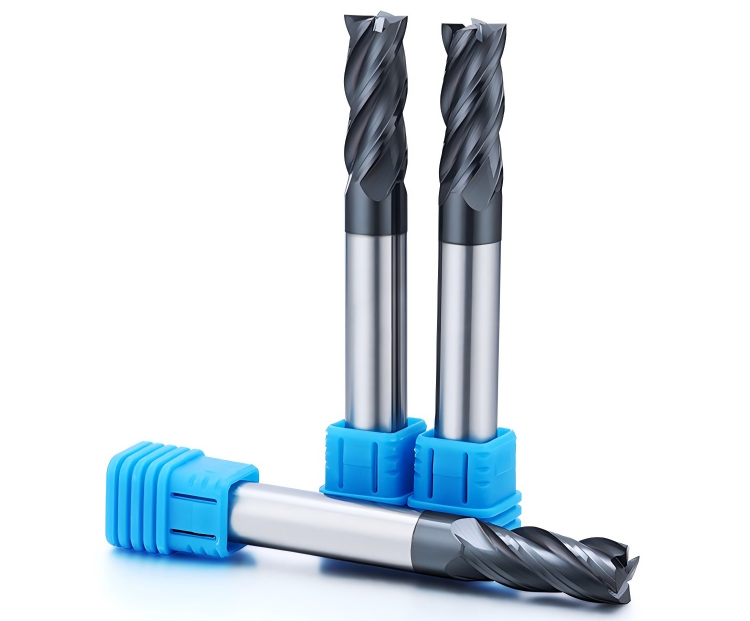
End mills are easy to group by appearance: flat end, rounded end, small diameter, large diameter, two flutes, four flutes, coated or uncoated. On the machine, those simple differences decide whether a slot comes out straight, a mold surface blends cleanly, or a roughing operation burns through tools before the job is profitable.
For CNC shops and tooling buyers, the best end mill is rarely the most expensive one on the shelf. It is the cutter whose shape, diameter, flute design, coating, and carbide grade match the part feature and the workpiece material. This guide explains the common end mill shapes, the main carbide end mill types, and the applications where each one earns its place.
What “end mill shape” really means
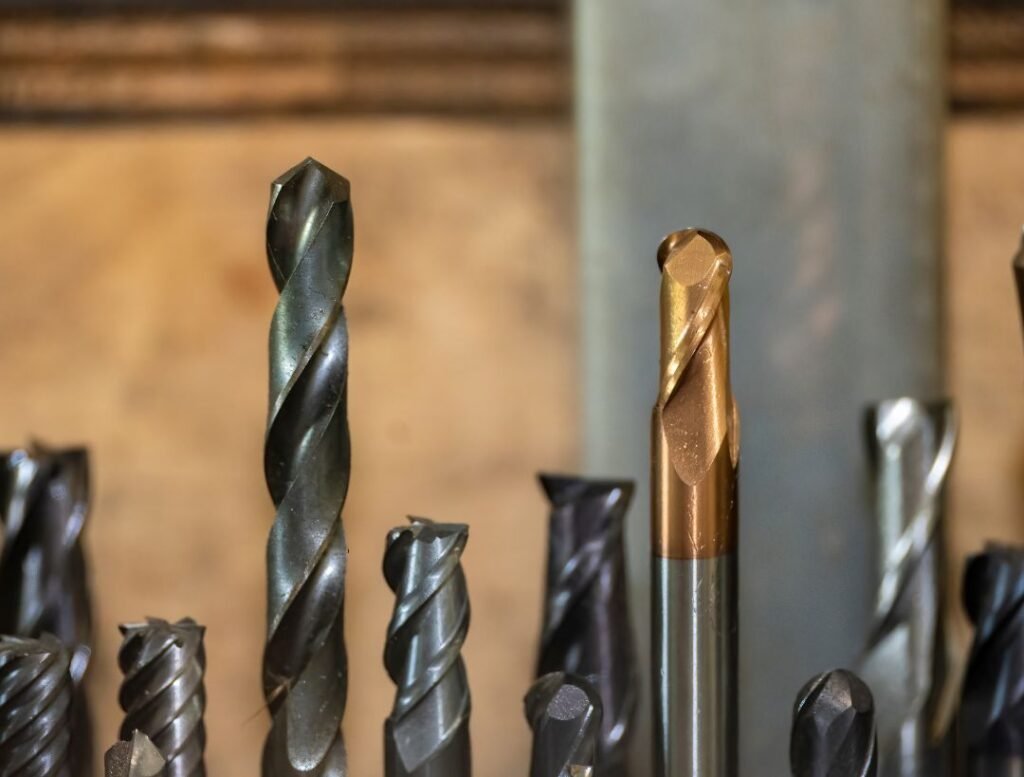
When machinists talk about the shape of an end mill, they usually mean the geometry at the cutting end. The three shapes buyers compare most often are square end mills, ball nose end mills, and corner radius end mills. Each can be made in different diameters, flute counts, helix angles, coatings, and lengths, but the end shape sets the basic cutting behavior.
A square end mill produces a flat floor and a sharp shoulder. A ball nose end mill produces a rounded path for 3D surfaces and curved details. A corner radius end mill keeps a flat-bottom capability while adding a small radius to protect the tool corner. That small design difference can matter a lot in production, especially when the cut includes heat, interrupted contact, or a long tool reach.
End mill shape | Surface or feature it creates | Best-fit applications | Main selection caution |
Square end mill | Flat floors, slots, shoulders, straight walls | Slotting, pocketing, side milling, general profiling | Sharp corners chip more easily in hard or unstable cuts |
Ball nose end mill | Curved surfaces, 3D contours, radius grooves | Mold cavities, dies, sculpted surfaces, finishing passes | Poor choice for fast flat-floor finishing unless toolpaths compensate |
Corner radius end mill | Flat floors with a protected corner radius | Roughing, semi-finishing, hard milling, aerospace pockets | Radius must match drawing requirements and CAM programming |
Square end mills: the general-purpose workhorse
Square end mills, also called flat end mills, are the first choice for many everyday milling jobs. They can cut slots, mill pockets, profile outside walls, machine shoulders, and finish small flat surfaces. A four-flute square carbide end mill is often used in steels and general machining because it has good core strength and can carry a productive feed rate when the setup is rigid.
The advantage is direct: a square tool makes square-bottom geometry. If the print calls for a flat-bottom slot or a crisp shoulder, this tool shape keeps programming straightforward. It also works well for roughing when the depth of cut and chip evacuation are under control.
The vulnerable point is the corner. On a square end mill, the outer corner takes heavy load and sees heat from both axial and radial engagement. In hard steel, stainless steel, or interrupted cuts, that corner may chip before the rest of the cutting edge wears out. If the part drawing allows a small internal radius, a corner radius end mill often gives better tool life.
Ball nose end mills: curved surfaces and mold work
A ball nose end mill has a hemispherical cutting end. It is built for surfaces that a square tool cannot finish cleanly: mold cavities, 3D contours, curved slots, sculpted die surfaces, and blended radii. In die and mold work, ball nose cutters are common because they can follow complex toolpaths and leave a smooth, continuous surface when stepover is controlled.
The tradeoff sits near the tool center. At the very tip of a ball nose cutter, surface speed drops toward zero. If the CAM strategy keeps the tool cutting mostly with the center, the cutter can rub, generate heat, and leave a poor finish. For finishing, shops often use a shallow stepover and try to cut with a more effective part of the ball where possible.
Ball nose tools are also used for arc grooves and full-radius channels. They can machine mold steel, cast iron, carbon steel, alloy steel, tool steel, and common ferrous materials when the carbide grade, coating, and cutting data are selected properly. In high-temperature environments, coating and coolant strategy become more important than the ball shape alone.
Corner radius end mills: a stronger edge for real production
Corner radius end mills, sometimes called bull nose end mills, look similar to square end mills but include a small radius at the outside cutting corner. Common small radii such as R0.5 mm and R1.0 mm are used when the part can accept a slightly rounded internal corner.
That radius spreads cutting force over a stronger edge. It also reduces the chance that the sharp tool corner breaks away in roughing, hard milling, or long-reach machining. The result is often better tool life and more stable size control, especially when a square-corner requirement is not important.
Corner radius tools can still produce flat floors. They simply leave a radius where the wall meets the floor. In many pockets, housings, aerospace brackets, mold bases, and general engineering parts, that radius is acceptable or even preferred because it reduces stress concentration in the part.

Diameter: small tools solve detail, large tools remove stock
End mill diameter has a direct effect on machining ability, accuracy, stability, and material removal rate. The diameter is the width of the cutting portion. It determines the smallest internal corner the tool can enter, the slot width it can cut, the stiffness of the tool, and the amount of chip load it can usually support.
Larger diameters, such as 6 mm, 8 mm, 10 mm, and 12 mm carbide end mills, suit heavier machining. They can remove more material, handle deeper cuts, and generally provide better stability because the tool cross-section is stronger. For roughing large parts, opening pockets, facing small surfaces, and removing stock before finishing, a larger cutter usually lowers cycle time.
Small diameters, such as 0.5 mm, 1 mm, and 1.5 mm end mills, belong in detail work. They can reach small radii, narrow slots, fine engraving, tiny cavities, and delicate profiles. They also break more easily. Runout, toolholder quality, spindle condition, feed per tooth, and workpiece vibration become critical. A small carbide end mill should not be treated as a scaled-down version of a 12 mm rougher; it needs its own process window.
For many shops, a practical tool crib includes a range of diameters instead of one “favorite” size. Rough with the largest tool that fits the feature and finish with the smallest tool needed for the required detail.
Common carbide end mill types by material
End mill type is not only about shape. A cutter for steel may share the same diameter as a cutter for aluminum, but the flute geometry, rake angle, coating, and edge preparation are often different.
Steel end mills usually use stronger cutting edges, stable flute spacing, and wear-resistant coatings. Four-flute tools are common because they balance rigidity and productivity. Variable helix or unequal flute spacing can help reduce vibration in side milling and finishing.
End mills for difficult-to-machine materials need more control. Stainless steel, titanium alloys, heat-resistant alloys, and some tool steels punish weak setups. The cutter may need a stronger core, a corner radius, advanced coating, and a strategy that limits heat. Heavy slotting in these materials is risky when chip evacuation is poor.
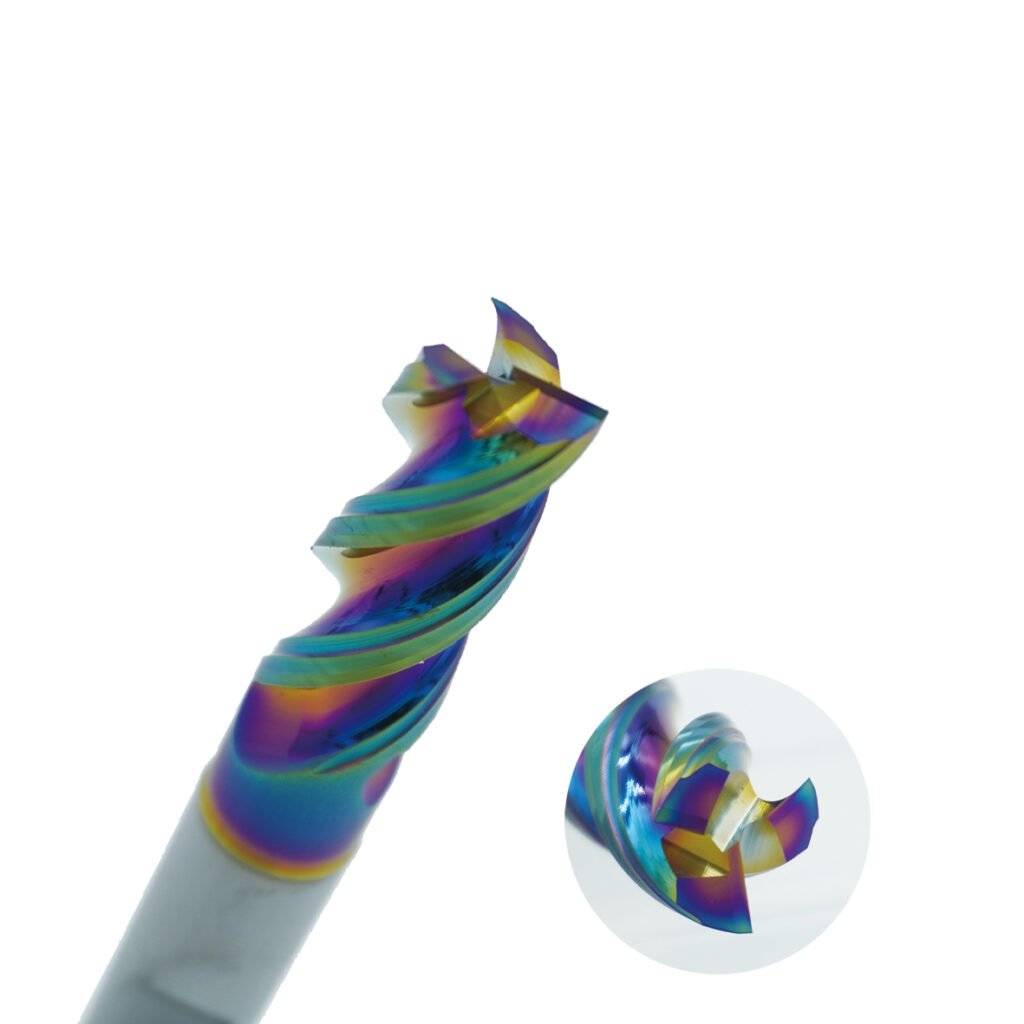
Aluminum end mills are usually sharper and more open. Two-flute and three-flute designs give chips room to escape. Polished flutes reduce sticking, and coatings such as ZrN, TiB2, DLC, or selected uncoated carbide options are often chosen to fight built-up edge. A steel-focused coating can work badly in aluminum if it encourages material welding.

Workpiece material | End mill focus | Typical geometry direction | Common risk |
Aluminum and non-ferrous alloys | Chip evacuation and anti-sticking performance | 2-3 flutes, sharp rake, polished flutes, high helix | Built-up edge, chip packing, poor finish |
Carbon and alloy steel | Strength, wear resistance, stable engagement | 4+ flutes, coated carbide, square or corner radius | Corner chipping, chatter, heat wear |
Stainless steel | Work-hardening control and heat management | Positive cutting action, variable geometry, suitable coolant | Rubbing, work hardening, notching |
Titanium and heat-resistant alloys | Heat control and edge strength | Strong core, corner radius, controlled radial engagement | Rapid edge wear, thermal cracking, tool breakage |
Cast iron | Abrasion resistance and edge stability | Coated carbide, strong edge, dry or controlled coolant depending on grade | Abrasive flank wear, dust management |

Applications across CNC milling and manufacturing
End mills are used mainly on milling machines and CNC machining centers, where they cut sideways as well as at the end. That ability separates them from drills. A drill is designed primarily to move axially into the material. An end mill can profile a wall, open a slot, create a pocket, machine a side surface, or follow a 3D path.
In metalworking, end mills cut gears, bearing housings, connectors, brackets, plates, fixtures, and machine components. Shops use different angles, stepovers, depths of cut, and toolpaths to reach the required shape and size.
In mold manufacturing, ball nose and corner radius end mills are especially important. Mold cavities need smooth surfaces and accurate transitions. A roughing tool removes stock first, then smaller ball nose tools and finishing strategies refine the details.
In aerospace, end mills machine aluminum structural parts, titanium brackets, stainless components, and thin-wall pockets. Tool stability matters because a scrapped workpiece can be far more expensive than the tool. Corner radius tools often help when sharp internal corners are not required.
In automotive manufacturing, end mills help produce engine parts, fixture plates, die components, transmission parts, brake components, and suspension-related features. Production consistency matters more than one perfect sample part, so tool life and predictable wear are major concerns.
Energy equipment also uses end mills for turbine-related components, power generation parts, pump bodies, valve details, and heavy engineering features. These jobs often involve difficult materials, deeper cavities, or larger workpieces, so tool reach and rigidity should be reviewed before ordering.

Selection checklist for buyers and machining teams
Before buying a carbide end mill, start with the part instead of the catalog. What feature must the tool create? What material is being cut? How rigid is the machine and holder? How much stock must be removed? What surface finish and tolerance does the buyer expect?
Question | Why it matters | Practical decision |
Does the feature need a flat floor, 3D contour, or protected corner? | End shape decides the surface the cutter can create | Choose square, ball nose, or corner radius first |
What is the smallest internal radius or slot width? | Tool diameter limits accessible geometry | Select the largest diameter that still fits the feature |
Is the job roughing or finishing? | Roughing favors strength and chip evacuation; finishing favors accuracy and surface quality | Use different tools when one cutter cannot do both well |
What material is being machined? | Material controls coating, flute count, rake, and edge prep | Avoid using one general tool across all materials |
How stable is the setup? | Carbide dislikes vibration and runout | Shorten overhang, use quality holders, check runout |
What is the target cost per part? | Tool price alone can mislead purchasing | Compare cycle time, tool life, scrap risk, and tool changes |
A simple way to choose
Tool selection becomes easier when the decision order is clear. Start with the feature, choose the end shape, match the workpiece material, then size the diameter and flute geometry around the machine setup.

If the part needs a flat-bottom slot in steel, a coated square or corner radius carbide end mill may be the starting point. If the part needs a mold cavity or sculpted surface, a ball nose tool becomes more likely. If the job removes heavy stock and the print allows a corner radius, a bull nose design may save money by reducing chipping. If the material is aluminum, chip clearance and anti-sticking geometry should move up the priority list.
The point is not to memorize every catalog option. The point is to connect the tool to the cut.

Conclusion
End mill shape sets the foundation for a milling operation. Square end mills handle slots, flat floors, shoulders, and general profiling. Ball nose end mills belong in 3D contours, molds, dies, and curved features. Corner radius end mills protect the cutting edge and often give better life in roughing or harder materials.
Diameter, flute count, coating, carbide grade, holder quality, coolant, and toolpath strategy complete the picture. A good tool choice reduces chatter, improves finish, protects tolerance, and lowers cost per part.
For B2B buyers and CNC teams comparing carbide end mills, HNCarbide can help match tool shape, diameter, coating, and geometry to the actual material and machining process. Bring the drawing, material, machine details, and application target first. The right cutter follows from there.