CVD Coating in CNC Cutting Tools: Where It Works, Where It Fails, and How to Choose
Table of Contents
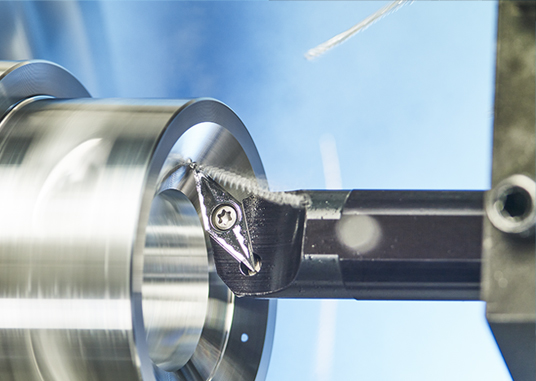
CVD coating has a strong reputation in carbide inserts because it can take heat and wear that would quickly destroy a bare carbide edge. In the right job, a CVD-coated insert can run for a long time, hold up against crater wear, and keep production stable through long batches of steel or cast iron parts.
The trouble starts when the same insert is used as a universal answer. A coating that works well in continuous alloy steel turning may chip in interrupted milling. A thick thermal barrier that protects the cutting edge in heavy steel turning may make the edge too rounded for stainless steel finishing. A coating stack designed for dry face milling of cast iron may be a poor choice for a thin-wall stainless part where built-up edge and vibration are the real problems.
This guide explains how traditional high-temperature CVD, thin MT-CVD for stainless steel turning, and milling-oriented MT-CVD coatings differ. It also shows where PVD is usually the better choice, so CNC shops and tooling buyers can select inserts by cutting condition instead of coating name alone.
What CVD Coating Does on a Carbide Insert
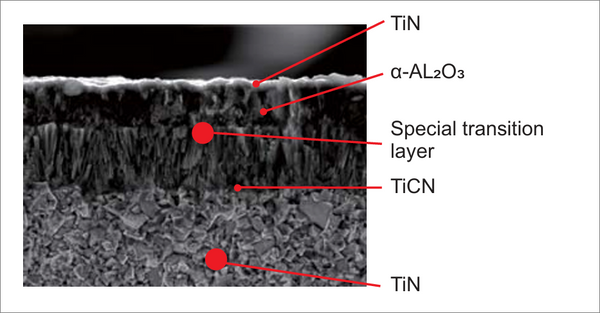
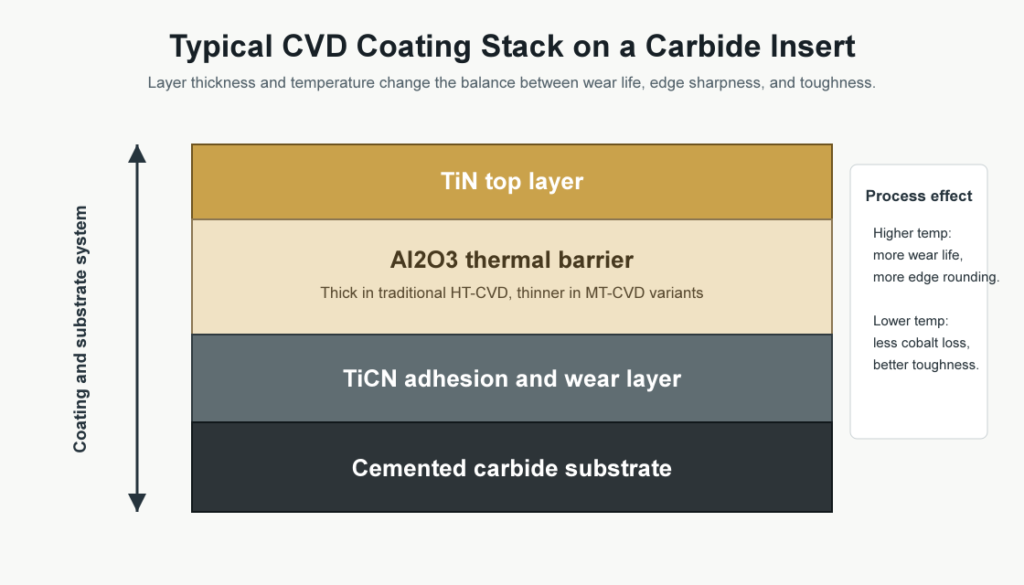
CVD means chemical vapor deposition. In cutting tools, reactive gases form ceramic-like coating layers on the surface of a cemented carbide insert. The common stack uses a TiCN layer for adhesion and wear resistance, an Al2O3 layer for heat control, and a TiN top layer for lubrication, wear visibility, or surface behavior.
Traditional high-temperature CVD is usually deposited around 900 to 1050 C. The coating can be thick, often about 8 to 15 um, which is useful when the tool faces high cutting temperature and long sliding contact. The Al2O3 layer is especially important because it acts as a thermal barrier. It helps resist crater wear and diffusion wear in continuous steel turning, where the chip flows over the rake face under high heat.
That same thick coating also changes the edge. It increases edge radius, adds internal stress, and can make the cutting edge less tolerant of impact. The high process temperature may also affect the cobalt-rich surface region of the carbide substrate. In severe cases, cobalt migration and brittle eta-phase formation reduce toughness at the surface. This is one reason conventional thick CVD grades are often excellent in stable turning but less happy in interrupted cuts.
Traditional Thick CVD: Best for Stable Steel Turning
Conventional high-temperature CVD remains one of the best choices for continuous roughing and semi-finishing of steels such as medium-carbon steel, 40Cr-type alloy steel, and case-hardening steels when the setup is rigid and the cut is steady.
In those conditions, the insert sees high temperature for a long time, but it does not receive repeated shock every spindle revolution the way a milling insert does. The thick Al2O3 layer slows heat transfer into the carbide. The TiCN layer supports wear resistance. The overall coating thickness gives the insert a long wear reserve before the substrate is exposed.
This is why traditional CVD grades are common in automated turning lines for shafts, sleeves, flanges, bearing-related parts and other steel components where the operation repeats for hours. In a stable process, longer tool life and fewer tool changes can matter more than having the sharpest possible cutting edge.
The weaknesses are just as important. Thick CVD tends to dull the edge. That can raise cutting forces, reduce finish quality, and make the insert less suitable for fine finishing. The coating can also be more vulnerable to cracking or flaking when the edge is hit by scale, interrupted surfaces, keyways, casting skin, or unstable clamping. In stainless steel, the higher friction and rounded edge can promote built-up edge, especially at lower speed or with poor chip control.
For practical selection, use traditional thick CVD when the job is continuous, hot, and wear-limited. Avoid it when the job is impact-limited, finish-limited, or adhesion-limited.
Thin MT-CVD for Stainless Steel Turning
MT-CVD, or medium-temperature CVD, was developed partly to reduce the problems caused by high-temperature thick CVD. Stainless steel turning is a good example of where the change matters.
Austenitic stainless steels such as 304 and 316 tend to work harden, generate heat, and stick to the tool. Martensitic stainless steels such as 1Cr13 can also be demanding when hardness rises or when the cut is not fully stable. In these materials, an overly blunt CVD edge may rub before it cuts cleanly. Built-up edge damages the surface, changes the effective geometry, and can tear away coating when it breaks off.
Thin MT-CVD stainless turning grades usually use a lower deposition temperature, often roughly in the 780 to 880 C range, and a total coating thickness closer to 3 to 6 um. The Al2O3 layer is thinner, and the top layer may be optimized for lower friction. Some coating systems also adjust chemistry to reduce chemical affinity with stainless steel.
The result is not the same as a sharp PVD grade, but it can bridge an important gap. Thin MT-CVD keeps more of the CVD advantage in heat resistance and coating adhesion while reducing edge rounding and internal stress. It is often useful in continuous or lightly interrupted stainless turning where the shop wants longer tool life than a PVD grade provides, but cannot accept the severe sticking and edge bluntness of a conventional thick CVD grade.
Use thin MT-CVD for stainless steel when the operation is turning, the cut is mostly stable, the speed and depth of cut are high enough to create thermal wear, and the required surface finish is commercial rather than mirror-like. For severe interruption, thin-wall parts, low-rigidity setups, or high-finish requirements, a PVD-coated stainless grade is usually the safer starting point.
MT-CVD for Milling: A Narrower but Useful Window
Milling is harder on coatings than turning. Every insert enters and exits the cut repeatedly. The edge sees impact, then heat, then cooling, then impact again. This mechanical and thermal cycling is exactly where traditional thick CVD can crack or flake.
Milling-oriented MT-CVD coatings reduce the risk by using a lower process temperature, thinner total coating, and gradient layer design. A TiCN base layer can reduce interface stress, while a thinner Al2O3 layer still provides useful heat protection. Total thickness is often in the same thin range as other MT-CVD systems, roughly 3 to 6 um, although exact values depend on grade and supplier.
This does not make CVD a universal milling coating. It makes it viable in selected milling jobs where the cut is stable and the main limit is heat or abrasive wear. Good examples include dry face milling of gray cast iron, ductile iron, and stable alloy steel blocks with short overhang and strong fixturing.
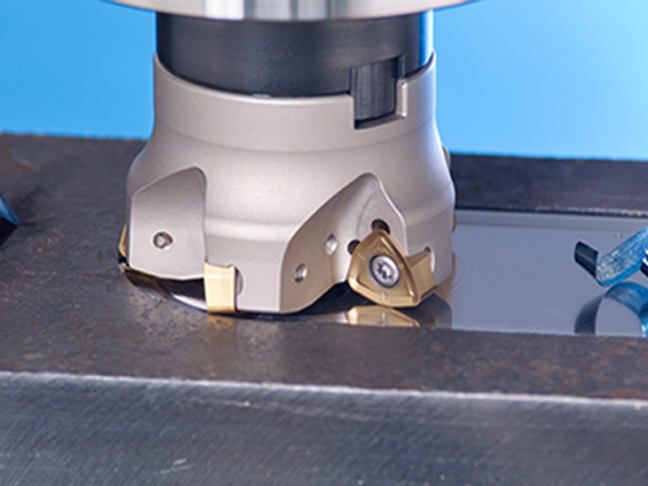
The warning signs are long overhang, thin walls, forged scale, deep cavities, aggressive ramping, high-feed milling, chatter, or coolant applied inconsistently in a hot cut. In those cases, the edge needs toughness and crack resistance more than a thick thermal barrier. PVD is usually the better choice, especially Cr-, Nb-, AlTiN- or AlCrN-family coatings matched with a tough carbide substrate and a positive geometry.
CVD and PVD Are Not Rivals in Every Job
Many coating mistakes come from treating CVD and PVD as a simple ranking. In reality, they solve different problems.
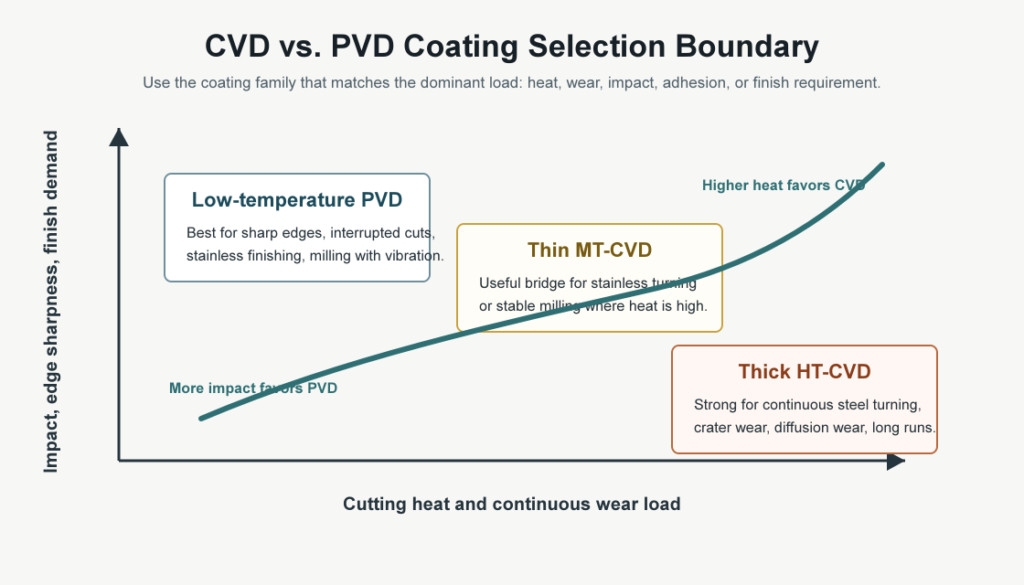
CVD is usually stronger when cutting is continuous, temperature is high, and wear progresses steadily. PVD is usually stronger when the edge must stay sharp, the cut is interrupted, the tool is small, the surface finish requirement is tight, or the work material tends to weld to the edge.
PVD coatings are deposited at lower temperature and are usually thinner. That helps preserve edge sharpness and substrate toughness. PVD is widely used on solid carbide end mills, drills, taps, and stainless or superalloy turning grades where edge control matters. It is also common in finishing and interrupted cuts because lower coating thickness and lower residual stress reduce the chance of coating-related chipping.
CVD, especially with Al2O3, still has an advantage where heat and crater wear are the limiting failure modes. In high-speed continuous steel turning, a good CVD grade may outlast a PVD grade because the thermal barrier is doing real work. The same insert may fail quickly if moved to a grooved, scaled, or unstable part.
Cutting condition | Better starting point | Why |
Continuous alloy steel rough turning | Thick CVD | Strong heat and crater-wear resistance in stable long cuts |
Stainless steel continuous or light interrupted turning | Thin MT-CVD or PVD | MT-CVD for longer wear life at heat; PVD for sharper edges and less sticking |
Cast iron dry face milling with stable setup | Milling-oriented MT-CVD | Al2O3 thermal barrier can help in hot, abrasive, stable milling |
Deep-cavity milling or long overhang | PVD | Better toughness and lower coating stress under vibration |
High-finish stainless or low-burr finishing | PVD | Sharper edge and lower built-up-edge risk |
Forged scale, keyways, interrupted skin | PVD or tough uncoated grade | Impact resistance matters more than thermal barrier thickness |
Application Examples from the Shop Floor
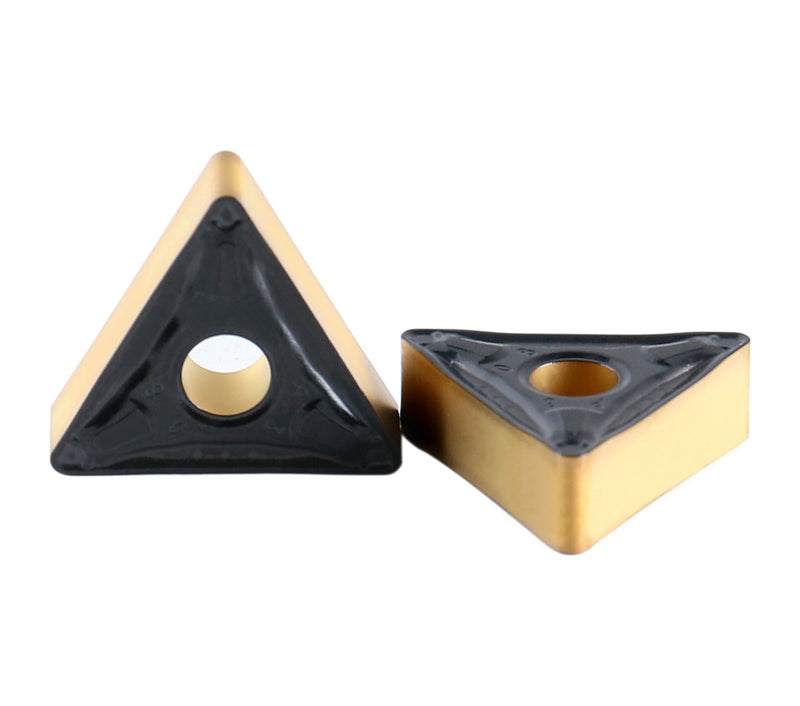
For a steel shaft roughing operation, a conventional CVD-coated CNMG or TNMG insert may be the most economical choice. The workpiece rotates continuously, the cut is predictable, and crater wear or flank wear is usually the life-limiting factor. A thicker CVD coating gives the insert enough wear reserve to run longer between indexing.
For a 304 stainless valve body, the choice is more delicate. If the operation is a stable outside turning or boring cut with enough speed and coolant, a thin MT-CVD stainless grade can improve tool life compared with a general PVD grade. If the same part has interrupted ports, low rigidity, or a strict surface requirement, a sharp PVD stainless grade is more likely to control built-up edge and edge chipping.
For face milling a cast iron housing, a milling-specific MT-CVD grade can work well if the machine, arbor, cutter body and workholding are rigid. The dry or semi-dry cutting temperature is high enough for the Al2O3 layer to earn its place. If the casting has heavy skin, sand inclusions, or interrupted bosses, the first trial should shift toward a tougher PVD grade or a more impact-resistant insert geometry.
How to Specify CVD-Coated Inserts in a B2B RFQ
When buying inserts, do not specify only “CVD coating.” That is too broad. A supplier needs to know the operation, material, hardness, machine rigidity, coolant method, finish target, current tool life, and failure mode.
A useful RFQ might say: “Continuous OD rough turning, 40Cr steel, normalized condition, ap 2.5 mm, feed 0.28 mm/rev, wet cutting, current failure is crater wear after 35 minutes.” That points toward a CVD steel grade with strong Al2O3 heat resistance.
For stainless, the RFQ might say: “316 stainless valve body, stable semi-finishing, light interruption at cross holes, built-up edge and coating peeling are the current failures.” That tells the supplier to compare thin MT-CVD stainless grades against PVD stainless grades rather than offering a thick general-purpose steel CVD insert.
For milling, include cutter diameter, insert shape, overhang, toolholder interface, radial and axial engagement, coolant use, and whether the cut is truly continuous. A milling-oriented MT-CVD coating can only work if the mechanical system is stable enough to let the coating survive.
RFQ detail | Why it matters for coating choice |
Workpiece material and hardness | Determines adhesion, heat generation, work hardening and abrasive wear |
Turning or milling operation | Turning is more continuous; milling adds impact and thermal cycling |
Continuous or interrupted cut | Heavy interruption usually moves the choice toward PVD |
Surface finish requirement | Fine finishing usually needs sharper PVD edges |
Current failure mode | Crater wear, chipping, built-up edge and peeling require different fixes |
Coolant strategy | Inconsistent coolant can create thermal cracks in hot operations |
Holder and overhang | Low rigidity can make any coating look worse than it is |
Practical Selection Rules
Choose traditional thick CVD for continuous steel and alloy steel turning when the setup is rigid, the chip flow is stable, and the operation is limited by flank wear, crater wear, or diffusion wear. This is still one of the strongest use cases for CVD-coated carbide inserts.
Choose thin MT-CVD for stainless steel turning when the cut is mostly stable and hot enough to benefit from CVD wear resistance, but the shop needs less edge rounding and lower sticking tendency than conventional CVD provides. Treat it as a production turning solution, not as a universal stainless grade.
Choose milling-oriented MT-CVD for stable dry face milling of cast iron or alloy steel when the toolpath, holder and workholding are strong. Use it where heat and abrasive wear are the problem, not where impact and vibration dominate.
Choose PVD when the edge must stay sharp, the cut is interrupted, the part is thin, the setup is long-overhang, the material is sticky, or the surface finish requirement is high. In those cases, the thinner coating and lower process temperature are often more valuable than CVD’s thermal barrier.
Do not ask the coating to solve a rigidity problem. If the toolholder, insert seat, cutter body, machine spindle or workholding is unstable, a more expensive coating may only fail in a more expensive way.

Conclusion
CVD coating is still a core technology for carbide CNC cutting tools, but its best use is specific. Traditional high-temperature thick CVD belongs in stable, continuous steel turning where heat and crater wear dominate. Thin MT-CVD expands the range into stainless steel turning by reducing edge rounding and coating stress. Milling-oriented MT-CVD can work in stable, hot face milling of cast iron and alloy steel, but it should not be forced into vibration-heavy or high-impact milling.
For most shops, the cleanest selection method is to identify the limiting failure mode first. Heat and continuous wear point toward CVD. Impact, adhesion, sharp-edge finishing and long-overhang machining point toward PVD. HNCarbide can help match carbide insert grade, coating family, edge preparation and holder rigidity so the coating supports the process instead of fighting it.