Skip to content
CNC Milling Tolerances Explained: Unilateral vs Bilateral — And How the Right End Mill Determines Your Precision
Table of Contents

Precision machining is not just about cutting metal — it is about controlling dimensions within microns.
Every machinist, engineer, or CNC programmer eventually faces the same question:
How do we make sure a machined feature stays within tolerance?
This is where unilateral tolerance and bilateral tolerance come into play. These two tolerance methods define how much variation is acceptable in a machined dimension. But tolerance is not controlled by design drawings alone.
It is influenced by:
- cutting tool geometry
- tool material
- machine rigidity
- cutting parameters
- and tool wear
In CNC milling, especially when using solid carbide end mills, the relationship between tool performance and dimensional tolerance becomes even more critical.
So let’s explore an important question:
How do unilateral and bilateral tolerances actually affect milling operations—and how can the right end mill help you achieve them consistently?
Why Do Tolerances Matter So Much in CNC Milling?
In theory, a design drawing may specify a dimension like:
Slot width = 10 mm
But in real machining environments, achieving exactly 10.000 mm every time is impossible.
Even the most advanced CNC machines are influenced by factors such as:
- tool runout
- spindle thermal expansion
- material hardness variation
- tool deflection
- vibration
This is why engineers specify tolerances, which define the acceptable dimensional range.
Without proper tolerance control, several problems can occur:
Manufacturing Issue | Consequence |
Oversized slots | Loose assembly fits |
Undersized pockets | Parts cannot be assembled |
Tool deflection | Surface finish issues |
Tool wear | Dimensional drift during production |
Tolerance ensures that even with natural manufacturing variation, parts still function properly in assembly.
But the type of tolerance used matters.

What Is Unilateral Tolerance — And When Is It Used?
Is It Ever Acceptable for a Dimension to Move Only in One Direction?
Unilateral tolerance allows variation in only one direction from the nominal dimension.
This means the dimension can increase or decrease — but not both.
Example:
Nominal Dimension | Tolerance | Actual Range |
10 mm | +0.02 / 0 | 10.00 – 10.02 mm |
In this case, the dimension cannot be smaller than 10 mm.
This type of tolerance is commonly used when one dimensional boundary is critical to function.
Where Do Machinists Encounter Unilateral Tolerance in Milling?
Several common CNC milling applications rely on unilateral tolerance.
1. Precision slot milling
When milling slots for sliding components or guide rails, the slot must not exceed a maximum width.
If the slot becomes too wide, the assembly will develop unwanted clearance.
Example requirement:
Feature | Nominal Size | Tolerance |
Guide slot | 12 mm | +0 / -0.02 |
The slot can be slightly smaller, but must never become larger than 12 mm.
2. Mold cavity machining
In mold manufacturing, cavity dimensions often require unilateral tolerance because oversized cavities produce defective molded parts.
3. Tooling and fixture manufacturing
Fixtures must hold components firmly. Oversized pockets may cause positioning errors.
How Does Tool Choice Affect Unilateral Tolerance?
When machining unilateral tolerance features, tool stability becomes critical.
The following properties of carbide end mills help maintain dimensional accuracy.
Tool Characteristic | Impact on Tolerance |
High rigidity | Reduces tool deflection |
Sharp cutting edges | Produces accurate feature size |
Low runout | Maintains consistent cutting diameter |
Wear resistance | Prevents dimensional drift |
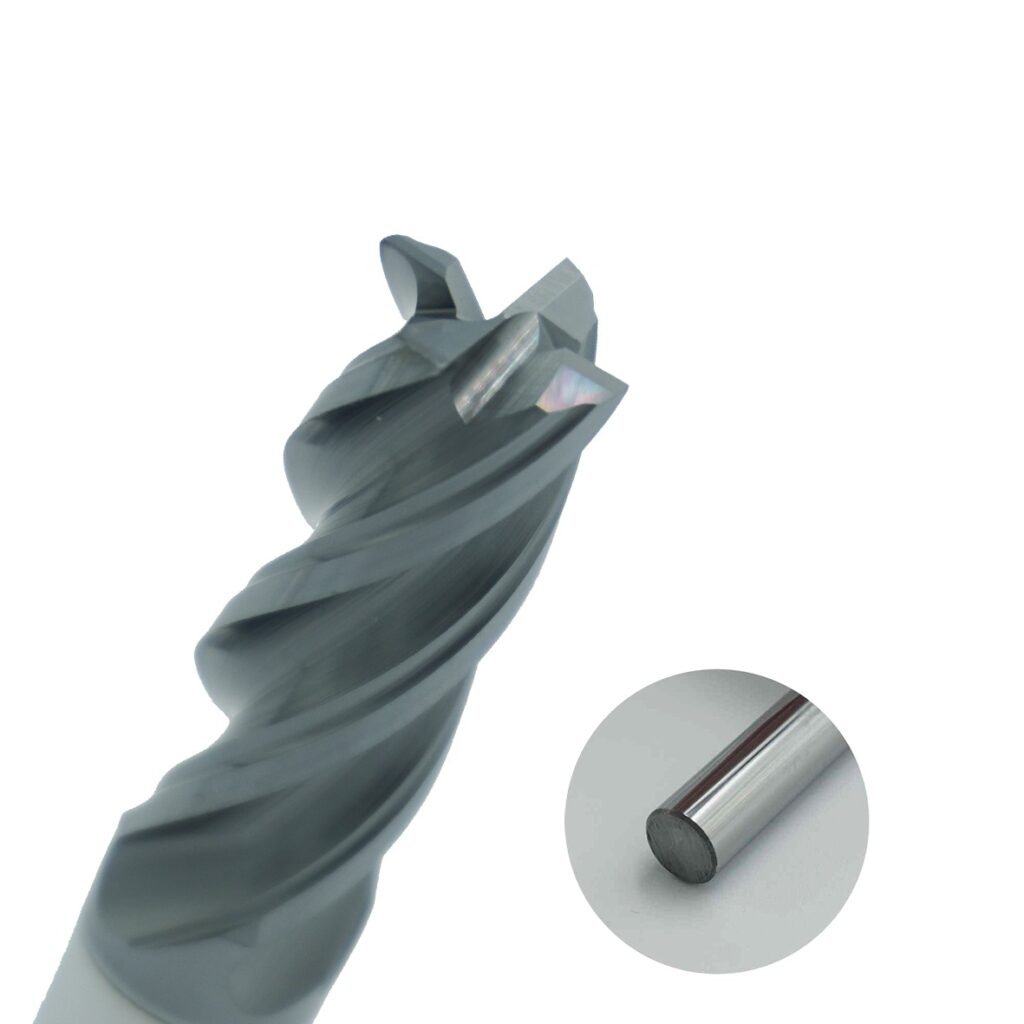
For example, single flute carbide end mills used for aluminum machining provide:
- large chip evacuation space
- minimal vibration
- high dimensional accuracy
These features help maintain tight tolerance windows during slot milling.

What About Bilateral Tolerance?
Why Is It the Most Common Tolerance Type in Machining?
Bilateral tolerance allows dimensional variation on both sides of the nominal dimension.
Example:
Nominal Dimension | Tolerance | Actual Range |
50 mm | ±0.05 | 49.95 – 50.05 mm |
This means the dimension may be slightly larger or slightly smaller.
Because variation can occur in both directions, bilateral tolerance provides greater flexibility for machining processes.
Where Is Bilateral Tolerance Used in CNC Milling?
Bilateral tolerance is widely used in general milling applications.
Typical examples include:
- external profiles
- general pockets
- flat surfaces
- structural components
These features typically do not require one-sided dimensional limits, making bilateral tolerance easier to manufacture.
Why Do Manufacturers Prefer Bilateral Tolerance?
The answer is process flexibility.
Factor | Bilateral Tolerance Advantage |
Tool wear compensation | Easier to adjust offsets |
Machining stability | Allows natural variation |
Production efficiency | Lower scrap rates |
Cost control | Reduced inspection failures |
In high-volume production, bilateral tolerance helps manufacturers maintain consistent throughput while meeting quality requirements.
How Do Carbide End Mills Influence Dimensional Accuracy?
Tolerance is defined on engineering drawings — but cutting tools determine whether those tolerances can be achieved.
Several key properties of carbide end mills directly affect machining precision.
Tool Property | Effect on Machining Accuracy |
Tool diameter accuracy | Determines final feature size |
Tool runout | Influences dimensional consistency |
Edge sharpness | Reduces cutting force and deflection |
Flute design | Improves chip evacuation |
High-quality carbide end mills are typically manufactured with diameter tolerances within a few microns.
For example:
End Mill Type | Diameter Tolerance | Typical Application |
Standard carbide end mill | ±0.01 mm | General milling |
Precision end mill | ±0.005 mm | Mold and aerospace |
Micro end mill | ±0.002 mm | High-precision parts |
The more precise the tool diameter, the easier it becomes to maintain machining tolerances.
Which End Mill Geometry Helps Achieve Better Tolerance?
Different end mill designs influence dimensional stability.
End Mill Type | Best For | Tolerance Performance |
Single flute end mill | Aluminum machining | Excellent chip evacuation |
2 flute end mill | Slot milling | Good dimensional stability |
3 flute end mill | Aluminum profiling | Balanced rigidity |
4 flute end mill | Steel machining | Higher rigidity |
For example:
Single flute carbide end mills are widely used for aluminum because they:
- minimize chip packing
- reduce vibration
- maintain slot width accuracy
Similarly, 4 flute end mills for steel offer higher rigidity, reducing deflection when machining harder materials.
What Other Factors Affect Milling Tolerance?
Even the best cutting tool cannot guarantee precision if machining conditions are unstable.
Several additional factors influence tolerance control.
1.Tool Holder Accuracy
Poor tool holders introduce runout, causing uneven cutting forces and dimensional errors.
High-precision holders typically maintain runout below:
3 microns
2.Machine Rigidity
Machine stiffness directly affects:
- tool vibration
- dimensional accuracy
- surface finish
Rigid CNC machining centers are essential for tight tolerance work.
3.Cutting Parameters
Improper feeds or speeds can lead to:
- excessive tool deflection
- thermal expansion
- inconsistent cutting forces
Optimized cutting parameters reduce dimensional variation.
4.Tool Wear
Tool wear gradually changes the effective cutting diameter.
For example:
Tool Wear Level | Potential Dimensional Error |
New tool | 0 mm |
Moderate wear | 0.01 mm |
Severe wear | 0.03 mm |
Regular tool monitoring prevents tolerance drift during long production runs.
How Can Manufacturers Maintain Consistent CNC Milling Tolerance?
Machinists can achieve stable tolerance control by combining proper tooling and process control.
Recommended strategies include:
Choose high-precision carbide end mills
Precision-ground tools maintain consistent diameters and cutting geometry.
Use appropriate flute geometry
Different materials require different chip evacuation strategies.
Monitor tool wear
Replacing tools before excessive wear occurs prevents dimensional drift.
Apply proper coolant or lubrication
Cooling reduces thermal distortion and tool wear.

Final Thoughts: Precision Begins with the Right Tool
Understanding unilateral and bilateral tolerance is fundamental to modern machining.
But drawings alone do not produce accurate parts.
Achieving real-world tolerance depends on:
- tool geometry
- tool material
- machine stability
- cutting strategy
Among these factors, cutting tools play one of the most decisive roles.
High-quality solid carbide end mills provide:
- superior rigidity
- accurate cutting diameters
- excellent wear resistance
- consistent machining performance
These characteristics make them essential for manufacturers seeking tight tolerances, improved productivity, and reliable part quality.
In today’s competitive manufacturing environment, the right end mill is not just a tool — it is a key contributor to precision engineering.