Skip to content
Cemented Carbide (WC-Co): Properties, Trade-offs, and How to Specify It for Cutting Tools
Table of Contents

What Cemented Carbide Is
Definition. Cemented carbide is a composite made by powder metallurgy: sub-micron to coarse WC grains are pressed with a metallic binder (usually Co) and sintered just below the melting point of the binder. The result is a two-phase material: super-hard WC particles embedded in a tough cobalt matrix.
Why it works.
WC brings extremely high hardness and abrasion resistance.
Co adds toughness and bridges cracks; it also provides some plasticity under impact.
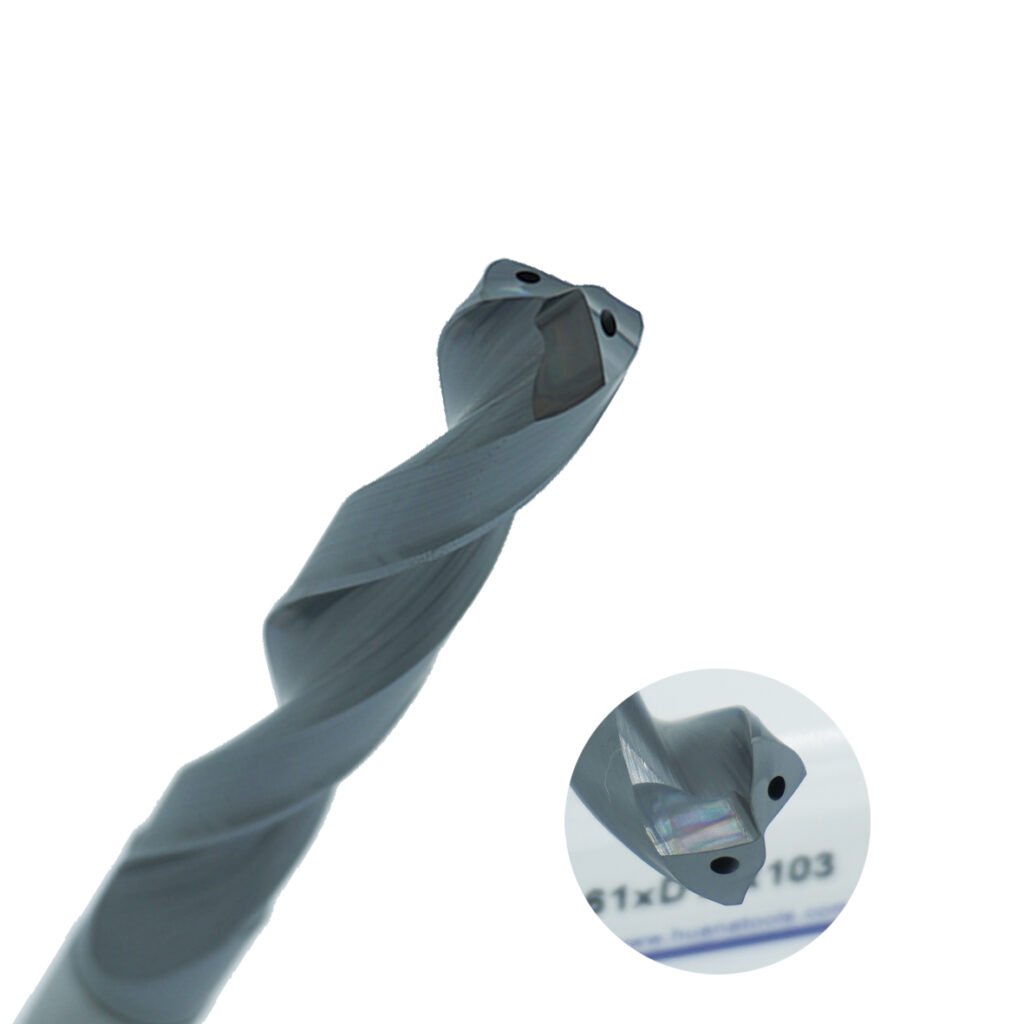
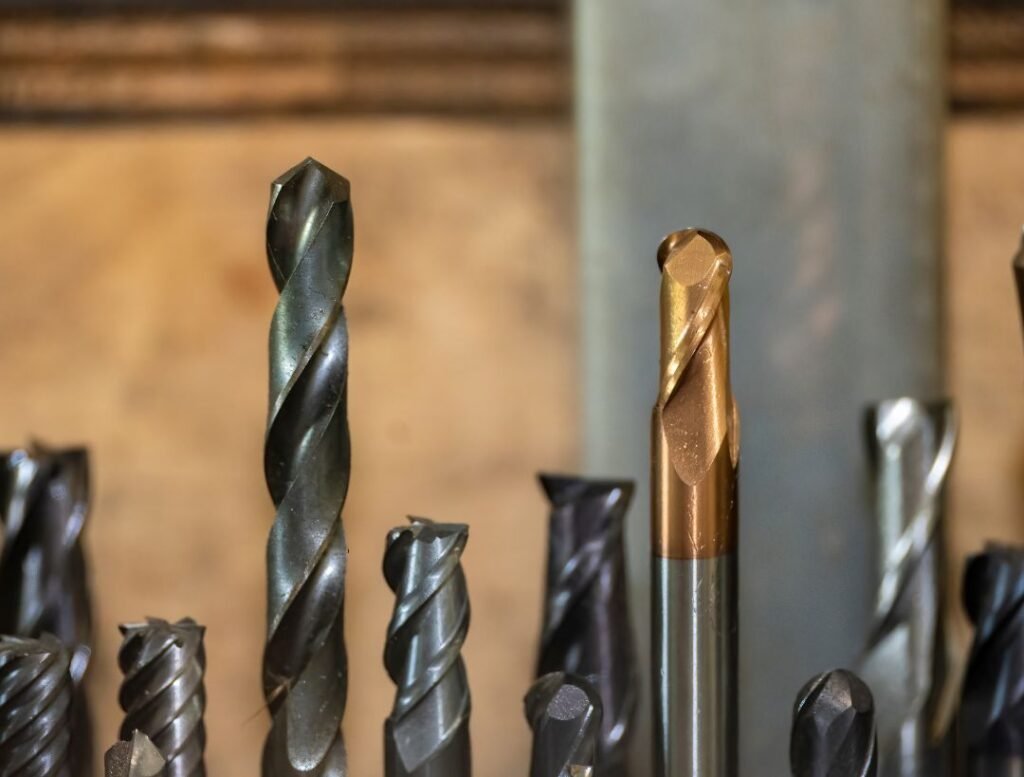
Where it’s used. Cutting tools (turning, milling, drilling, threading), wear parts and dies, mining and construction tooling, and hot-work inserts where conventional steels fail.
Composition and Microstructure
Carbide grades are tuned by WC particle size, cobalt percentage, and secondary carbides (TiC, TaC, NbC).
Typical Composition and Role
Constituent | Role in the Composite | Typical Proportion |
Tungsten carbide (WC) | Hard phase: primary source of hardness and abrasion resistance | 70–97% |
Cobalt (Co) | Binder: adds toughness, bridges cracks | 3–30% |
Additives (TiC, TaC, NbC) | Improve hot hardness, crater-wear resistance, oxidation and corrosion behavior | <10% (combined) |
Grain size matters. Finer WC grains raise hardness and edge stability; coarse grains improve fracture toughness.
Grain Size Classes (at sintered state)
Class | WC Grain Size (μm) | Characteristics | Typical Use |
Ultra-fine | 0.2–0.5 | Very high hardness & strength; fine edge integrity | Micro-tools, finishing, small-diameter drills |
Fine | 0.5–1.0 | Balanced hardness/toughness | General-purpose cutting |
Coarse | 1.0–3.0 | Higher toughness, impact tolerance | Heavy roughing, mining buttons |
Physical Properties (What the Numbers Mean on the Machine)
Thermal expansion coefficient: 4–7 × 10⁻⁶ / °C → dimensional stability under temperature swings; helpful for tight-tolerance tooling and hot runs.
Density: 11–15 g/cm³ → high mass improves vibration damping and thermal inertia (useful in intermittent cuts).
Thermal conductivity: typically 20–100 W/m·K (grade-dependent). While lower than copper or aluminum, it’s high enough to draw heat into the insert/body; still, many grades behave as poor heat sinks compared with tool steels, so cooling strategy and coatings matter.
Mechanical & Thermal Performance
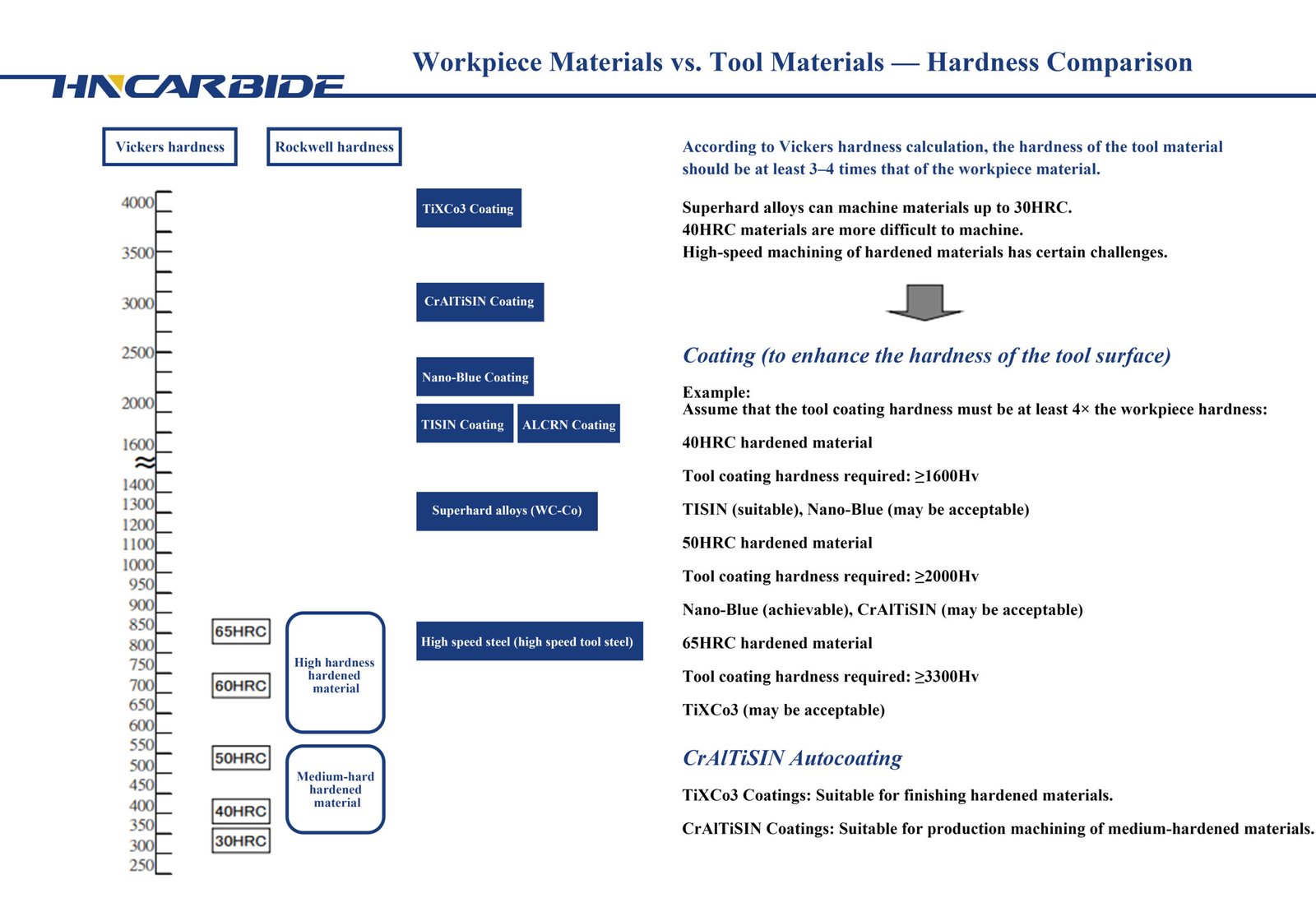
Cemented carbide sits near the top of the hardness pyramid, just below PCD (diamond) and CBN.
Core Performance Envelope
Property | Cemented Carbide (WC-Co) | Notes for Application |
Hardness | HRA 88–94 (≈ HRC 80–90) | Second only to diamond/CBN; maintains edge at speed |
Compressive strength | ~3000–6000 MPa (can reach 6000–8000 MPa in some grades) | Handles high feed/pressure in roughing |
Transverse/ flexural strength | ~1000–3000 MPa | Indicates brittleness; avoid bending/impact |
Hot hardness / red hardness | Holds hardness to 800–1000 °C | Enables high cutting speeds in steels |
Thermal conductivity | ~20–100 W/m·K (≈ ~70 W/m·K typical) | Manage heat with coolant or coatings |
Chemical stability | Good corrosion resistance vs HSS; oxidation above ~600 °C | TiAlN/AlCrN coatings mitigate oxidation |
Key takeaways
Carbide tolerates compressive loads exceptionally well.
It is brittle in bending/impact; micro-chipping and catastrophic breakage occur if edge geometry, runout, or engagement are poor.
With the right coating, carbide keeps cutting at high temperature where HSS softens.
Grade Families by Cobalt Content
Cobalt content directly tunes toughness vs. wear.
Cobalt Content vs. Behavior
Grade Family | Co Content | Behavior | Typical Applications |
Low-Co | 3–6% | Highest hardness/abrasion resistance; lowest toughness | Finishing inserts, micro-drills, PCB tools |
Medium-Co | 6–10% | Balanced wear/toughness | General turning & milling cutters |
High-Co | 10–30% | Toughest; best impact strength; lower hardness | Mining buttons, form tools, stamping dies |
Rule of thumb. Increase Co when impact is unavoidable or edges are large; decrease Co for fine edges and abrasive wear control. Remember: more Co → more toughness but lower hardness and wear life.
Cemented Carbide vs. Other Tool Materials
No single material wins everywhere. Use the matrix below during tool selection.
Tool Material Comparison
Performance | Carbide | HSS | Ceramic | CBN/PCD |
Hardness (HRA) | 88–94 | 82–87 | 92–95 | 95–100 |
Hot strength (°C) | 800–1000 | 600–650 | 1200+ | 1400+ |
Toughness | Medium | High | Low | Very low |
Best at | Steels, cast irons, many stainless grades | Soft metals, general purpose | Hardened steels, high-temp alloys (continuous cut) | Hardened steels (CBN), non-ferrous/composites (PCD) |
Limits | Brittle in impact; oxidation >600 °C without coating | Softens at speed; wear | Thermal shock; interrupted cuts | Cost; limited to specific materials |
Coatings That Unlock Performance
Coatings reduce crater and flank wear, suppress diffusion, and protect against oxidation.
TiN — general purpose, good wear, easily recognized gold color; suitable for low–mid speeds in steels.
TiAlN / AlTiN / AlCrN — high-temperature protection up to ~800 °C+; ideal for high-speed steel machining and dry/semi-dry operations.
TiCN — low friction, good for stainless where adhesion is a risk.
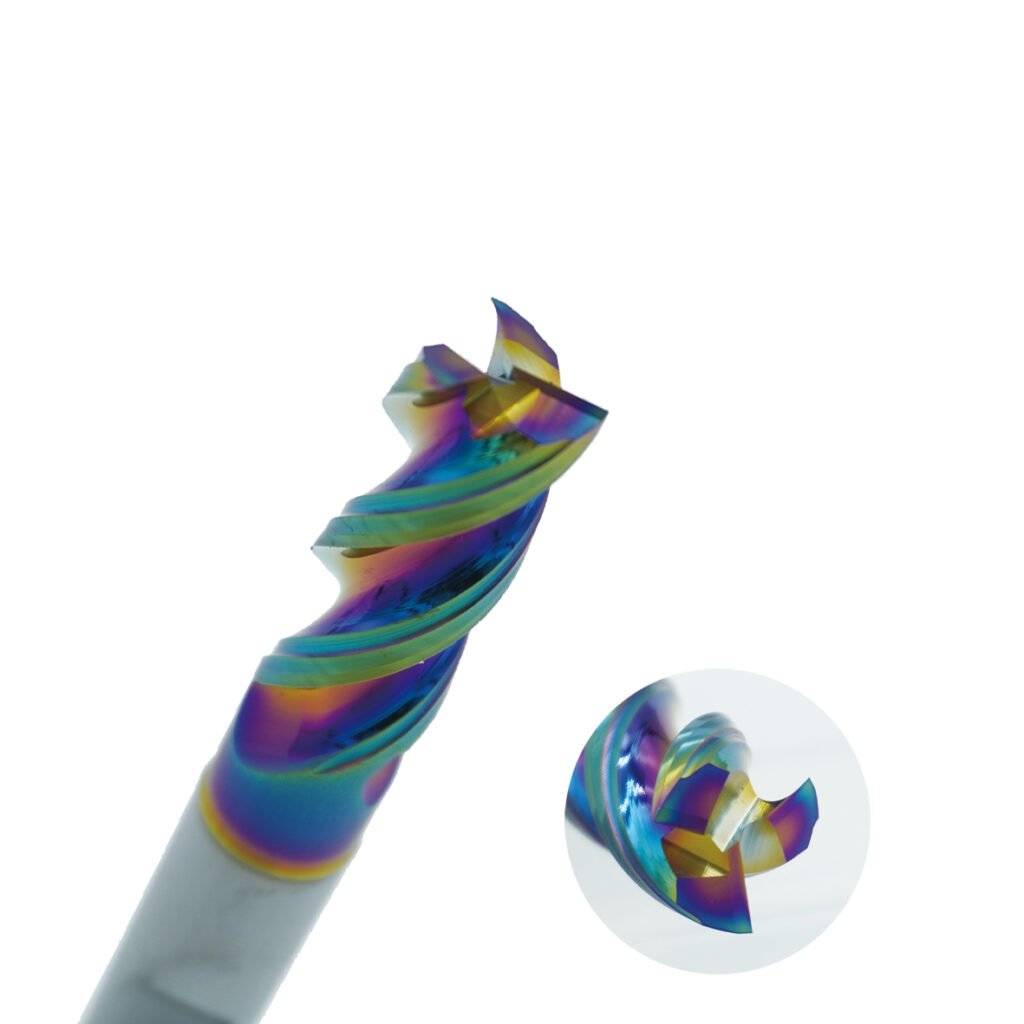
DLC / TiB₂ / diamond-like — very low friction for aluminum and composites; minimizes built-up edge.
Pairing guide.
Steels / stainless: TiAlN or AlCrN; TiCN for sticky austenitics.
Titanium / Ni alloys: AlTiN/AlCrN with polished flutes; keep edge strong.
Aluminum: uncoated polished or DLC/TiB₂ to avoid BUE.
Applying Carbide in Cutting Tools
Edge geometry. Because carbide is brittle, the micro-geometry matters:
Use a small hone or land to suppress micro-chipping (but not so large that it raises cutting forces excessively).
Keep runout extremely low; asymmetry concentrates load on one tooth.
Favor constant-engagement toolpaths in milling to avoid force spikes.
Cutting conditions.
Carbide thrives at higher cutting speeds; leverage its red hardness.
If heat is excessive (especially in stainless/Ni), increase chip thickness slightly to avoid rubbing and reduce dwell.
Coolant strategy: High-pressure coolant helps in drilling/threading; with thermal-shock-sensitive grades, avoid intermittent coolant.
Design examples.
Finishing inserts: low-Co, ultra-fine grain + TiAlN for wear and sharpness.
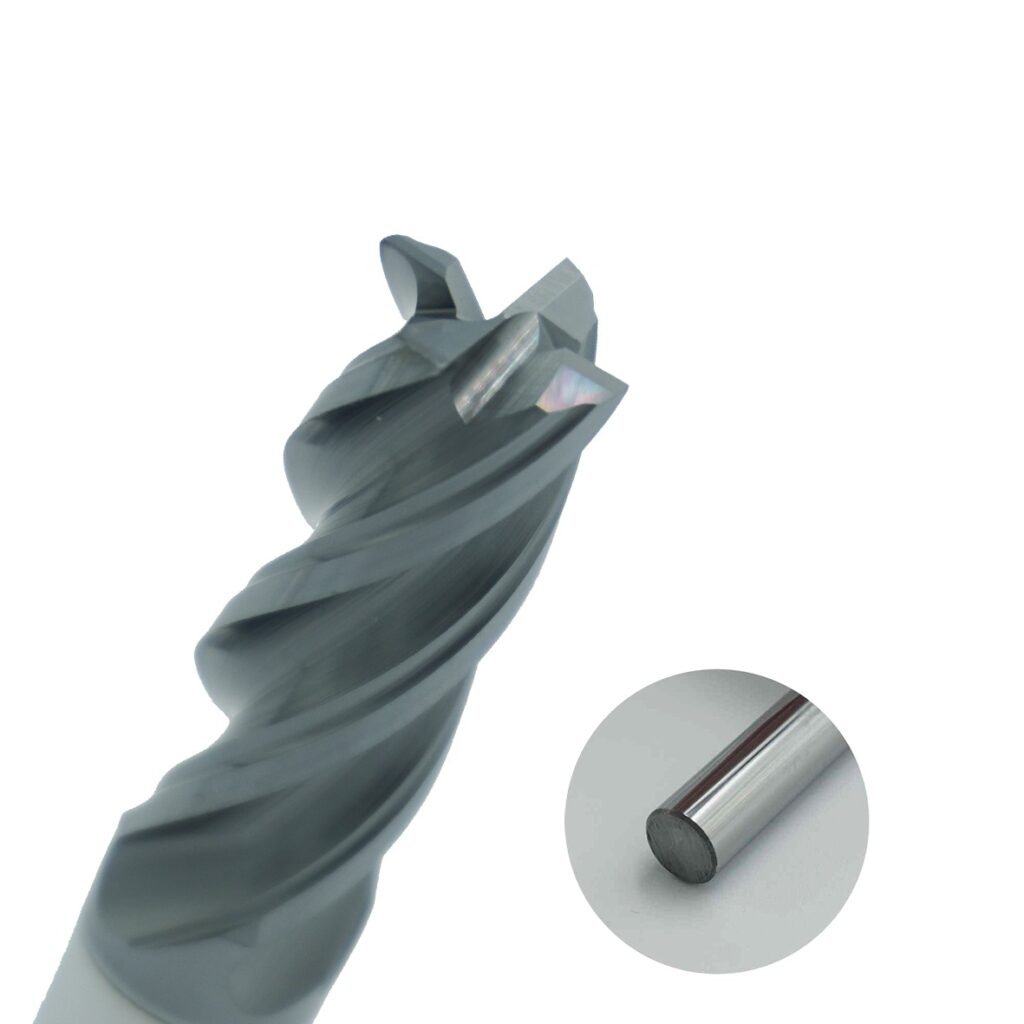
Roughing end mills: medium-Co, fine/coarse grains + AlCrN for edge strength.
Mining buttons / hot-work punches: high-Co, coarse grains for impact.
Chemical & Thermal Stability
Corrosion/chemical: Better than HSS; composition tweaks (e.g., partial Ni binder) can improve corrosion or magnetism behavior where needed.
Oxidation: WC oxidizes above ~600 °C; TiAlN/AlCrN coatings act as an oxygen barrier.
Diffusion wear: At high speeds on alloyed steels, protective coatings plus lower cutting temperature (through coolant or optimized engagement) are essential.
Limitations and How Industry Mitigates Them
Brittleness / low flexural strength (≈1000–3000 MPa).
Fixes: pick higher Co, coarser grains, add a micro-hone, and avoid shock (better entry/exit strategies, trochoidal paths).
Cost.
Fixes: recycling and reclaim—zinc-melt or chemical routes recover WC and Co efficiently; many suppliers run closed-loop programs.
Manufacturing difficulty.
Fixes: EDM and laser processing enable complex geometries that grinding can’t, especially on micro-tools and chipbreaker features.
Selecting a Grade: A Practical Workflow
Identify the dominant failure mode (abrasive flank wear? chipping? built-up edge? crater? thermal cracks?).
Choose Co% and grain size to counter that failure:
Flank wear → lower Co / finer grains.
Chipping/impact → higher Co / coarser grains + edge hone.
Layer on a coating matched to both material and temperature regime (TiAlN/AlCrN for hot ferrous cuts; DLC/TiB₂ for Al).
Validate with data: measure tool life versus wear mode, not just minutes; adjust edge prep and coolant before changing grade.
FAQs
Q1: Why do some carbide tools chip even at moderate speeds?
Because bending shock and runout exceed flexural limits. Reduce radial immersion, introduce a small hone, shorten overhang, and ensure TIR ≤ 5–10 μm on small end mills/drills.
Q2: Can I use one “universal” carbide grade for everything?
Not realistically. You need at least two grade families: a tough grade for roughing/unstable cuts and a hard, fine-grain grade for finishing or abrasive wear. Coating choice then tunes each to the workpiece.
Q3: Is carbide always better than ceramics or CBN?
No. Ceramics/CBN win in dry, continuous turning of hardened steels at very high temperatures. Carbide wins in mixed work, interrupted cuts, and where toughness is still required.
Q4: Does higher density help?
Yes—mass adds damping. In boring bars and large form tools, carbide shanks reduce chatter compared with steel.