Carbide vs HSS End Mills:Why Two Tool Materials Still Matter
Table of Contents

Open almost any end mill catalog and the substrate choice appears simple: high-speed steel or solid carbide. Carbide occupies far more pages in modern CNC catalogs, yet HSS has not disappeared because the two materials solve different production problems.
Carbide wins when the machine, holder, program, and setup can support higher cutting speeds and a rigid process. HSS gives up speed but tolerates deflection, interrupted contact, and less predictable setups more gracefully. The right choice is the material that produces the lowest reliable cost per finished part on the machine that will actually run the job.
What is HSS
High-speed steel is a family of alloy tool steels designed to retain useful hardness at cutting temperatures while still offering much more toughness than cemented carbide. Common HSS compositions contain tungsten or molybdenum, chromium, vanadium, and sometimes cobalt. Heat treatment creates a hardened steel matrix with wear-resistant carbides distributed through it.
For a milling cutter, the practical benefit is the ability to flex slightly and survive shock without immediately chipping. HSS is therefore useful on older knee mills, manual machines, long-reach setups, large cutters at moderate speed, and short production runs where breakage risk matters more than maximum metal removal rate.
HSS M35 M42 and PM HSS
Plain HSS, commonly represented by grades such as M2, does not rely on a high cobalt addition. M35 contains about 5 percent cobalt, while M42 contains about 8 percent. Cobalt improves hot hardness and wear resistance, so cobalt HSS can run faster and handle more demanding alloys than standard HSS. It remains steel and is still substantially tougher and less rigid than carbide.
Powder-metallurgy HSS has a finer and more uniform carbide distribution. It can improve edge stability and wear resistance and often occupies a useful middle ground for complex tools, tapping, broaching, and shock-sensitive work.
HSS family | Typical description | Where it fits | Main caution |
Conventional HSS such as M2 | Tough and economical | General work, manual machines, softer steels and nonferrous alloys | Lower hot hardness limits cutting speed |
M35 or HSSE about 5 percent Co | Improved hot hardness | Stainless and alloy steels in moderate production | More expensive and less forgiving than plain HSS |
M42 or HSSE about 8 percent Co | High hot hardness within HSS | Demanding alloys needing better edge retention | Still below carbide productivity in rigid CNC work |
PM HSS | Fine and uniform microstructure | Complex geometries, form tools, tapping | Performance varies by grade and supplier |
Why shops still use HSS end mills
HSS is often described as the budget option, but its decisive advantage is toughness. In a long-reach setup with measurable runout, unequal tooth loading can chip a carbide edge. HSS absorbs more deflection and intermittent loading, so the slower cutter may finish the job with fewer surprises.
HSS also remains practical when spindle speed is the limiting resource. Small carbide end mills need high rpm to reach an efficient surface speed. If an older machine cannot reach that range, paying for carbide may produce little cycle-time benefit. Workpiece material alone is not enough to select the substrate.

What is cemented carbide
The substrate used in most solid carbide end mills is cemented tungsten carbide. Hard tungsten carbide grains form the wear-resistant phase, while cobalt usually acts as the metallic binder. The result is a composite material rather than a steel alloy.
Compared with HSS, cemented carbide has much higher hardness, compressive strength, hot hardness, and elastic modulus. A well-supported carbide end mill can run at much higher cutting speeds, retain size longer, and hold a more consistent finish through a production batch. The tradeoff is fracture behavior: chatter, runout, weak fixturing, excessive stickout, an aggressive entry, or recut chips can cause chipping or breakage.
Carbide grain size
Terms such as micrograin, submicron, ultrafine, and nano are not used with perfectly universal boundaries. CERATIZIT publishes one classification in which nano is below 0.2 micrometers, ultrafine is 0.2 to 0.5 micrometers, submicron is 0.5 to 0.8 micrometers, and fine or medium grades are larger.
Finer grains generally support higher hardness and sharper, more wear-resistant edges. Coarser grains and higher binder content can improve fracture toughness. Cobalt percentage, grain-growth inhibitors, mixed carbides, sintering quality, geometry, edge preparation, and coating all affect the finished tool, so the smallest advertised grain is not automatically the best choice.

Why carbide dominates CNC milling
On a rigid machining center, carbide converts spindle power and rpm into output. Higher cutting speed reduces cycle time, while the stiff substrate helps maintain dimensional accuracy. Wear resistance is especially valuable in abrasive materials and heat-resistant alloys when tool geometry and coating match the workpiece.
Carbide also scales well in automated production. Longer, more predictable tool life means fewer offsets and tool changes. The tool may cost several times more than an HSS equivalent yet reduce cost per part. That advantage depends on stability; excessive runout or chatter can destroy carbide before it delivers its expected life.
Carbide vs HSS at a glance
Decision factor | HSS or cobalt HSS | Solid carbide |
Cutting speed | Lower | Much higher in a stable setup |
Shock resistance | Better tolerance of deflection and interrupted contact | Vulnerable to chipping under impact or chatter |
Rigidity | Lower modulus and more tool deflection | High modulus supports size and finish control |
Heat and wear | Adequate at moderate speed; cobalt helps | Strong hot hardness and wear resistance |
Purchase price | Usually lower | Higher, especially for large or long tools |
Best setting | Low volume, manual or less rigid machines | Repeat CNC production with stable workholding |

Match the substrate to the real setup
Start with machine rigidity and runout
A sound spindle, rigid holder, short gauge length, and secure workholding favor carbide. Check runout at the tool, not only at the empty holder. As diameter decreases, a few micrometers of runout consume a larger share of the chip load and can overload one flute. HSS is a safer starting point when the machine has backlash, the setup vibrates, the cutter must reach far from the holder, or the cut has a hard interrupted entry.
Check whether the spindle can use carbide
Surface speed links diameter to spindle rpm. A small cutter needs high rpm. If the machine cannot reach the recommended range, carbide may rub or run below the window where its geometry works best. At the other extreme, a high-speed machining center leaves productivity unused when HSS runs at conservative parameters.
Consider the workpiece and cut type
Carbide is usually preferred for abrasive materials, hard steels, cast iron, and heat-resistant alloys, provided the tool is designed for that material. HSS remains credible in low-volume milling of aluminum, brass, plastics, mild steel, and some alloy steels. Cobalt HSS extends the range, but geometry, coolant strategy, chip evacuation, and cutting data still decide whether the edge survives.
Calculate cost per finished part
Include cycle time, expected tool life, tool-change time, scrap risk, machine hourly rate, and the probability of sudden failure. In a stable batch job, carbide often wins because faster cutting and longer life overwhelm the higher price. In a one-off repair with a questionable setup, an HSS tool that survives can be cheaper than a broken carbide tool and a damaged component.
Shop condition | Better starting choice | Reason |
Rigid CNC and repeat production | Carbide | Uses higher speed and offers predictable wear |
Manual or older machine | HSS or cobalt HSS | Better resistance to shock and deflection |
Small cutter and high-rpm spindle | Carbide | High stiffness and wear resistance |
Large cutter for occasional use | HSS | Lower capital cost may outweigh slower cutting |
Long reach or unstable workholding | HSS first | Reduces brittle failure risk while the process is stabilized |
Abrasive or hard material | Application-specific carbide | Better hot hardness and wear resistance |
Common selection mistakes
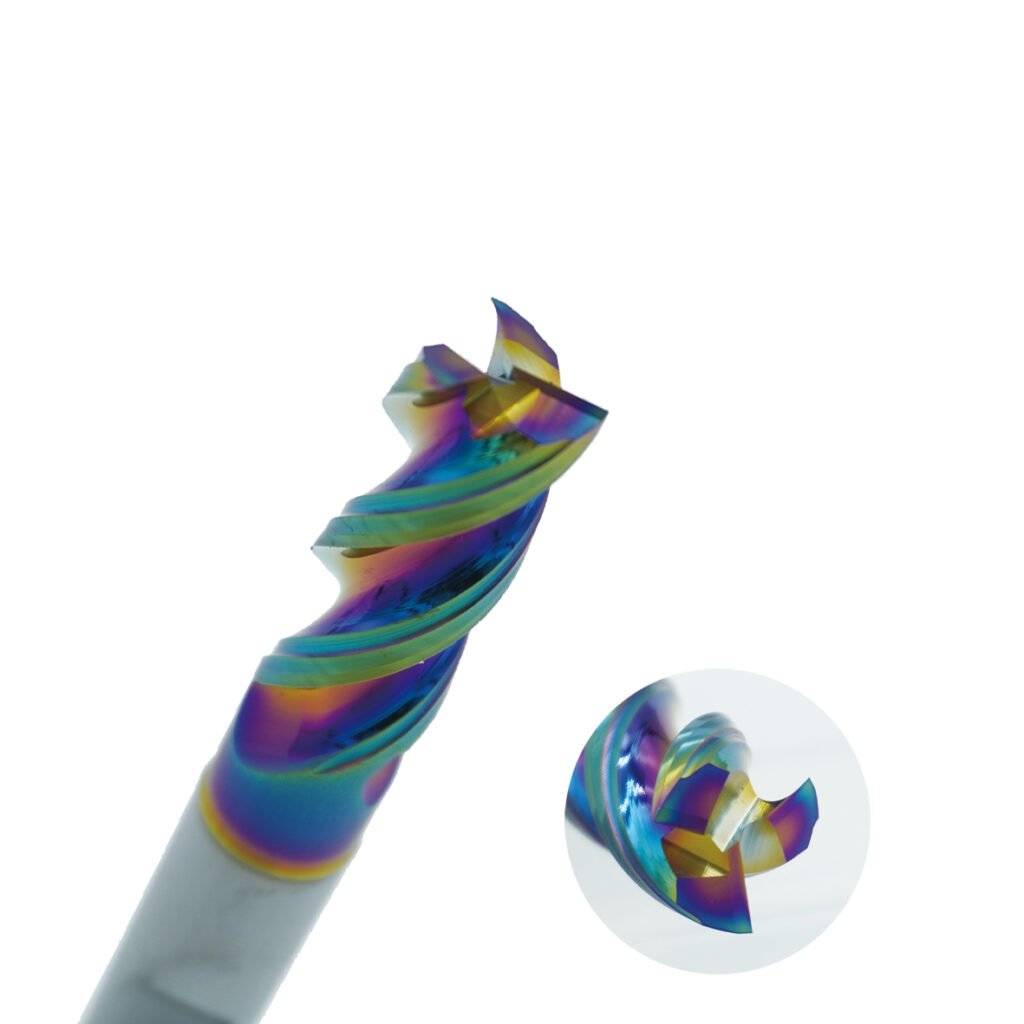
Do not choose by coating color. Blue, bronze, gray, or rainbow finishes do not identify the substrate, and similar-looking coatings can have different compositions. Read the tool specification.
Do not treat all carbide as equal. A polished cutter for aluminum and a strong-edge tool for stainless steel may share a carbide base but behave very differently. Flute count, helix, core diameter, rake, edge hone, coating, and coolant access all matter.
Do not copy carbide cutting data onto HSS or reduce carbide data until it behaves like HSS. Start from the manufacturer’s range for the exact tool and workpiece group, then adjust for engagement, depth, runout, stickout, and machine condition.

A practical purchasing checklist
Before requesting a quotation, give the supplier the workpiece grade and hardness, operation, cutter diameter, flute length, reach, radial and axial engagement, coolant method, spindle speed limit, holder type, and expected batch size. If the job has failed before, include the failure mode: gradual wear, built-up edge, corner chipping, flute breakage, chatter, or poor finish.
For a new production job, test one HSS or cobalt-HSS option against two carbide grades instead of comparing catalog prices alone. Record parts per tool, cycle time, dimensional drift, finish, and failure mode. The result is a buying decision tied to the process.

Conclusion
HSS and carbide remain in the market because milling shops do not all have the same machines, volumes, and risk tolerance. HSS offers toughness, lower entry cost, and useful performance when speed or rigidity is limited. Carbide provides the heat resistance, stiffness, and wear life needed for productive CNC milling.
Choose carbide when the entire process can support carbide. Choose HSS when toughness and forgiveness are more valuable than maximum speed. For application-specific end mills, HNCarbide can review the material, tool geometry, machine limits, and production target before recommending a carbide grade and coating.