Anti-Vibration, High-Efficiency End Mills: Geometry That Kills Chatter and Multiplies Metal Removal
Table of Contents

What you’ll learn
Why unequal indexing (93°/87°) and variable core thickness suppress resonance and let you push feed far beyond “ordinary” end mills.
How a 13° high rake + 8° arc relief and sub-micron carbide combine to cut forces and heat while protecting the edge.
Practical, diameter-based speeds/feeds and setup tips you can drop into your CAM today.
Where HNCarbide’s anti-vibration series slots into stainless, carbon/alloy steel, titanium, and Ni-base alloys.
Why anti-vibration end mills matter
Chatter is energy you didn’t budget for: once the tooth leaves a wavy surface, the next tooth meets a varying chip thickness, the spindle feeds that oscillation, and the whole system locks into resonance. Results: stripes on the finish, chipped edges, short tool life, and operators dialing back feed “just to be safe.”
Anti-vibration (a.k.a. variable pitch / unequal division) end mills attack the root of the problem: they break the periodicity of cutting forces so the spindle, holder, tool, and workpiece never get a clean kick at their natural frequency. Instead of one big tone, you get smaller, phase-shifted force packets that the structure can swallow without ringing.
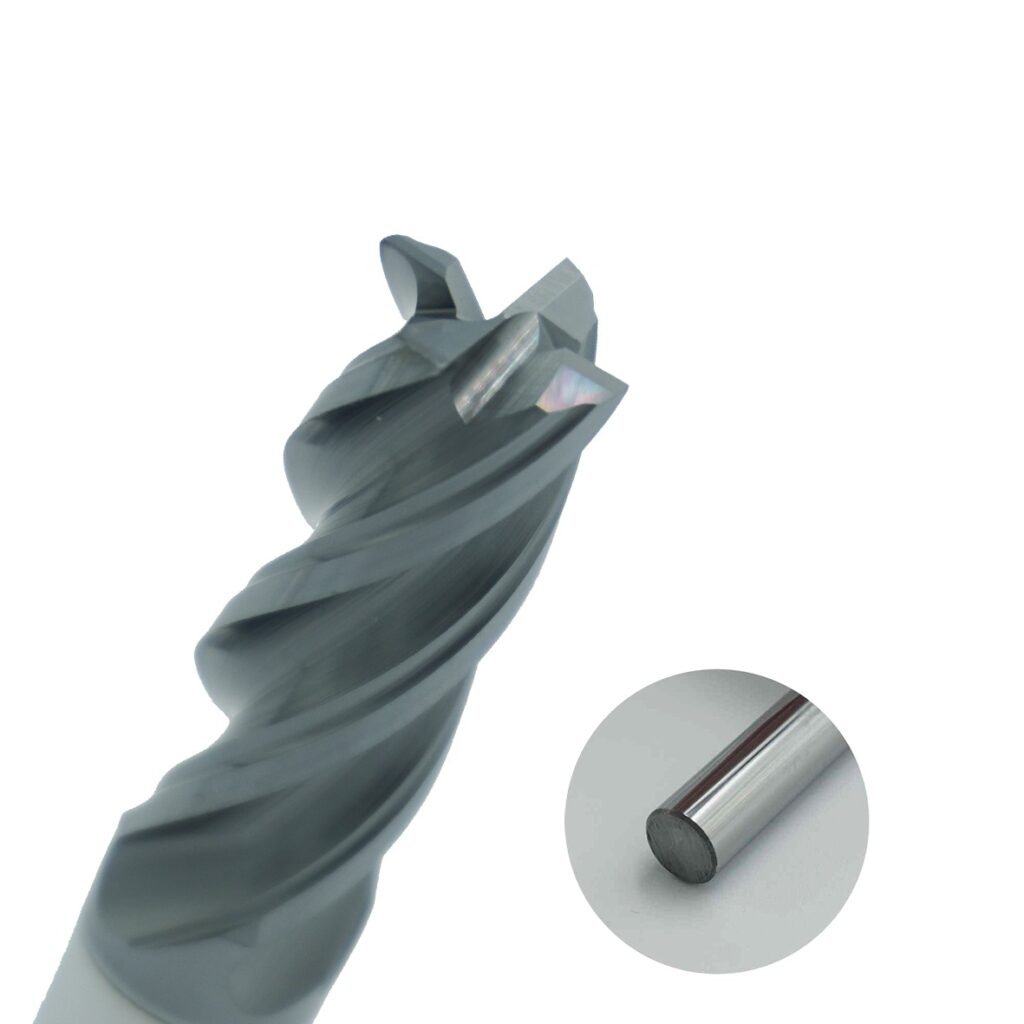
Unequal tooth indexing (93° / 87° / 93° / 87°)
What it is: Four flutes split into alternating 93° and 87° angular gaps (instead of 90°–90°–90°–90°).
Why it works: Each tooth sees a different entry time, so the cutting force peaks are offset. The frequency content spreads out and drops below the threshold that excites system modes. Result: less resonance, less chatter, and cleaner surface finish at higher material removal rates (MRR).
48° helix with variable core thickness
Front 20 mm of flute length: core ≈ 10.5 mm, creating large chip gulley for fast evacuation.
Beyond 20 mm: core increases to ≈ 14 mm, which stiffens the body where bending moments peak.
Why it matters: You get both chip space (front) and bending rigidity (rear), so the tool deflects less and stays stable as axial depth increases.
Edge angles tuned for low force and high life
Rake (γ): ~13° high-positive → sharper edge, lower cutting force and lower heat, especially useful in gummy stainless, Ti, and Ni alloys.
Relief (α): 8° arc-shaped → generous clearance without starving the land; the arc shape spreads stress along the edge, raising bending strength and minimizing back-face rubbing.
Edge prep: Controlled honing (a modest, uniform “K-land”) desensitizes the edge to micro-chipping and reduces surface fuzz, so Ra drops and consistency rises.
Manufacturing accuracy
Cylindricity of shank OD: ≤ 0.002 mm
Radial & axial run-out (assembled): ≤ 0.005 mm
Face/relief roughness: Ra ≈ 0.4 µm
Why you care: With variable pitch, runout becomes the next weakest link. If you keep the edge positions honest, each flute does its fair share, and the variable-pitch logic works as designed.
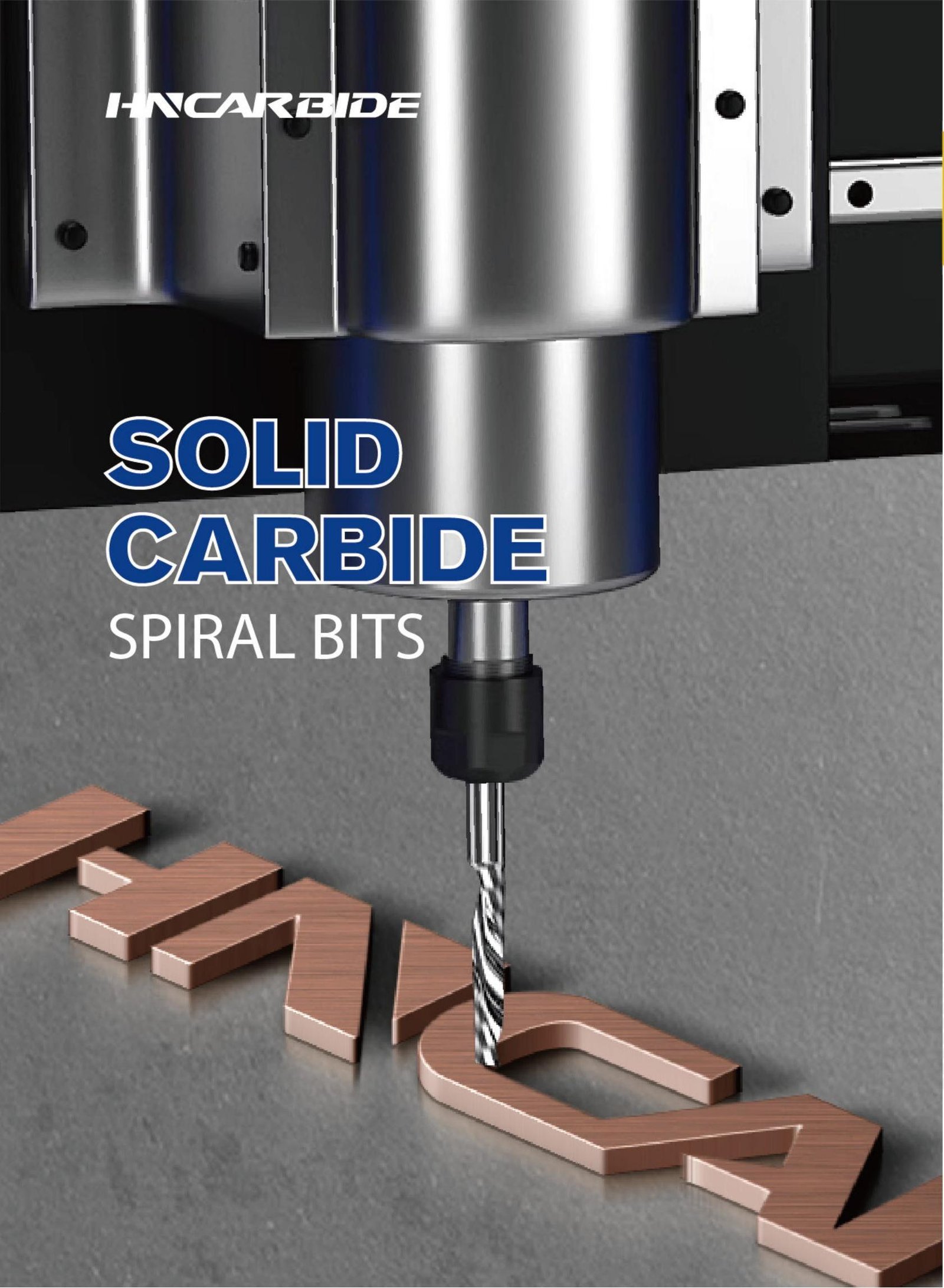
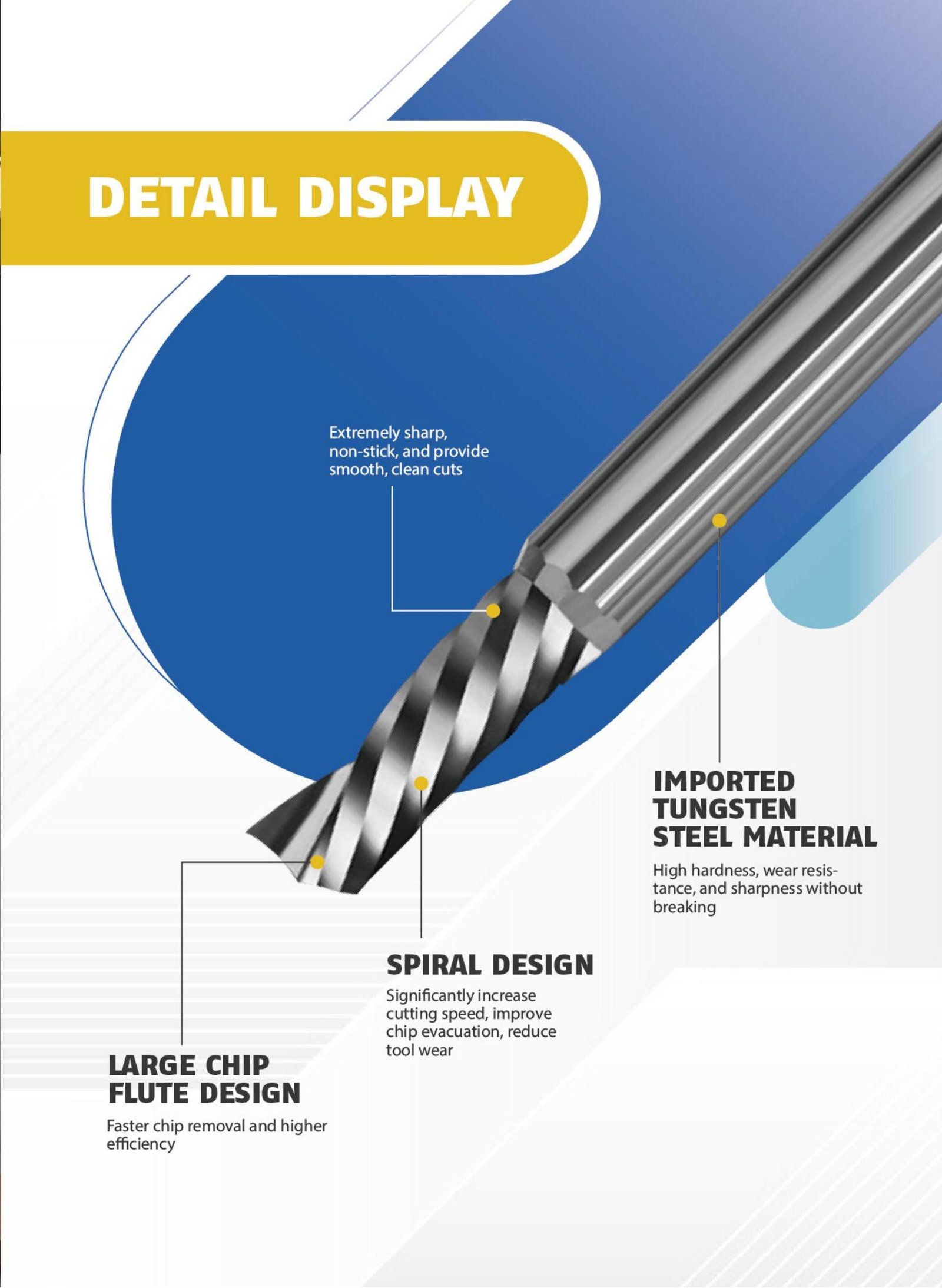
Single-Flute Cutter Catalog
Click the button below to view our single-flute cutters and detailed specs to choose the right tool.
Substrate and coating: pairing the geometry with a core that lasts
Substrate: Ultra-fine carbide (sub-micron WC with a balanced Co binder). Compared with typical domestic micrograin, we target ~+2 HRA higher hardness and a bending-strength uplift on the order of 600–800 MPa (owing to tight porosity control and grain growth inhibition).
Material class: The cutting table below uses K30-class blanks as the reference.
Coatings:
AlTiN/AlCrN PVD for steels/stainless (oxidation resistance, hot hardness).
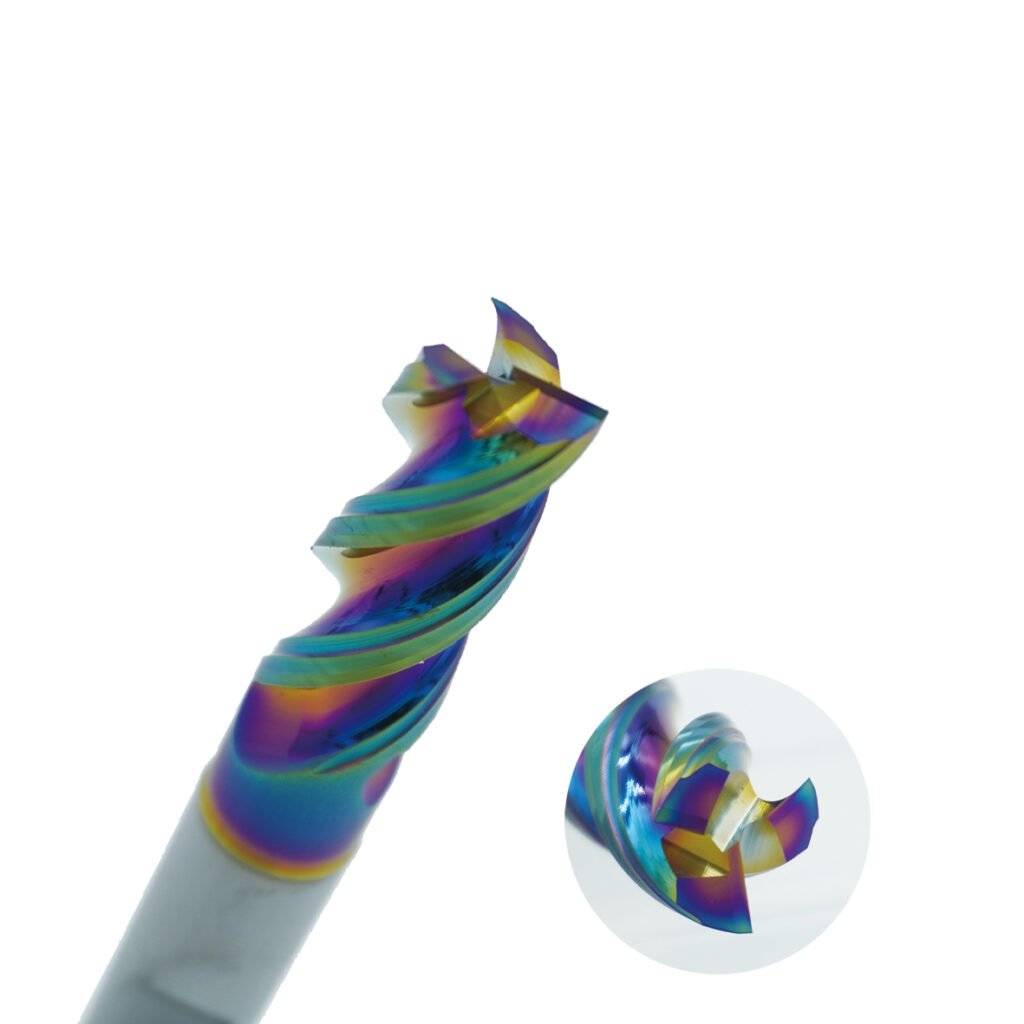
TiB₂/ZrN/DLC-like for aluminum and high-Si non-ferrous (anti-adhesion).
Edge hone adjusted by material group (smaller for M/S, larger for K).
Recommended cutting data
Below is the re-organized version of the provided speeds/feeds. Use it as a starting window; dial in based on your holder, machine stiffness, coolant strategy, and required finish.
Anti-vibration end mill: starting parameters (K30 substrate)
Tool Ø (mm) | Cutting speed vc (m/min) | Feed rate vf (mm/min) | Radial DOC ae (mm) | Axial DOC ap (mm) | Notes |
≤ 25 | 90–110 | 200–300 | 0.3–0.8 | 5–7.5 | 48° helix; front core 10.5 mm; dry or MQL preferred on stainless |
≥ 25 | 100–120 | 300–400 | 0.3–0.8 | 2.5–8 | Use robust holder (HMC or BT/HSK with dual-contact) |
Compared with “ordinary” end mills in the same material, customers typically see up to ~4× higher process throughput (feed and/or axial DOC), because the tool stays below resonance even as the chip load climbs.
To convert vc to rpm, use:
n [rpm]=1000 × vc [m/min]π×D [mm]n \;[\text{rpm}] = \frac{1000\,\times\,v_c\;[\text{m/min}]}{\pi \times D\;[\text{mm}]}n[rpm]=π×D[mm]1000×vc[m/min]
Then choose feed per tooth fzf_zfz from the material section below and compute:
vf [mm/min]=n×z×fzv_f \;[\text{mm/min}] = n \times z \times f_zvf[mm/min]=n×z×fz

How the design translates to the cut
Stainless steel & difficult-to-cut alloys (M)
Problem pattern: Work-hardening, adhesive wear, notch wear at the depth line, and chatter when walls get thin.
Why this tool helps: 13° rake reduces plowing, variable pitch breaks the tone, and PVD AlCrN holds hot hardness.
Starting fz: 0.03–0.06 mm/tooth on Ø10–20 mm (scale with rigidity).
Coolant: Flood or high-pressure through-spindle to kill notch wear; MQL for thinner walls to avoid thermal shock.
Edge prep: Keep hone modest to maintain sharpness; consider small corner chamfer for slotting.
Carbon and alloy steels (P)
Behavior: Predictable chips but chatter risks at long overhangs.
Tactic: Push ap; keep ae at 5–25% of D for trochoidal and high-efficiency toolpaths. Speeds toward the top end of Table 1 are realistic with the 48° helix.
Titanium (S: Ti-6Al-4V etc.)
Pain points: Low thermal conductivity, gummy chip, edge build-up.
Counter: High rake + polished rake face, sharp edge with micro-hone, and lower radial immersion to keep heat out of the tool. Use MQL or air/oil to avoid thermal shock.
fz: 0.02–0.05 mm/tooth on Ø10–16 mm as a safe start.
Nickel-base superalloys (S: Inconel, Hastelloy)
Pain points: Notch wear and rapid edge collapse if force peaks pile up.
Counter: Variable pitch spreads the peaks; stay conservative on vc, keep ae narrow, and use a tough, AlCrN-family PVD.
Feature summary at a glance
Geometry and manufacturing summary
Feature | Spec (typical) | Why it matters |
Tooth indexing | 93°/87°/93°/87° | Breaks force periodicity → anti-resonance, smoother finish |
Helix | 48° | A balanced helix for smooth cutting and chip lift |
Core thickness | 10.5 mm (front 20 mm FL), 14 mm thereafter | Chip space where chips form; stiffness where bending peaks |
Rake angle | 13° | Lower cutting force/heat, especially in gummy alloys |
Relief | 8° arc relief | Less rubbing, stronger edge land |
Edge prep | Controlled hone | Suppresses micro-chipping, improves Ra |
OD cylindricity | ≤ 0.002 mm | Concentric clamping, lower runout |
Runout (assembled) | ≤ 0.005 mm | Balanced chip load per flute |
Face/relief roughness | Ra ≈ 0.4 µm | Edge integrity and predictable coating adhesion |
Process tuning and troubleshooting
Symptom | Likely cause | First moves |
Chatter marks / “singing” | Hitting a structural mode | Reduce ae 20–40% and increase ap; move away from resonant rpm ±10%; use HSK/dual-contact; shorten overhang |
Edge micro-chipping | Runout or too small hone | Check TIR at tool tip (goal ≤ 0.005 mm); add a modest hone or 0.1–0.2 mm corner chamfer |
Built-up edge (Al, Ti) | Adhesion, heat | Switch to ZrN/TiB₂; add MQL; increase rake polish; reduce ae, increase feed slightly to keep chip thick and hot at the shear—cold at the tool |
Notch wear at DOC line | Thermal/mechanical shock | Raise coolant pressure or switch to MQL/air; vary DOC between passes; consider tougher coating variant |
Poor surface finish in stainless | Rubbing or insufficient pitch break | Increase feed per tooth 10–20%; verify unequal pitch tool is installed (not a uniform-pitch substitute); reduce runout |
Where the “4× efficiency” comes from
No roar → no forced slowdown. With unequal indexing and a stiffer rear core, you’re free to move into a stable, high-MRR pocket of the stability lobe instead of tip-toeing under it.
Lower force per tooth. The 13° rake and sharp, honed edge convert more energy into chip formation, less into heat.
Chip evacuation that keeps cutting edges clear. Large gulley in the first 20 mm of flute clears chips so the flutes aren’t recutting.
Consistency from manufacturing. Low runout means each flute shares the load, so no single flute becomes the “martyr” that fails early.
HNCarbide anti-vibration product family
We’ve folded the above geometry into our HNCarbide Anti-Vibe HE series. All tools are made from sub-micron carbide and finished to the accuracy levels noted earlier.
HNCarbide HE-V4-93/87 (4-flute, variable pitch)
Use on: Stainless (M), steels (P), difficult alloys (S) at moderate radial engagement.
Edge: Controlled hone; optional 0.1–0.2 mm corner chamfer.
Coatings: AlCrN (default), AlTiN, or ZrN (for non-ferrous).
Why it wins: Agnostic to light interruptions; finish quality improves without slowing down.
HNCarbide HE-V5-Finish (5-flute, variable pitch, long reach options)
Use on: Semi-finishing/finishing of stainless and alloy steels where wall support is marginal.
Geometry: 5 flutes for smoother force signature; same 48° helix family, variable core.
Result: Higher table feeds with the same finish requirement; excellent on 3D surfacing.
HNCarbide HE-Ti-Al (Ti/Al specialist)
Use on: Titanium parts (medical, aero) and high-Si aluminum where BUE is common.
Edge: Polished rake faces, sharper hone; TiB₂ or ZrN coat.
Customization: Special shanks (e.g., Weldon), neck-relief for deep reach, unusual flute lengths, or special pitches are available on request to match your spindle/part’s stability lobes.

Ready to try it?
Tell us your material, tool diameter, axial/radial DOC, holder type, and spindle rpm limit. We’ll map you to an HNCarbide anti-vibration SKU and edge prep that lands you in a stable, high-MRR pocket—typically with 2–4× the throughput of standard end mills in the same machine.
About HNCarbide
HNCarbide specializes in precision carbide cutting tools for the German and broader EU market, including anti-vibration end mills, single-flute aluminum routers, drills, and wear parts. Our blog focuses on practical, application-first content backed by real drawings and inspection data.