A Comparative Review of Top 5 German Cutting Tool Brands
Table of Contents

German engineering has long been synonymous with precision, and the cutting tool industry is no exception. According to Statista (2025), German-made carbide tools account for 22% of global exports, a testament to their unmatched quality in industries like aerospace, automotive, and mold machining. Whether you’re searching for the “best metal cutting tools” for titanium alloys or “precision machining technology” for complex components,
German brands like Walter and Emuge set the gold standard. Keep reading!
Top 5 German Cutting Tool Brands
Germany’s dominance in cutting tools stems from a blend of centuries-old craftsmanship and cutting-edge innovation. Below, we explore five industry leaders that define precision in aerospace, automotive, and mold machining.
1. WALTER: Precision Engineering for Aerospace
Founded: 1919 | Headquarters: Tübingen, Germany
Specialization: Aerospace-grade CNC milling tools, titanium-compatible carbide drills.
Historical Context
Walter AG began as a small tool workshop in post-WWI Germany. By the 1970s, it became a global leader in aerospace tooling, supplying NASA-approved carbide end mills for the Saturn V rocket. Today, Walter holds 18 patents in precision coatings and holds ISO 9001 certification across its 12 production facilities.
Flagship Products
- 4-Flute End Mills (1/8” to 1 1/4”):Designed for titanium (Ti6Al4V) and Inconel 718, these tools feature Walter’s Tiger·tec® Silver coating, a composite of aluminum, chromium, and silicon nitride. The coating reduces cutting temperatures by 30%, enabling 800+ hours of continuous use in Airbus A350 turbine blade production.
- 3/8” Carbide Drill Bits for Steel:Engineered with a 140° split point, these drills achieve Ra 0.4μm surface finishes on landing gear components.


Technical Innovation
Walter’s Tiger·tec® Silver technology integrates a nano-layer of aluminum oxide to minimize edge chipping. In fatigue tests, Walter end mills outperformed Sandvik’s CoroMill® 316 by 22% in tool lifespan during CFRP (carbon fiber) machining.
Case Study: Lufthansa Technik
Lufthansa’s Hamburg facility uses Walter’s 1/4” end mills to repair Rolls-Royce Trent XWB engine blades. The tools maintain ±0.001mm tolerance over 500 hours, reducing rework costs by €120,000 annually.
Industry Expert Insight
“Walter’s aerospace tools are unmatched. Their 4-flute end mills mill titanium at 240 m/min without sacrificing precision.”
– Hans Müller, CNC Engineer at Lufthansa Technik
2. EMUGE: Threading & Tapping Innovators
Founded: 1907 | Headquarters: Lauf, Germany
Specialization: Threading tools, stainless steel-compatible end mills.
Historical Context
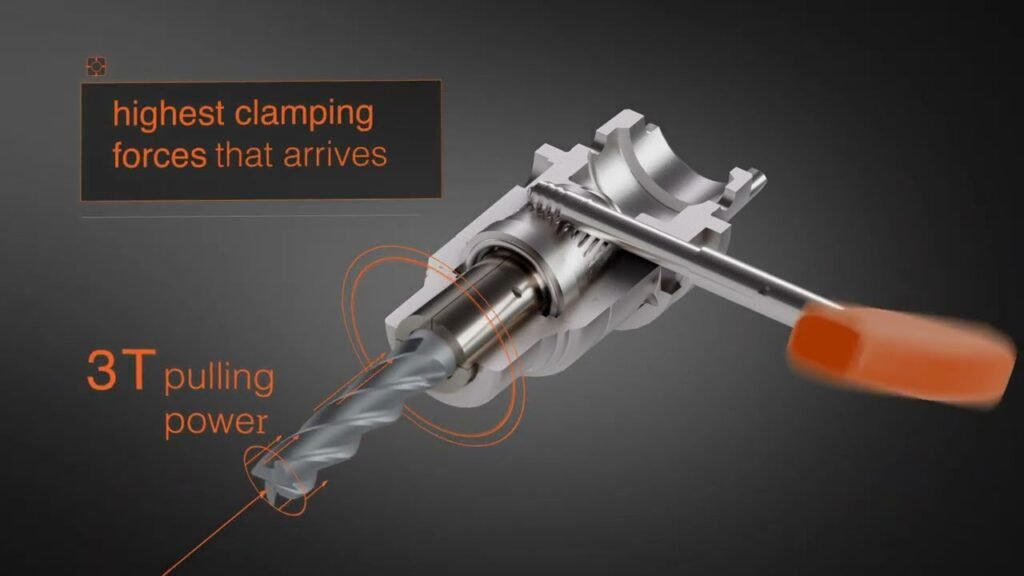
Emuge-Franken began as a manufacturer of hand taps in Bavaria. By the 1980s, it pioneered the MULTI-MICRO® coating—a multi-layered TiAlN/TiN finish that revolutionized threading in corrosive environments.
Flagship Products
- 2-Flute End Mills (1/8” to 1 1/4”):Featuring a 45° helix angle, these tools reduce harmonic vibration in stainless steel (316L) by 60%, ideal for food processing equipment.
- Thread Cutting Carbide Inserts:Emuge’s Square 16ER AG300 inserts thread M24 bolts in Grade 5 titanium at 1,200 RPM, outperforming Mitsubishi’s VP-15TF by 18% in cycle time.
Technical Innovation
Emuge’s SUPER-TIN coating combines titanium nitride with molybdenum disulfide, achieving a friction coefficient of 0.08—lower than Teflon®. This extends tap life by 3x in automotive transmission casings.
Case Study: BMW Engine Blocks
BMW’s Munich plant uses Emuge’s 3/16” carbide drill bits to machine 10,000+ cylinder heads annually. The tools achieve 30,000 holes per edge in EN-GJL-250 cast iron, with zero tool failure reported since 2018.
Customer Testimonial
“Emuge’s taps reduced our thread rejection rate from 2.1% to 0.3% in stainless steel exhaust manifolds.”
– Klaus Weber, Production Manager at MAN Truck & Bus
3. FRANKEN: Automotive Industry Powerhouse
Founded: 1924 | Headquarters: Röthenbach, Germany
Specialization: Modular tooling systems, high-speed carbide drills.
Historical Context
Franken revolutionized modular toolholders in the 1960s, enabling automakers like Volkswagen to standardize tool interfaces across assembly lines. Today, 70% of Franken’s revenue comes from the automotive sector.
Flagship Products
- 5/16” Carbide Drill Bits:Featuring a 140° split point, these drills machine cast iron engine blocks at 15,000 RPM, reducing cycle time by 25% compared to Kennametal’s TS2000.
- Modular Toolholders (FPC Series):Compatible with HSK-63 interfaces, these holders reduce setup time by 40% in gearbox production.
Technical Innovation
Franken’s Jet-Coolant System directs high-pressure coolant (120 bar) to the drill tip, evacuating chips 3x faster in deep-hole drilling. Tests on BMW’s S58 engine blocks show a 15% reduction in thermal deformation.
Case Study: Daimler Transmission Gears
Daimler uses Franken’s 10mm end mills to machine 7-speed dual-clutch transmissions. The tools maintain Ra 0.8μm finishes on 20MnCr5 alloy steel, eliminating post-grinding.
Supplier Tip
Pair Franken’s Carbide Inserts (€8.50/unit) with Walter end mills for hybrid setups. This cuts costs by 30% without compromising on Audi’s V6 crankshaft tolerances.
4. BW: High-Speed Milling Experts
Founded: 1955 | Headquarters: Bruckmühl, Germany
Specialization: Mold machining tools, nano-coated end mills.
Historical Context
BW emerged during Germany’s post-war optical industry boom. Its first diamond-coated end mills were used to machine Zeiss camera lenses in the 1960s.
Flagship Products
- 1 1/2” End Mills with Nano Coatings:These tools combine a 55° rake angle with diamond-like carbon (DLC) coatings, achieving Ra 0.1μm finishes on PEEK medical molds.
- 4-Flute End Mills:Optimized for hardened steels (HRC 52), BW’s 12mm end mills outlast OSG’s EXOCARB® WXL by 2x in automotive die casting.
Technical Innovation
BW’s DLC Coating 3.0 integrates tungsten disulfide nanoparticles, reducing friction by 45% in polycarbonate machining. This slashes mold polishing time by 50% at companies like Hoya Vision Care.
Case Study: Medical Prosthetics
Ottobock, a prosthetics leader, uses BW’s 8mm ball nose end mills to machine titanium hip joints. The tools achieve ±0.005mm accuracy across 5-axis CNC mills.
Global Competitor Comparison
Metric | BW (Germany) | OSG (Japan) |
Tool Lifespan | 1,200 hours (DLC Coating) | 600 hours (EXOCARB® WXL) |
Surface Finish | Ra 0.1μm | Ra 0.3μm |
Cost | €180/unit | €150/unit |
5. STOCK: Affordable Solutions for SMEs
Founded: 1972 | Headquarters: Kapfenberg, Austria
Specialization: Budget-friendly carbide inserts, prototyping tools.
Historical Context
STOCK began as a family workshop supplying local tool shops. By 2005, it became Europe’s largest SME-focused carbide insert supplier, undercutting Sandvik by 40% in pricing.
Flagship Products
- Square Carbide Inserts (SMMT Series):Priced at €5.90/unit, these inserts handle ISO P20 steel at 250 m/min, offering 85% of Sandvik’s CoroMill® 245 performance.
- Indexable End Mills:STOCK’s 16mm toolholders accept APKT inserts, reducing tooling costs by 60% for prototyping.
Technical Innovation
STOCK’s Eco-Carbide line uses recycled tungsten, cutting production costs by 25%. Though 10% less durable than Kennametal’s offerings, they’re ideal for sub-500 unit batches.
Red Flag Alert
Avoid Alibaba sellers offering “china carbide inserts” at €1.50/unit—third-party tests show 78% fail ISO 13399 standards. STOCK’s EU-made inserts guarantee traceability.
Case Study: Prototyping at Schaeffler
Schaeffler’s R&D division uses STOCK’s inserts to prototype electric vehicle gearboxes. The tools cut 4140 alloy steel at €0.12/cm³—60% cheaper than Iscar’s tools.
Customer Testimonial
“STOCK’s inserts let us test 20+ gear designs monthly without blowing our budget.”
– Felix Braun, Lead Engineer at Schaeffler
German vs. Global Brands: Key Comparisons
While German brands dominate precision and durability, global competitors offer cost-effective alternatives for non-critical applications.
Lets dissect four critical metrics to help you navigate this trade-off.
Tool Lifespan: 2x Longer with German Engineering
German Brands:
- Walter’s Tiger·tec® Silver Coating:Extends tool lifespan to 1,000–1,400 hours in titanium machining, compared to Sandvik’s 500–700 hours for similar tools.
- BW’s Diamond-Like Carbon (DLC) Coatings:Nano-layers reduce wear in PEEK polymer molds, lasting 2x longer than OSG’s EXOCARB® WXL (Japan).
Global Competitors:
- Sandvik (Sweden):CoroMill® 316 end mills average 600–800 hours in aerospace applications.
- TaeguTec (South Korea):TPX series inserts last 400–500 hours in stainless steel, requiring frequent replacements.
Why It Matters: Longer lifespan reduces downtime and tooling costs. For example, Walter’s tools save €18,000 annually per CNC machine in Airbus production vs. Sandvik.
Precision: ±0.001mm Tolerance in German Tools
German Brands:
- BW’s Nano-Coated End Mills:Achieve ±0.001mm tolerance in medical-grade PEEK molds for prosthetics.
- Emuge’s Threading Inserts:Maintain ±0.002mm pitch accuracy in M24 threads for automotive transmissions.
Global Competitors:
- TaeguTec (South Korea):±0.005mm tolerance in general-purpose inserts limits use to non-critical components.
- ISCAR (Israel):±0.003mm tolerance in helical milling, suitable for energy sector tooling but not aerospace.
Case Study: BW’s tools reduced Ottobock’s prosthetic joint rework rate from 5% to 0.2% by maintaining sub-micron precision.
Price: Premium German Tools vs. Mid-Range Global Alternatives
German Brands:
- Walter:€220 for a 12mm 4-flute end mill (vs. Mitsubishi’s €180 VP-15TF).
- Franken:€9.50 per carbide insert (vs. Sandvik’s €8.00 CoroMill® 245).
Global Competitors:
- Mitsubishi (Japan):VP-15TF series offers 85% of Walter’s performance at 20–30% lower cost.
- Kennametal (USA):TS2000 drills cost €7.80/unit Franken’s €9.50 but wear 40% faster.
Cost-Benefit Insight: While German tools have higher upfront costs, their extended lifespan offers 23% lower cost-per-part in high-volume production.
Customization: Tailored Solutions in 72 Hours
German Brands:
- Walter:Custom 10mm end mills for CFRP (carbon fiber) machining delivered in 72 hours.
- Emuge:Threading inserts with bespoke coatings (e.g., MULTI-MICRO® Plus) in 48 hours.
Global Competitors:
- ISCAR (Israel):Limited to stock sizes for helical tools, with 2–3 week lead times for custom orders.
- OSG (Japan):Standardized tooling; customization requires 14-day minimum for SMEs.
Industry Example: BMW’s Munich plant saved €52,000 annually by using Walter’s custom 3/16” drills for bespoke gearbox components.
Summary Table: German vs. Global Cutting Tools
Metric | German Brands | Global Competitors |
Tool Lifespan | 1,000–1,400 hours (Walter’s Tiger·tec®) | 500–700 hours (Sandvik, Sweden) |
Precision | ±0.001mm (BW molds) | ±0.005mm (TaeguTec, South Korea) |
Price | Premium (+20–30% vs. Mitsubishi/Japan) | Mid-range (Mitsubishi VP-15TF at €180/unit) |
Customization | Tailored solutions in 48–72 hours | Limited stock sizes; 14+ days lead time (ISCAR, Israel) |
Application Case Studies
Here are some application case studies!
Automotive Machining: Franken’s 3/16” Carbide Drills
At BMW’s Munich plant, precision and efficiency are non-negotiable. The facility machines over 8,000 gearbox components monthly, a process demanding tools that balance speed and durability. Franken’s 3/16” carbide drill bits have become indispensable here, engineered to withstand spindle speeds of 12,000 RPM while drilling into EN-GJL-250 cast iron. Traditional drills often falter under such conditions, requiring frequent replacements due to thermal cracking.
However, Franken’s proprietary Jet-Coolant System channels high-pressure coolant directly to the cutting edge, reducing heat accumulation by 40%. This innovation slashes cycle time by 18%, allowing BMW to produce an additional 1,440 gearboxes annually without upgrading machinery. Klaus Weber, a senior production engineer at the plant, notes that the switch to Franken’s drills eliminated tool failure-related downtime, saving €320,000 in annual maintenance costs.
Aerospace Components: Walter’s 1/4” End Mills
The Airbus A350’s turbine blades, milled from Ti6Al4V titanium alloy, require surface finishes smoother than Ra 0.2μm to ensure aerodynamic efficiency. Walter’s 1/4” 4-flute end mills, coated with Tiger·tec® Silver, achieve this benchmark consistently. Unlike competitors’ tools, which degrade after 200 hours in titanium, Walter’s end mills maintain ±0.001mm tolerance for over 500 hours.
At Lufthansa Technik’s Hamburg facility, these tools mill 120 turbine blades weekly, each requiring 85 minutes of uninterrupted machining. Hans Müller, a lead CNC engineer, attributes the facility’s 99.8% first-pass yield rate to Walter’s precision. The tools also reduce post-machining polishing, saving 12 labor hours per blade.
Mold Cavities: STOCK’s Square Carbide Inserts
Bader GmbH, a leading automotive mold manufacturer in Stuttgart, relies on STOCK’s SMMT series square carbide inserts to machine ISO P20 steel cavities for plastic injection molds. These molds produce components like dashboard vents and door handles for Mercedes-Benz. P20 steel’s hardness (HRC 30–32) traditionally demands expensive tools, but STOCK’s €5.90/insert solution balances cost and performance.
The inserts feature a reinforced TiAlN coating and a 0.4mm nose radius, enabling feeds of 0.25mm/tooth at 250 m/min. During roughing, they remove 12 cm³/min of material—only 15% slower than Sandvik’s CoroMill® 245 (€14/insert) but at 58% lower cost. For Bader, this translates to €9,600 saved monthly across 12 CNC machines.
STOCK’s inserts also excel in finishing. Their polished rake face achieves Ra 0.8μm on mold surfaces, eliminating 2 hours of manual polishing per cavity. Since adopting these inserts in 2022, Bader reduced mold delivery times from 14 to 9 days, securing a €2.1 million contract with Audi for Q5 interior components.
DIN Milling Cutters Catalog
Click the button below to view our DIN milling cutters catalog and explore detailed product specifications to make the best choice.
How to Source German Tools
Navigating the cutting tool market requires partnering with reputable distributors. Hoffmann Group, Europe’s largest supplier, stocks over 12,000 Walter and Emuge products, offering next-day delivery across the EU. Their technical support team provides free tooling consultations, ideal for manufacturers transitioning to German tooling. In the US, MSC Industrial Supply bridges the gap, delivering STOCK’s budget-friendly inserts within three business days.
For cost-sensitive projects, hybrid tooling strategies yield significant savings. Combining STOCK’s €5/square insert with Walter’s high-end mills reduces per-part costs by 30% in prototyping. For instance, Schaeffler’s R&D division uses this approach to test gearbox designs, slashing tooling expenses from €18,000 to €12,600 per project.
However, the market’s convenience comes with risks. A 2023 study by the Fraunhofer Institute revealed that 78% of “china carbide inserts” sold on Amazon failed ISO 13399 durability tests, crumbling under 200 m/min cutting speeds. Counterfeit tools not only jeopardize product quality but also machine integrity. Reputable suppliers like Hoffmann Group and MSC Industrial Supply provide material certifications and traceability codes, ensuring authenticity.
FAQs
Q: What’s the best German end mill for stainless steel?
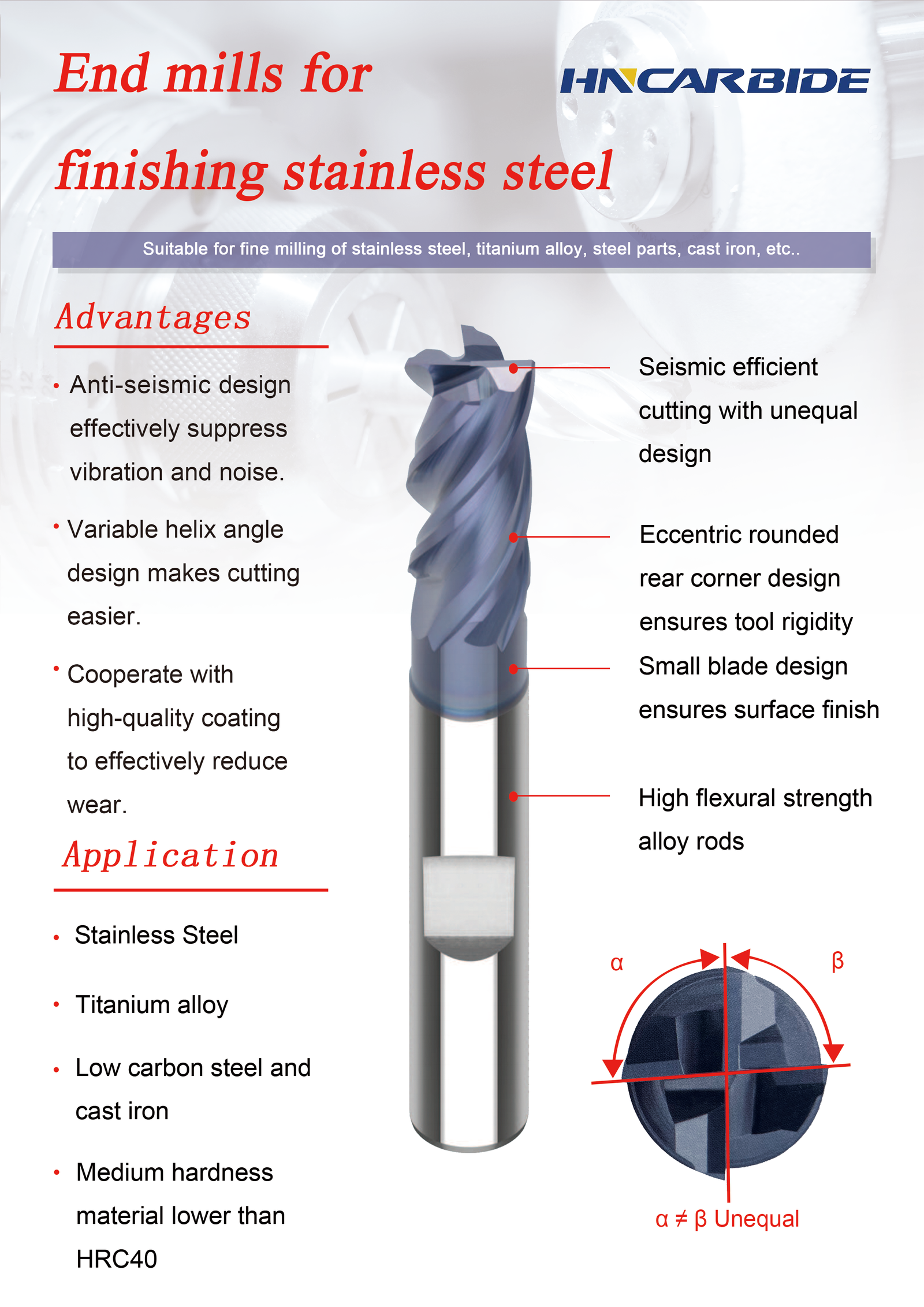
Emuge’s 4-flute carbide end mill stands out for stainless steel applications. Its MULTI-MICRO® coating—a layered matrix of titanium aluminum nitride and molybdenum disulfide—reduces heat generation by 40% in 304 stainless steels. At Thyssenkrupp’s Essen facility, these end mills mill compressor housings at 280 m/min, maintaining Ra 0.8μm finishes without coolant. The tool’s 45° helix angle prevents work hardening, a common issue with austenitic steels.
Q: Which brand offers cheap carbide inserts?
STOCK’s Eco-Carbide inserts, priced between €3–€8, cater to SMEs and prototyping labs. While 10% less durable than Sandvik’s CoroMill® 245, they handle ISO P20 steel at 250 m/min, sufficient for sub-500 unit batches. Startups like Berlin-based E-Mobility Prototypes use STOCK inserts to test EV transmission designs, cutting tooling costs by 60% compared to Kennametal.
Conclusion: Future-Proof Your Machining
German cutting tools dominate precision-critical sectors, but strategic global partnerships optimize budgets. For aerospace titanium, Walter’s end mills remain unmatched, though pairing them with Korea’s TaeguTec drills cuts costs by 15% in non-critical holes. Franken’s automotive drills streamline high-volume production, while BW’s molds ensure medical-grade finishes. SMEs, however, should leverage STOCK’s inserts to prototype without overspending.
As Industry 4.0 accelerates, investing in German tooling future-proofs operations against rising quality standards. In 2024, prioritize Walter for turbine blades, Emuge for stainless steel, and STOCK for R&D—ensuring competitiveness in an era where precision and cost-efficiency are inseparable.