Stop Chasing the Cheapest Carbide End Mill: How Price, Scrap Value & TCO Really Work
Table of Contents
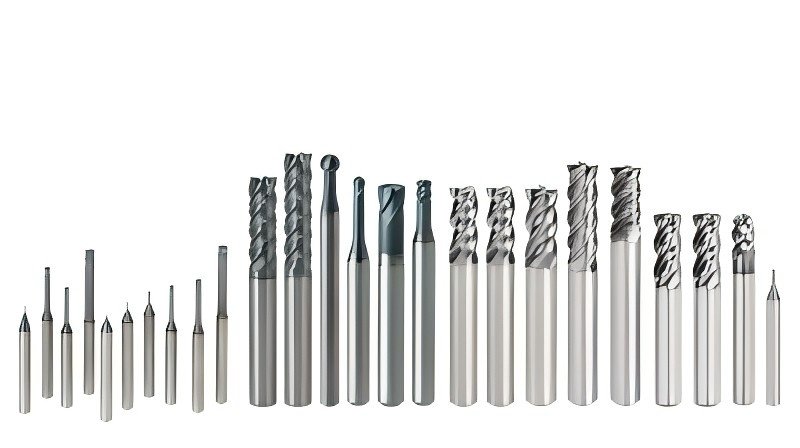
When buyers compare carbide end mills, the first question is usually:
“How much is it per piece?”
That’s understandable—but dangerously incomplete. The carbide end mill price on the invoice is only a small slice of your real machining cost. Tool life, machine time, scrap rate, and even carbide end mill scrap price all change your true cost per finished part.
In this article, we’ll walk through:
- What actually drives the purchase price of a solid carbide end mill
- How scrap value improves your effective tool cost
- A clear, numeric total cost of ownership (TCO)comparison between a cheap tool and a high-performance one
- How to use speeds & feeds, trials, and scrap programs to pick the right tools and suppliers
We’ll use common tools like a 1/2 4 flute carbide end mill for general steel and an HRC70 carbide end mill for hardened steel as examples, because these are widely used and easy to benchmark.
What Really Drives Carbide End Mill Price?
Two tools that look similar in a catalog can be very different in cost. The purchase price of a carbide end mill cutter is mainly driven by:
Carbide grade & micro-grain quality
Higher quality micro-grain tungsten carbide end mill grades and tighter quality control cost more to produce, but they usually deliver:
- Longer tool life
- Better edge integrity
- Higher possible carbide end mill cutting speed
Geometry, diameter & flute length
A standard 1/2 inch carbide end mill with regular flute length uses less material and grinding time than:
- An extra-long 2 inch carbide end mill
- A deeply relieved high-helix profile
- A complex necked or reduced-shank design (e.g. 5/16 carbide end mill 1/4 shank)
More grinding and inspection time = higher price.
Flute count and complexity
Manufacturing a simple 2 flute carbide end mill is much easier than making a:
- 5 flute carbide end millor 6 flute carbide end mill
- Variable-helix design
- Corner-radius or bull-nose geometry
These advanced tools often justify their higher price through better stability and tool life.
Coating system
Coatings move the tool from “basic” to “high-performance”:
- Entry-level: classic TiN
- Higher tier: AlTiN, TiAlN, and other advanced multilayer coatings
For hardened steel, an HRC70 carbide end mill with a premium coating dramatically improves wear resistance and allows more aggressive solid carbide end mill speeds and feeds.
Standard vs. custom
A stocked 3/8 4 flute carbide end mill or 10mm carbide end mill in catalog dimensions is more economical than a one-off design, such as:
- Non-standard diameter (e.g. 17/32 carbide end mill)
- Custom corner radius
- Special neck relief or shank options
Brand, origin & volume
Premium solid carbide end mill manufacturers invest in:
- High-end grinding machines
- Process control and inspection
- Application support and R&D
Their tools often cost more per piece, but less per finished part. Volume purchasing from a reliable carbide end mill supplier also reduces unit cost.
Carbide End Mill Scrap Price – Your Hidden Rebate
Unlike HSS, worn-out carbide tools remain valuable. Scrap dealers and recycling programs buy used tungsten carbide end mill cutter bodies, inserts, drills and wear parts by weight.
Typical factors that affect carbide end mill scrap price:
- Global tungsten market levels
- Purity and cleanliness of the scrap (coated vs. uncoated, contamination)
- Whether the scrap is sorted (end mills, inserts, drills separated) or mixed
This scrap value doesn’t “pay for” your tools, but it reduces your net tooling spend, especially if you use high volumes of:
- 1/2″ and 3/4 solid carbide end milltools
- Small 1/8 carbide end millor 1/16 carbide end millcutters for PCB or engraving
- Short, heavy roughers and indexable bodies
How Scrap Affects Net Tool Cost (Conceptually)
Assume:
- Each worn 1/2 carbide end millhas a certain weight
- You receive a scrap credit based on scrap price per unit weight
Then:
Net tool cost = purchase price − scrap credit
You don’t see this when you only compare catalog prices, but over hundreds or thousands of tools, the difference becomes significant.
Total Cost of Ownership (TCO): The Real Number That Matters
To judge a carbide end mill set or a particular series, you should look at total cost of ownership, not just price per piece. TCO includes:
- Purchase price (minus scrap value)
- Carbide end mill tool life(parts or machining hours per tool)
- Cycle time (influenced by carbide end mill speeds and feeds)
- Scrap and rework due to tool failure or poor finish
- Machine downtime for tool changes
- Labor for setup, troubleshooting and programming
A simple way to think about TCO is:
Cost per good part = (Net tool cost / parts per tool) + machine cost + scrap penalty + overhead
Even if you don’t calculate every detail precisely, comparing tools on cost per part rather than cost per tool changes many decisions.
Case Study: Two 1/2″ Solid Carbide End Mills Compared
We’ll compare:
- Tool A:Budget 1/2 4 flute carbide end mill(general-purpose)
- Tool B:Premium 1/2 4 flute solid carbide end milldesigned for alloy steels, with advanced coating
Cutting data and productivity
Typical starting data for alloy steel (simplified example):
Parameter | Tool A – Budget GP 1/2″ 4F | Tool B – Premium 1/2″ 4F |
Recommended SFM | Lower | Higher |
RPM (for same diameter) | Lower | Higher |
Feed per tooth (fz) | Smaller | Larger |
Feed rate (for same number of flutes) | Slower | Faster |
Approx. cycle time per part | Longer | Shorter |
Tool B allows higher carbide end mill rpm and feed rate, reducing cycle time per part.
Tool life and scrap rate
From typical shop experience:
- Tool A may last a relatively small number of parts before wear, chipping or chatter becomes unacceptable.
- Tool B may last several times more parts with stable wear, thanks to better geometry and coating.
- Tool A might produce more scrap and rework due to inconsistent surface finish or sudden failures.
- Tool B usually offers smoother finish and more predictable wear, reducing scrap.
Relative Cost Index per Good Part
To avoid actual currency values, we can use an index where higher numbers mean higher cost per part.
Item | Tool A – Budget | Tool B – Premium |
Net tool cost per part (index) | 1.00 (baseline) | 0.50–0.60 |
Machine time cost per part (index) | 1.00 (baseline) | 0.85–0.90 |
Scrap penalty per part (index) | 1.00 (baseline) | 0.20–0.40 |
Total cost per good part (index) | 1.00 | ≈ 0.60–0.70 |
Even though the premium solid carbide end mill cutter costs more to buy, it can reduce total cost per good part by a large percentage once you account for:
- Longer tool life
- Faster cycle time
- Lower scrap rate
This is the essence of TCO thinking.
Lorem ipsum dolor sit amet, consectetur adipiscing elit. Ut elit tellus, luctus nec ullamcorper mattis, pulvinar dapibus leo.
Choosing the Right Tool for Your Application
Different jobs need different tools. Here’s how price, application and geometry connect.
General steel and stainless steel
For mild steel and common stainless steels:
- A quality 4 flute solid carbide end mill(e.g. 3/8 carbide end mill, 10mm carbide end mill) with a modern coating is often the best balance.
- Use the manufacturer’s carbide end mill speed and feed chartas a starting point.
- Fine-tune based on rigidity, tool overhang, coolant and actual wear patterns.
For stainless and tougher alloys, consider:
- 5 flute carbide end millor 6 flute carbide end mill
- High-helix angle and optimized chip thinning
- Dedicated carbide end mill for stainless steelseries
Aluminum and non-ferrous
For aluminum, copper alloys and brass:
- Use a carbide end mill for aluminumwith polished flutes and 2–3 flutes.
- Smaller sizes like a 1/4 inch carbide end millor 1/8 inch carbide end millbenefit from sharp edges and large flute spaces to avoid built-up edge.
- A carbide end mill single fluteor 1/8 single flute carbide end millworks very well on lower-power spindle machines and routers, where chip evacuation is critical.
Hardened steels (50–70 HRC)
For die steels and hardened tool steels:
- Choose a dedicated carbide end mill for hardened steel, typically labeled HRC60 or HRC70 carbide end mill.
- These tools often have 4–6 flutes, corner radii and very wear-resistant coatings.
- Start from the manufacturer’s solid carbide end mill feeds and speedsrecommendations for hardened materials and adjust based on your setup.
Conclusion: Think Like an Investor, Not a Shopper
When you buy carbide tooling, you’re not just buying a carbide end mill cutter tools; you’re investing in spindle time, quality and throughput.
- Purchase priceis only the starting point.
- Scrap valueof worn tools is a real rebate on your tooling budget.
- Total cost of ownership (TCO)and cost per good part are what really decide whether your shop makes or loses money on a job.
If you start evaluating your carbide end mill price this way—factoring in tool life, speeds and feeds, scrap, and recycling—your “expensive” tools will often turn out to be the most economical decision you can make.