Skip to content
Why Do Some Carbide Rod Blanks Produce Stable, Long-Lasting Cutting Tools—While Others Lead to Runout and Early Chipping?
Table of Contents
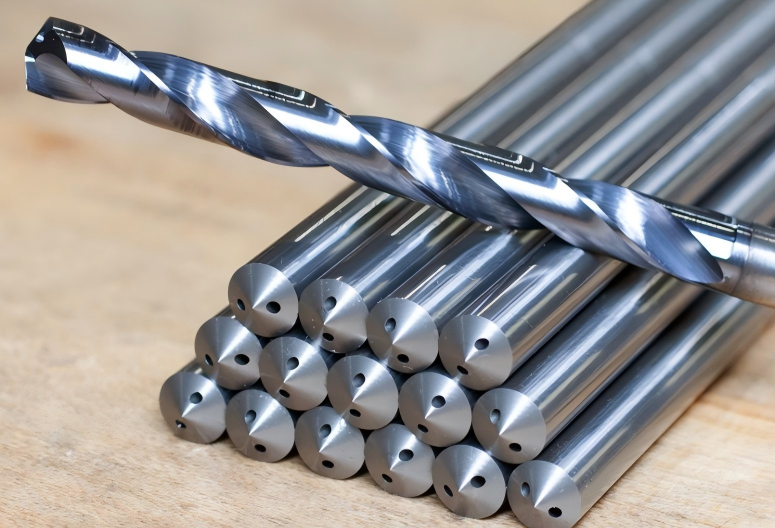
In solid carbide cutting tools, performance differences often begin long before grinding or coating. Two carbide rods with similar nominal hardness can behave very differently once transformed into end mills or drills. One may grind concentrically, cut smoothly, and deliver consistent tool life, while another causes unexplained runout, vibration, or premature edge failure.
These differences are rarely accidental. They are usually rooted in tungsten carbide rod composition, microstructure, and manufacturing control.
This article explains how cemented tungsten carbide rod blanks (WC–Co) are manufactured, which material properties truly matter, how cobalt content and grain size affect cutting performance, and why rod quality can influence tool runout. It also examines solid rods, coolant-hole rods, and common rod series used for modern cutting tools, providing a practical, verifiable technical reference.
What Is a Tungsten Carbide Rod in Cutting Tool Applications?
In cutting tools, a tungsten carbide rod is a cemented carbide composite consisting of hard tungsten carbide (WC) grains bonded by a cobalt (Co) binder phase. The rod is produced by powder metallurgy and serves as the blank for solid carbide tools such as end mills, drills, reamers, and special tools.
Because cobalt is ferromagnetic, magnetic measurements can be used to indirectly evaluate internal structure and composition. For this reason, coercivity and magnetic saturation are widely applied in carbide quality control as practical indicators of grain size, binder condition, and carbon balance.
How Are Tungsten Carbide Rod Blanks Manufactured?
Carbide rod production follows a powder metallurgy route. Each process step directly affects the final rod’s density, microstructure, and dimensional stability.
Typical Manufacturing Flow
Process stage | Purpose | Potential issues | Downstream impact |
Raw material selection (WC, Co, additives) | Defines chemistry and target properties | Impurities, incorrect WC distribution | Hardness, toughness, wear resistance |
Mixing and ball milling | Homogeneous dispersion of WC and Co | Agglomeration, contamination | Co pools, grain anomalies |
Forming (pressing / extrusion / injection) | Creates green rod geometry | Density gradients, distortion | Straightness, runout sensitivity |
Debinding | Removes organic binders | Cracks, delamination | Structural defects |
Sintering (vacuum or controlled atmosphere) | Full densification and bonding | Residual porosity, eta-phase, grain growth | Tool life, reliability |
Grinding and finishing | Controls OD, straightness, surface | Size scatter, microcracks | Grinding stability, concentricity |
Carbon control during sintering is especially critical. If carbon is excessive, free graphite may form; if insufficient, η-phase (eta-phase) can appear. Both are well-documented defect modes in cemented carbides and are detectable through metallographic inspection.
Which Carbide Rod Types Are Commonly Used for Cutting Tools?
For tool manufacturing, carbide rods are typically supplied as:
- Solid carbide rod blanks (no hole)
- Carbide rods with internal coolant holes
- Ground rods(tight OD tolerance and straightness)
- Unground rods(for further machining or custom processing)
- Customized chamfered rods(improves handling and clamping stability)
As tool diameters decrease and spindle speeds increase, rod straightness and OD consistency become increasingly important, since small deviations can translate into significant edge runout after grinding.
How Do Grain Size and Cobalt Content Affect Cutting Performance?
The mechanical behavior of WC–Co carbide rods is governed by the balance between WC grain size and cobalt content.
- Finer grains + lower cobalt→ higher hardness and wear resistance
- Coarser grains + higher cobalt→ greater toughness and impact resistance
This trade-off explains why hardness alone is not sufficient for grade selection.
Typical WC–Co Rod Series for Cutting Tools
Rod series | WC grain size (typical) | Co content (typical) | Key characteristics | Typical applications |
Submicron / ultrafine | ~0.2–0.8 μm | 6–10% | Very high hardness, excellent edge retention | Aluminum finishing, hardened steel finishing, micro end mills |
Fine grain | ~0.8–1.2 μm | 8–12% | Balanced wear resistance and toughness | General-purpose end mills |
Medium grain / tough grades | ~1.2–2.5 μm | 10–15% | Higher impact resistance, reduced chipping | Roughing, interrupted cuts |
Increasing cobalt content generally lowers hardness and wear resistance while increasing bending strength and fatigue resistance. Therefore, carbide rod grades must be selected according to tool geometry, cutting conditions, and workpiece material.

Which Quality Indicators Truly Matter in Carbide Rods?
Several measurable properties provide insight into rod quality beyond hardness.
Coercivity (Hc)
Coercivity is widely used as an indirect indicator of WC grain size and sintering condition. For a given cobalt content and carbon balance, higher coercivity generally corresponds to finer WC grains.
Magnetic Saturation (Cobalt Magnetism)
Magnetic saturation reflects changes in the cobalt binder’s chemical state and is commonly used to monitor carbon balance and binder composition during production.
Density
Density indicates whether full densification has been achieved and helps detect residual porosity or compositional errors.
Microstructure
Metallographic examination reveals:
- Porosity
- Free graphite
- Eta-phase
- Abnormal grain growth
- Cobalt pooling
Standards such as ISO 4499-4 define accepted methods for evaluating these features in cemented carbides.
Quality Signal Interpretation
Indicator | What it suggests | Practical significance |
High coercivity | Fine WC grain size | Improved edge retention |
Low coercivity | Coarser structure or altered binder | Higher toughness, lower wear resistance |
Off-target magnetic saturation | Carbon imbalance | Risk of eta-phase or graphite |
Low density | Residual porosity | Reduced strength, unstable grinding |
Microstructural defects | Process instability | Chipping, inconsistent tool life |
Which Microstructural Defects Are Unacceptable?
Not all defects have equal impact, but certain conditions pose serious risks in cutting tools:
- Large or clustered poresact as crack initiation sites
- Eta-phaseincreases brittleness and chipping risk
- Free graphiteindicates carbon imbalance and property inconsistency
- Severe cobalt poolingleads to localized weakness
Such defects compromise reliability, particularly in high-speed or high-precision tools.
How Can Carbide Rod Quality Influence Tool Runout?
Tool runout is often attributed to holders or spindles, but carbide rod quality can contribute indirectly through:
- Rod straightness deviation after sintering
- Density gradients causing distortion during grinding
- OD roundness or cylindricity variation
- Internal defects influencing material removal during grinding
- Asymmetry in coolant-hole rods
These factors affect how concentrically a tool can be ground, even when high-quality holders are used.
Special Considerations for Coolant-Hole Rods
For carbide rods with internal coolant holes, additional parameters are critical:
- Hole concentricity relative to OD
- Hole diameter consistency
- Uniform wall thickness
- Defect-free microstructure around the hole
Uneven wall thickness or off-center holes can significantly increase fracture risk and amplify runout.
How Are Carbide Rod Grades Matched to Tool Types?
Tool type | Preferred rod characteristics | Performance focus |
Micro and high-speed finishing end mills | Submicron or fine grain, stable magnetic values | Edge stability, wear resistance |
General-purpose end mills | Fine grain balanced grades | Versatility |
Roughing or interrupted-cut tools | Tougher grades with higher Co | Impact resistance |
Internal-coolant drills/end mills | Coolant-hole rods with high concentricity | Structural reliability |
Reamers and precision tools | Ground rods with tight tolerances | Size accuracy, surface finish |
Why Are Carbide Rod Prices Increasing?
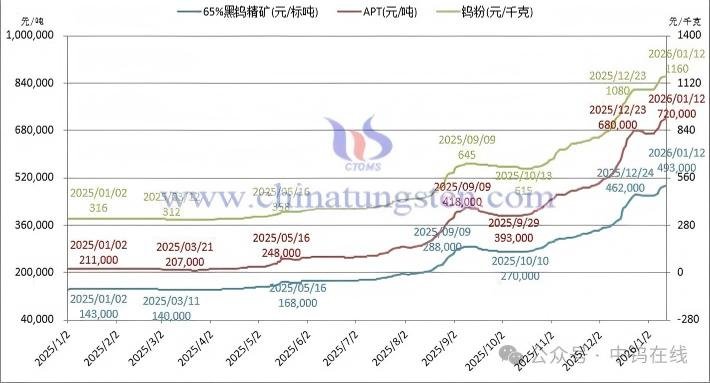
The cost of cemented carbide rods is strongly influenced by upstream raw materials, particularly tungsten and cobalt.
Recent market data shows:
- Ammonium paratungstate (APT)prices have experienced significant upward pressure, reflecting tightening tungsten supply.
- Cobalt supply disruptions and export controlshave contributed to price volatility and uncertainty.
These trends directly affect carbide rod production costs and, ultimately, cutting tool pricing.
Conclusion
Consistent cutting tool performance begins with carbide rod quality. Grain size control, cobalt content optimization, magnetic property monitoring, and microstructural integrity all play essential roles in determining how a rod behaves during grinding and cutting.
As raw material prices continue to rise, selecting the right carbide rod grade—rather than relying on hardness alone—has become even more important. A well-engineered tungsten carbide rod not only improves tool life and machining stability, but also helps reduce scrap, regrinding, and unexpected runout across the entire tool manufacturing process.