Skip to content
Nano Coated End Mill Tools vs Uncoated: How to Decide If the Extra Cost Really Pays Off
Table of Contents
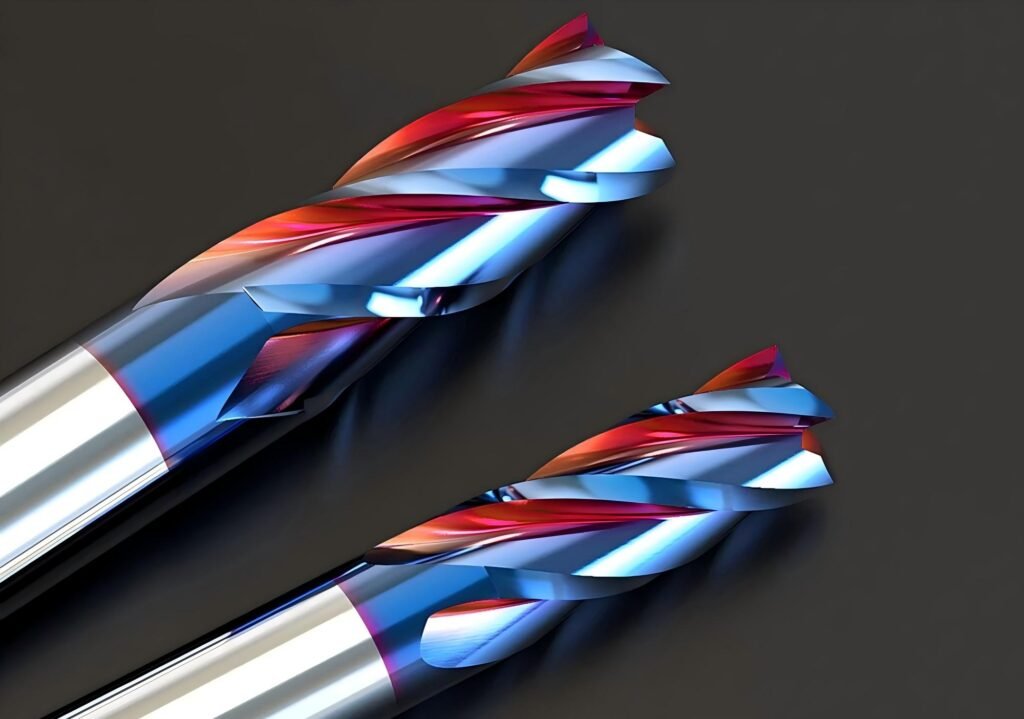
When comparing cutting tools, few decisions generate as much debate as whether a nano coated end mill tool is truly worth its higher price compared to an uncoated alternative. On most tooling price lists, nano coated carbide end mills typically cost 20–40% more than equivalent uncoated tools, and in some premium series the difference can appear even larger.
At first glance, this price gap can feel difficult to justify—especially when both tools look similar in geometry, size, and carbide grade. However, coatings remain one of the very few upgrades that can significantly extend carbide end mill tool life without requiring any changes to the machine tool, fixturing, workholding, or CAM strategy.
Modern nanostructured PVD coatings are no longer a marginal improvement. In steels, stainless steel, and hardened materials, they routinely deliver multiple times the usable life of uncoated tools, particularly when cutting speeds increase and thermal loads rise. In production environments, this difference directly affects tool change frequency, surface finish stability, and cost per part.
This article explains what “nano coated” actually means from a technical perspective, where the added cost delivers measurable value, and where an uncoated flat end mill tool remains the most sensible and economical choice.
What Is a Nano Coated End Mill Tool?
What “Nano Coated” Really Means
The term “nano coated” does not describe the physical size of the tool. Instead, it refers to the internal structure of advanced PVD coatings engineered at the nanometer scale.
Modern coatings such as AlTiN, TiAlN, and AlCrN are often constructed as nanolayer or nanocomposite systems. In these coatings, individual layers may be only a few nanometers to a few hundred nanometers thick. This fine-scale layering dramatically improves toughness and crack resistance while maintaining extremely high hardness and oxidation resistance.
On a carbide end mill:
- Total coating thickness is typically around 2–4 μm, thin enough to preserve a sharp cutting edge
- The nano-layered structure limits crack propagation, preventing premature coating failure
- Thermal stability improves without significantly altering edge geometry or chip formation
In practical terms, a nano coated end mill tool is a high-quality carbide tool designed to maintain edge integrity under high-speed, high-temperature cutting conditions.
Typical Nano Coatings Used on End Mills
Several coating families dominate modern end mill applications:
Coating Type | Typical Composition | Main Strengths | Typical Applications |
TiAlN / AlTiN | Ti–Al–N | High hardness, strong oxidation resistance above 800 °C | High-speed machining of steels and stainless |
AlCrN / AlCrTiN | Al–Cr–N (±Ti) | Very high hot hardness, stable under thermal shock | Hardened steels, interrupted cutting |
AlTiN–SiN nanocomposite | Al–Ti–Si–N | Extremely fine grain structure, outstanding wear resistance | Tool steels, long production cycles |
Although suppliers use different trade names, the underlying goal remains consistent: preserve edge hardness and stability at elevated temperatures where uncoated carbide begins to degrade.
Uncoated vs Coated: Fundamental Differences
Heat Resistance
Uncoated carbide exhibits excellent hardness at room temperature. However, as cutting temperature rises, the carbide substrate gradually loses strength and becomes more vulnerable to wear and plastic deformation.
TiAlN-based nano coatings address this problem by forming a thin aluminum-oxide layer at high temperature. This oxide layer acts as a thermal barrier, reducing heat transfer into the carbide substrate and stabilizing the cutting edge.
As a result, coated tools:
- Operate reliably at higher surface speeds in steels and stainless steel
- Better tolerate short-term overloads and less-than-ideal cooling
- Maintain edge sharpness longer under thermal cycling
Wear Resistance and Tool Life
Numerous cutting tests and real-world production studies consistently show that coated carbide tools:
- Significantly reduce flank wear and crater wear
- Allow 20–70% higher cutting speeds at similar or improved tool life
- Commonly achieve 3–5× the usable life of uncoated tools in difficult materials
In many applications, coating alone contributes more to extended end mill tool life than switching carbide grades or minor geometry adjustments.
Surface Finish Stability
PVD coatings also influence surface finish quality. Low-friction coatings reduce adhesion and built-up edge formation in steels and stainless steel.
This leads to:
- More stable cutting forces
- Reduced edge chipping
- More consistent surface finish over the life of the tool
For aluminum machining at lower speeds, extremely sharp polished uncoated tools may still produce superior finishes, especially in finishing operations.
Where Nano Coated End Mill Tools Deliver the Most Value
High-Speed Machining Environments
Nano coatings are specifically engineered to perform at the elevated temperatures generated during high-speed machining. AlTiN and similar coatings retain hardness well beyond the thermal limits of uncoated carbide.
They are particularly effective in:
- High-RPM milling of tool steels
- Stainless steel machining with 4–6 flute geometries
- High-efficiency milling (HEM) and trochoidal toolpaths
In these conditions, coated tools can run at their designed cutting parameters with predictable and gradual wear rather than sudden failure.
Dry Machining and MQL Applications
Dry machining and minimum-quantity lubrication (MQL) place greater thermal stress on cutting tools.
In these environments:
- Coated tools exhibit lower wear rates than uncoated tools
- Higher cutting speeds become feasible without excessive heat accumulation
This combination is widely adopted in automotive and aerospace manufacturing, where coolant usage is restricted for environmental or process reasons.
Hardened Steels and Stainless Steel
For hardened steels, tool steels, and stainless steel:
- Coated carbide tools resist both abrasion and adhesion far better than uncoated tools
- Nanostructured coatings often double or triple tool life compared to conventional coatings
In sustained production, uncoated tools rarely achieve the lowest cost per part in these materials.
Situations Where Uncoated End Mills Remain Effective
Nano coatings are powerful, but they are not universally advantageous.
Low-Speed or Low-Power Machines
On machines with limited spindle speed or basic toolholding:
- Cutting temperatures may never reach levels where coatings provide benefit
- Sharp uncoated tools may cut cooler with lower cutting forces
In such cases, coating can add cost without proportional performance gain.
Soft Materials: Aluminum, Plastics, Wood
In aluminum, plastics, and other soft materials:
- Edge sharpness and chip evacuation dominate performance
- Polished uncoated tools often deliver superior results in finishing operations
Although ZrN or DLC coatings are used in some aluminum-specific tools, bright uncoated tools remain widely preferred.
Prototyping and Short Production Runs
For prototype work or small batches:
- Tool life rarely limits productivity
- Lower-cost uncoated tools typically provide sufficient performance
Saving premium coated tools for repeat production often makes economic sense.
Performance Analysis: Looking Beyond Tool Price
The critical comparison is cost per part, not purchase price.
Example Cost Comparison
Tool Type | Tool Price | Average Parts per Tool | Tool Cost per 1,000 Parts |
Uncoated carbide | $20 | 100 | $200 |
Standard TiAlN coated | $26 | 250 | $104 |
Nano coated AlTiN | $30 | 350 | $86 |
Despite higher upfront cost, nano coated tools can reduce tooling cost per part by more than 50% in suitable applications.
Realistic Expectations
While extreme cases may show dramatic improvements, most production environments can realistically expect a 2–4× improvement over uncoated tools in steels and stainless steel when cutting parameters and toolholding are optimized.
Selecting the Right Nano Coated End Mill Tool
Matching Coating to Material
- General steels and stainless steel:TiAlN or AlTiN
- Hardened steels (HRC > 55):AlTiN or AlCrN nanocomposites
- High-temperature alloys:AlTiN or AlCrN with air blast or MQL
- Aluminum and non-ferrous materials:polished uncoated, ZrN, or DLC
Geometry and Toolholding Considerations
Coating performance depends heavily on proper geometry and stable toolholding. Flute count, helix angle, core strength, and corner design must match the application. Low runout is especially critical for small-diameter and micro tools.
Practical Methods for Maximizing Nano Coated Tool Life
Break-In Procedures
Starting at 70–80% of recommended parameters and gradually increasing helps stabilize the cutting edge and prevent early micro-chipping.
Chip Evacuation and Cooling
Consistent chip evacuation using air blast or through-tool coolant is essential. Sudden coolant quenching of overheated tools should be avoided to reduce thermal cracking risk.
Tool Life Management
Tracking tool life by parts or cutting length allows planned tool changes. Regrinding and re-coating high-value tools can extend usable life in stable production environments.
When Does Nano Coating Pay Off?
Nano coated end mill tools deliver the greatest value when machining steels, stainless steel, and hardened materials at moderate to high cutting speeds. They reduce tool changes, stabilize surface quality, and lower overall cost per part in production settings.
Uncoated tools remain practical for low-speed machines, soft materials, and short or non-critical jobs.
Evaluating tools based on cost per part rather than purchase price leads to more consistent and economical machining decisions.