Skip to content
HSS vs Solid Carbide End Mills: A Buyer’s Guide to Brand Positioning, Geometry, and Real Shop Use Cases
Table of Contents
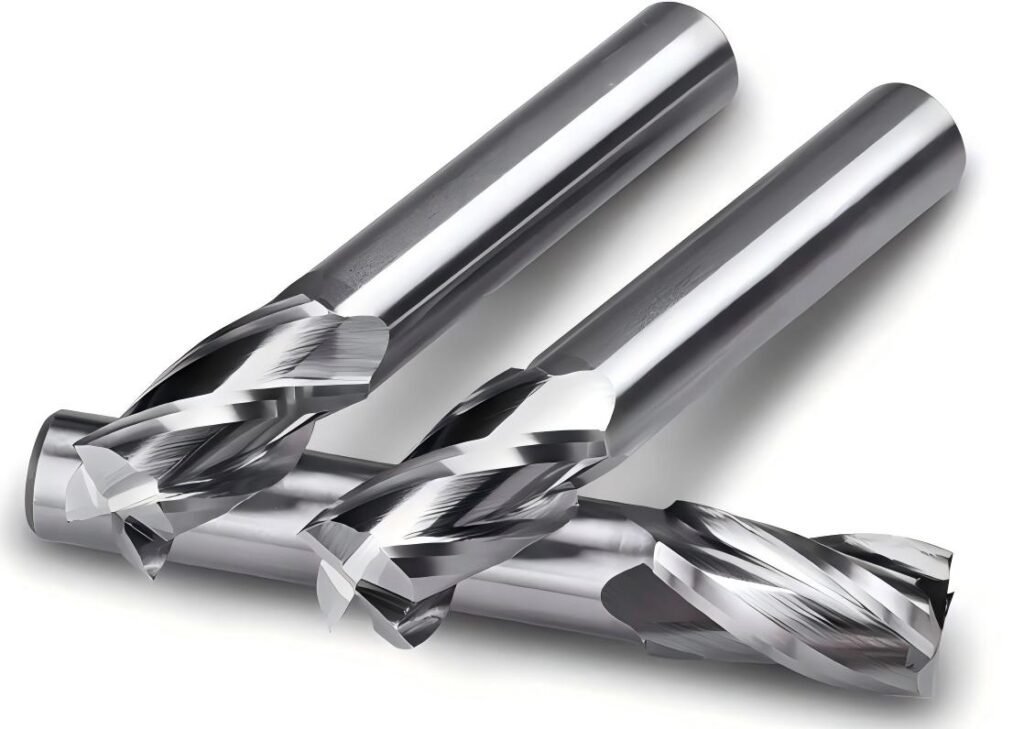
Choosing between an HSS milling cutter end mill and a solid carbide end milling cutter looks like a “tool material” decision. In practice, it’s usually a decision about application scenario + machine capability + how a brand positions its product line.
A premium brand can sell both HSS and carbide end mills—but the role of each line is different. HSS lines are often optimized for toughness, forgiveness, and regrind value. Solid carbide lines are optimized for rigidity, heat resistance, and throughput—especially on modern CNCs.
This article breaks down the differences in a way that’s easy to verify on catalogs and real cutting results: material properties, geometry choices, brand positioning, and when each wins on cost-per-part.
what is an end milling cutter?
An end milling cutter is a rotating cutting tool used for side milling, slotting, pocketing, profiling, ramping, and finishing. Unlike drills, end mills cut radially and (in many designs) axially.
What is an HSS end milling cutter?
An HSS end milling cutter is typically made from high-speed steels such as M2, cobalt HSS (e.g., M35/M42 families), or powder metallurgy HSS-E-PM. HSS is valued for toughness and edge integrity under interrupted conditions and lower-rigidity setups. (M2 and cobalt HSS are widely used for cutting tools due to balanced toughness/wear/red hardness.)
What is a solid carbide end milling cutter?
A solid carbide end milling cutter is made from cemented carbide (WC-Co). Compared with steel, cemented carbide has a much higher modulus (stiffness) and maintains hardness at elevated temperatures—one reason it dominates high-speed CNC milling.
What brands optimize for
End mill “brand strength” isn’t only about quality. It’s also about where the brand expects the tool to be used and what it’s optimized to do: maximize MRR, reduce chatter, simplify selection, enable reconditioning, or hit a price point.
Below is a practical positioning map. The “example lines” are meant to show how brands describe these products, not to claim one is always better.
Brand positioning map
Positioning segment | What the brand optimizes for | Typical users | What you’ll see in product lines |
Industrial heavy / high productivity | Maximum MRR, chatter control, stable tool life at high speed | CNC production, aerospace/energy/medical | Variable helix/index, advanced edge prep, proprietary flute core, multilayer PVD; “optimized” categories (e.g., Sandvik’s solid carbide assortment spans versatile/optimized/customized categories) |
General-purpose industrial | Wide coverage, predictable results, easier selection | Job shops, mixed materials | “Universal” geometries, medium helix, common coatings; strong distribution |
Economy/value industrial | Cost-per-part balance, decent stability | Price-sensitive job shops, distributors/private label | Simpler geometries, fewer SKUs, coating options by price tier |
E-commerce / hobby-light industrial | Convenience, small-qty purchase, broad kits | Makers, routers, light CNC | Bundles/sets, simplified specs, marketing-driven naming |
HSS-focused / regrind value | Toughness + reconditioning economics | Manual mills, older CNC, interrupted cuts | HSS-E / HSS-E-PM, uncoated or AlCrN/AlTiN; common DIN styles (e.g., Dormer Pramet HSS-E-PM end mills with defined helix/rake in spec) |
How to use this map as a buyer:
- If your shop’s bottleneck is cycle time, you’re shopping the upper-left.
- If your bottleneck is tool breakage, setup rigidity, or operator variability, HSS and “forgiving” carbide geometries move up in value.
- If you’re a distributor building a line, your target isn’t “best tool,” but the best positioning fit.
Performance comparison
Most people stop at “carbide is harder.” The differences that matter in real milling are: rigidity, hot performance, chipping behavior, regrind economics, and sensitivity to runout.
HSS vs solid carbide: what changes on the machine
Factor | HSS end mill | Solid carbide end mill |
Rigidity (stiffness) | Lower stiffness (more deflection under load) | Much higher stiffness; cemented carbide is roughly 2–3× stiffer than steel in modulus terms (typical data ~530–700 GPa for WC vs ~200 GPa for steels) |
Heat resistance / “red hardness” | Better than normal steels; cobalt HSS improves hot hardness | Excellent hot hardness; handles higher cutting speed without softening (tool material matters for speed selection) |
Chipping vs plastic deformation | More likely to “wear and round” before chipping; forgiving in interrupted cuts | More likely to micro-chip if overloaded, if runout is high, or if chatter occurs |
Runout sensitivity | More tolerant when holders/spindles are not perfect | More sensitive; one flute can take all the load if runout is poor |
Regrind value | Often worth regrinding (especially larger diameters) | Regrind possible but economics depend on tool cost, coating, and geometry complexity |
Best fit | Low rigidity, interrupted cuts, older/manual machines, budget-sensitive | High speed/high efficiency CNC, hard materials, batch production |
A quick “HRC50 example” to avoid confusion:
If the workpiece is around HRC50, solid carbide becomes the default choice in most modern CNC environments. But if the setup is weak (long stick-out, poor holder, thin wall, interrupted cut), an HSS tool can sometimes survive longer at lower parameters, even if it’s not “faster.”
Geometry differences between HSS and carbide lines
Tool material influences geometry because it changes what the tool can survive.
Common geometry tendencies in HSS end milling cutter lines
- Bigger chip spaceand “friendlier” flute forms to reduce clogging and shock loading
- Edges that tolerate rubbing, imperfect feeds, and manual variability
- Lots of classic standards and patterns (slot drills, roughers, DIN-style long/short series)
You’ll often see powder-metal HSS-E-PM positioned as the “premium HSS” tier, sometimes with modern coatings (for example, HSS-E-PM roughers listed with AlCrN in distribution catalogs).
Common geometry tendencies in solid carbide end milling cutter lines
- Stronger coreto resist bending at higher loads
- Variable helix / variable pitch to suppress vibration and widen the stable cutting window (many high-performance lines explicitly call out variable helix/index)
- Edge preparation matched to coating and material group (steel/stainless/titanium/aluminum)
- More specialization: roughing vs finishing, trochoidal/HPC designs, specific corner geometry
A concrete example of the “modern carbide line” philosophy is how manufacturers describe features like asymmetric divided flutes, variable helix, and stability-focused core designs in high-performance families.
Use cases: when HSS wins
HSS still earns its place when the real-world job is messy.
Choose HSS when…
- Low rigidity: small benchtop mills, older CNCs, worn spindles, questionable holders
- Interrupted cuts / scale / cast skin: shock loads punish brittle edges
- Manual millingor operator-driven variability (feed inconsistency, dwell marks)
- Budget-sensitive workwhere regrinding makes sense
- Short-run prototypeswhere reliability matters more than peak MRR
This is why many suppliers still keep strong HSS catalogs: it’s not “obsolete”—it’s a different risk profile.
Use cases: when solid carbide wins
If you have a modern milling environment, carbide is usually the productivity answer.
Choose solid carbide when…
- High-speed CNCand stable holders (shrink-fit/hydraulic/quality collets)
- Harder materials, or abrasive alloys, or stainless where heat dominates
- Batch productionwhere consistency matters and cycle time is money
- High-efficiency toolpaths(adaptive, trochoidal) where rigidity and heat resistance pay off
- Finish-critical workwhere predictable edge stability produces better surfaces
Manufacturers position solid carbide families specifically around demanding materials and high productivity (e.g., broad solid-carbide milling portfolios and high-performance end mill pages).
How to choose a supplier
A good supplier is not just “cheap” or “premium.” It’s the one that matches your scenario and can prove consistency.
A brand-agnostic checklist for wholesale buyers
Sample strategy
Ask for a controlled comparison: same holder, same stick-out, same toolpath, same material.
Batch consistency
Request proof of tolerance control and repeatability (especially OD, runout expectations, coating consistency).
Lead time and SKU stability
Can they keep the same geometry/coating across future orders?
After-sales and application support
Do they help you tune parameters, or do they just ship tools?
Line clarity
A good “end milling cutter manufacturer” has a clear ladder: economy → general → high performance, with honest tradeoffs.
A practical decision matrix
Your reality | Best starting point | Why |
Manual mill / older CNC / unknown runout | HSS end milling cutter | Forgiveness + toughness |
Modern CNC + good holders + need throughput | Solid carbide end milling cutter | Speed + rigidity + heat resistance |
Interrupted cuts / scale / poor stability | HSS or “tough” carbide geometry | Reduce chipping risk |
Stainless or heat-driven wear | Carbide + appropriate coating/edge prep | Heat resistance dominates |
Budget-sensitive + regrind workflow | HSS (esp. larger diameters) | Lower cost per life-cycle |
FAQ
Is HSS milling cutter end mill still worth buying?
Yes—especially for manual milling, older machines, interrupted cuts, and budget-sensitive work where toughness and regrinding matter more than maximum speed. HSS grades like M2/M42 remain standard for cutting tools because they balance toughness, wear resistance, and hot hardness.
What is the best solid carbide end milling cutter for steel?
“Best” depends on your operation (slotting vs side milling vs finishing) and stability. For steel, look for a high-performance carbide line that explicitly targets steels with vibration-control geometry (variable helix/index) and a suitable multilayer PVD coating approach. Many major manufacturers describe these features in their high-performance solid carbide families.
How does end milling cutter price differ between HSS and carbide?
In general, solid carbide is priced higher per tool, but it can reduce cost-per-part by enabling higher speed, longer life, and fewer tool changes. Real pricing varies by brand/series: for example, distribution listings for premium carbide end mills commonly show higher unit prices than typical HSS options.
What geometry should I ask a manufacturer to provide?
Ask for helix angle, flute count, core design intent (rigidity), edge prep standard, coating type, and recommended application window (materials + operations). If they can’t clearly explain geometry intent (chip control, vibration control, edge strength), you’re likely buying an undifferentiated “generic” tool.