Skip to content
How Do Cutting Parameters Really Affect Tool Life in Turning?
Table of Contents
Why does a carbide insert sometimes fail much earlier than expected?
Why does increasing cutting speed by just 20% reduce tool life dramatically?
Why does lowering feed not always improve surface finish—or tool life?
In modern CNC turning, productivity is not limited by machine power anymore.
It is controlled by how precisely we manage three fundamental cutting parameters:
- Cutting Speed (Vc)
- Feed Rate (f)
- Depth of Cut (ap)
Understanding how these variables interact with tool materials and workpiece properties is the key to:
- Extending insert life
- Reducing cost per component
- Improving machining stability
- Maintaining dimensional consistency
This article explains how cutting parameters truly influence wear mechanisms in ISO P (steel), M (stainless steel), and K (cast iron) materials—and how to optimize them in real production.
Why Is Cutting Speed the Most Critical Parameter?
Cutting speed directly determines temperature in the cutting zone.
And temperature controls wear.
When cutting speed increases:
- Shear zone temperature rises
- Diffusion wear accelerates
- Oxidation wear increases
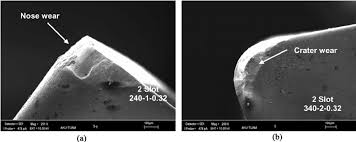
- Crater wear forms faster
- Thermal cracks may develop
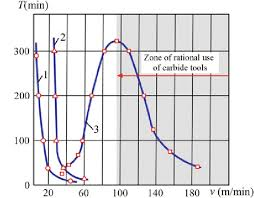
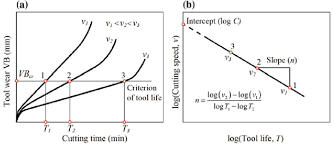
Tool life typically follows Taylor’s equation:
V⋅Tn=CV \cdot T^n = CV⋅Tn=C
This means tool life decreases exponentially as speed increases.
What Does the Speed–Life Relationship Look Like?
From industrial machining data:
- Increasing cutting speed by 20% can reduce tool life by roughly 50%
- Increasing speed by 50% may reduce tool life to only 20% of its original value
This is particularly critical when machining alloy steels.
Why Is Stainless Steel Even More Sensitive?
Stainless steel has:
- Low thermal conductivity
- Strong work-hardening behavior
- High adhesion tendency
Heat remains concentrated at the cutting edge.
At higher speeds:
- Edge plastic deformation occurs
- Adhesion wear increases
- Built-up edge becomes unstable
- Micro-chipping risk rises
For ISO M materials, speed must be selected more conservatively than for ISO P steel.
Typical Cutting Speed Ranges by Material
ISO Class | Work Material | Typical Vc (m/min) | Main Wear Type | Speed Sensitivity |
P | Carbon & alloy steel | 180–320 | Diffusion + flank wear | High |
M | Stainless steel | 120–240 | Adhesion + deformation | Very High |
K | Cast iron | 250–450 | Abrasive wear | Moderate |
These ranges vary by insert grade and coating, but the relative behavior remains consistent.
Is Lower Feed Always Better?
Many operators reduce feed to “protect” the insert.
But actual wear trends tell a different story.
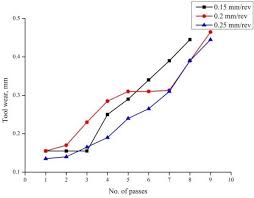
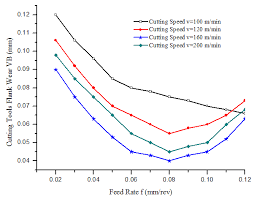
Wear versus feed often follows a U-shaped curve.
What Happens at Very Low Feed?
When feed is too small:
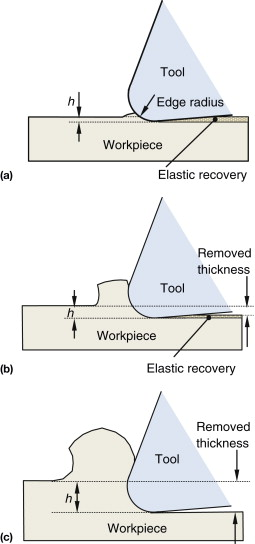
- Chip thickness falls below minimum chip thickness
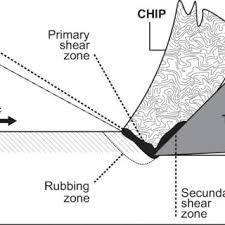
- Tool begins to rub rather than cut
- Friction increases
- Flank wear increases sharply
This is especially problematic in hardened steels and stainless steel.
Lower feed does NOT automatically mean longer tool life.
What Happens at Optimal Feed?
At moderate feed:
- Stable chip formation
- Balanced mechanical load
- Controlled temperature
- Minimum flank wear
This is the economic machining zone.
What Happens at Excessive Feed?
When feed becomes too large:
- Cutting force rises
- Mechanical stress increases
- Risk of edge chipping grows
But compared to cutting speed, feed has a less dramatic exponential effect on tool life.
Example Feed Influence (Turning Steel at 200 m/min)
Feed (mm/rev) | Wear Behavior | Tool Life Trend | Stability |
0.05 | High rubbing wear | Poor | Unstable |
0.15 | Minimum wear zone | Optimal | Stable |
0.30 | Higher load | Moderate | Stable |
0.50 | Edge stress risk | Reduced | Risk of chipping |
Feed should be optimized—not minimized.
Why Does Depth of Cut Matter Less—But Still Matter?
Depth of cut generally has less influence on tool life compared to speed and feed.
However, improper depth selection can cause unexpected failures.
What Happens When Depth of Cut Is Too Small?
If depth of cut is insufficient:
- Tool only engages hardened surface layer
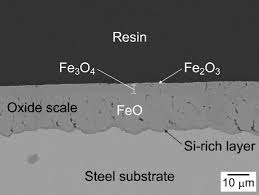
- Oxide scale acts as abrasive
- Edge repeatedly strikes hard skin
- Localized chipping occurs
This is common when rough turning castings or forgings.
Special Case: Cast Iron and Oxide Layers
Cast iron surfaces often contain:
- Oxide scale
- Sand inclusions
- Hard decarburized layers
If ap is too small:
- Abrasive wear increases dramatically
- Edge breakdown accelerates
Best practice:
Use sufficient depth of cut to penetrate the hardened surface in one stable pass, within machine power limits.
Relative Influence of Cutting Parameters
Parameter | Influence on Tool Life | Dominant Mechanism | Optimization Priority |
Cutting Speed | Very High | Thermal wear | Adjust last |
Feed Rate | Moderate | Flank wear | Optimize second |
Depth of Cut | Low–Moderate | Mechanical load | Set first |
Practical sequence:
1.Set correct depth of cut
2.Increase feed to stable zone
3.Fine-tune cutting speed
Avoid adjusting speed first.
How Should Insert Grades Be Matched to Parameters?
Cutting parameters and insert grades must work together.
For ISO P (Steel)
- Balanced toughness
- Strong CVD coating
- Suitable for 200–300 m/min
- Moderate feed range
Wear: gradual flank wear + mild crater wear.
For ISO M (Stainless Steel)
- Tough substrate
- Sharp cutting edge
- PVD coating preferred
- Controlled speed range
Focus: resist adhesion and deformation.
For ISO K (Cast Iron)
- Wear-resistant substrate
- Thick CVD coating
- Edge strength prioritized
Higher speeds acceptable, but abrasive wear dominates.
What Is the Most Common Mistake in Turning?
Increasing cutting speed to reduce cycle time.
Yes, cycle time decreases.
But tool life decreases exponentially.
Cost per part often increases.
Smarter strategy:
- Increase feed moderately
- Maintain stable speed
- Use sufficient depth of cut
Productivity should be improved by balancing all three parameters—not maximizing one.
Final Thoughts: Precision Is the Key to Predictability
Cutting parameters are not independent variables.
They interact with:
- Workpiece material
- Insert grade
- Coating type
- Machine rigidity
- Surface condition
When properly balanced, they deliver:
- Stable wear patterns
- Predictable tool life
- Lower tooling cost
- Higher machining efficiency
Understanding the real behavior of cutting speed, feed, and depth of cut allows you to move from trial-and-error machining to controlled performance engineering.
If you would like assistance selecting optimized turning inserts for:
- Carbon steel
- Stainless steel
- Cast iron
- Roughing with oxide scale
Our engineering team can help define safe and productive parameter windows based on your application conditions.