Skip to content
Big Holes in Tough Metal: How Solid Carbide Drills Take You to 1-1/2″ and Beyond
Table of Contents

When you need a 38 mm / 1-1/2″ hole in alloy steel, you’re instantly in “serious tooling” territory. HSS twists chatter, indexable drills need a lot of torque and space, and scrap costs go up fast if anything walks, breaks, or tapers.
That’s exactly where solid carbide drills shine. In this guide we’ll look at how to use them for large-diameter holes in tough metals, from planning pilot holes with a carbide drill bits set to pushing a full 1 1/2 carbide drill bit at production speeds.
Main focus: solid carbide drills / solid carbide drill bit for carbide drill bits metal applications.
What Are Solid Carbide Drills?
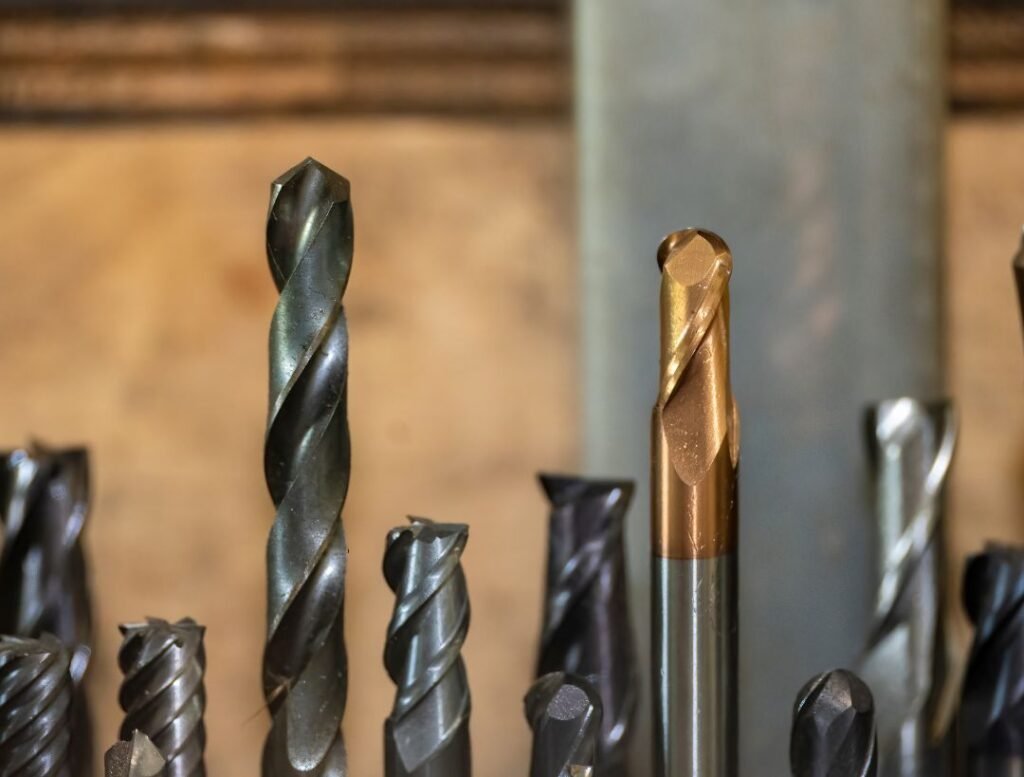
A solid carbide drill is a monolithic tool made entirely from cemented carbide, usually ultra-fine grain with a PVD coating like TiAlN or AlTiN. Modern designs typically include:
- 140° or similar split-point geometryfor low thrust and good centering
- Optimized flute and margin design for stable chip evacuation
- Through-coolant channelsfor high-pressure coolant in 3×D, 5×D, 8×D and longer versions
These tools are engineered for steel, stainless, cast iron and high-temp alloys, not just mild materials.
Solid Carbide vs. Tipped and Indexable Drills
When we talk about creating big holes in tough metal, it helps to distinguish three common types:
Solid carbide drills
One-piece carbide body and cutting edges
Best for high productivity, tight positional tolerance and excellent hole quality
Common up to ~20–25 mm, but available in large diameters (30–40+ mm) from major brands
Carbide-tipped HSS drills
HSS body with brazed carbide tip
Lower cost, good for medium production and manual machines
Typically run at lower speeds than full solid carbide and often need more pecking in deep holes
Indexable insert drills
Steel body with 2+ carbide inserts
Excellent for very large holes (40–80+ mm) and roughing, but need rigid, high-power machines and enough stock for the insert nose radius to work
For many 30–40 mm holemaking jobs in steels and stainless, a large solid carbide drill combines the best of both worlds: high penetration rate and better hole quality than most indexable drills—if the machine and fixturing are up to it.
3D Internal Coolant ALCRONA Coated Carbide Drill Bit

The 3D internal coolant ALCRONA coated carbide drill bit is designed for stable, high-performance drilling in steels and stainless steels.
Made from premium micro-grain tungsten carbide and coated with ALCRONA, it offers excellent wear resistance, heat resistance and low friction, making it ideal for high-speed and dry or semi-dry machining.
Dual internal coolant channels deliver cutting fluid directly to the cutting edge, improving chip evacuation, reducing heat and extending tool life. This ensures consistent hole quality and process reliability on modern CNC machining centers.


When to Use a Solid Carbide Drill Bit Instead of HSS
Material and Speed
Carbide has much higher hot hardness than HSS and keeps its edge at elevated temperatures.
That’s why:
- Carbide drill bitscan run several times faster than HSS in steel and stainless ·
- Industry comparisons show carbide tools can cut up to ~10–12× fasterthan HSS in suitable conditions, with significantly longer tool life in production
In practice, that means:
- HSS may run at modest speeds for steel
- Solid carbide drillscan run at far higher cutting speeds, especially with through-coolant
Production vs. Job-Shop Work
Use a solid carbide drill bit instead of HSS when:
- You are running medium to high volumeproduction
- The machine has sufficient spindle power and rigidity
- Hole quality (roundness, straightness, surface finish) is critical
- You are drilling alloy steels, stainless, heat-resistant alloyswhere HSS burns out quickly
HSS still makes sense when:
- You are on manual or low-power machines
- Volumes are small and tool costmatters more than cycle time
- Workholding or part access is poor and you prefer a tougher, more forgiving tool
Quick Comparison: Drill Types for Large Holes in Steel
Drill type | Relative cutting speed vs HSS | Hole quality | Typical sweet-spot diameter for production | Pros | Cons |
HSS twist drill | 1× (baseline) | Fair | Up to ~20 mm | Low cost, tough, easy to regrind | Slow, wears quickly in hard/tough steels |
Carbide-tipped HSS | ~1.5–3× | Good | ~20–40 mm | Cheaper than full carbide, fits weaker machines | Lower speed than solid carbide, tip can chip |
Solid carbide drill bit | ~3–8×+ | Very good to excellent | ~3–30+ mm (incl. 1-1/2″) | High productivity, tight tolerances, good finish | Higher cost, more brittle, needs rigid setup |
Indexable insert drill | ~3–6× | Good (roughing focus) | ~25–80 mm | Low cost per edge, easy diameter changes | Needs high power, larger minimum feed and DOC |
Large-Diameter Carbide Drilling: 1-1/2″ in Steel and Alloys
A 1-1/2″ solid carbide drill (≈ 38.1 mm)—often searched as a “1 1 2 carbide drill bit”—is a serious tool. The benefits are big: fast metal removal and excellent hole geometry. But so are the loads.
Cutting Loads and Power
Drilling power can be estimated with standardized formulas using cutting speed, feed per revolution, drill diameter and specific cutting force for the material.
As a rough example in medium steel:
- Diameter: 38 mm
- Cutting speed: 60–80 m/min(moderate for carbide in steel)
- Feed per rev: ~2–3% of diameter→ ~0.8–1.1 mm/rev (typical rule of thumb for solid carbide drills in steel)
With these values, a typical calculation shows tens of kilowatts of spindle power may be required for a full-diameter 38 mm solid carbide drill in steel—on the order of 20–30 kW (≈ 27–40 hp) for aggressive feeds. That’s why machine power and torque must be checked against such calculators before committing to the process.
Key Risks with Big Solid Carbide Drills
1.Tool breakage
Any misalignment or sudden increase in torque (chips packing, interrupted cut) can snap the drill.
2.Oversize or tapered holes
Runout and poor rigidity cause the drill to deflect, producing bell-mouthed holes.
3.Chip evacuation failure
Especially in deep holes (>3×D) or gummy alloys without adequate high-pressure through coolant.
4.Machine overload
If spindle power or torque is insufficient, rpm and feed must be reduced, negating much of the carbide advantage.
Because of these risks, many shops use pilot and step-drilling strategies with a carbide drill bits set to “prepare” the hole before the final large drill goes in.
How Carbide Drill Bits Sets Support Large Hole Making
A carbide drill bits set gives you multiple diameters with consistent geometry and coating. Typical high-performance sets for steel feature:
- Ultra-fine grain solid carbide
- TiAlN or similar high-temperature PVD coating
- 135–140° split point
- Through-coolant on selected diameters
- You can leverage the set in three ways:
1.Centering / spotting
Use a small solid carbide drill or center drill to ensure accurate entry and prevent walking, especially on curved or cast surfaces.
2.Pilot drilling
A pilot of 1×D depth is often recommended for performance drills if used, and typically slightly larger point angle and smaller diameter than the final drill.
3.Step drilling for underpowered machines
If your spindle cannot safely drive a full-diameter 38 mm solid carbide drill, use a sequence like 10 → 20 → 30 → 38 mm to gradually increase cutting load.
Step-Drilling Plan to 38 mm in Steel
Below is a conceptual example for a 3×D hole in medium carbon steel using solid carbide drills from a set. Cutting speed is held at 60 m/min for illustration, with feed set to 2.5% of diameter (a common starting rule).
Step | Drill diameter (mm) | Role | Approx. spindle speed (rpm) | Feed per rev (mm/rev) | Feed rate (mm/min) |
1 | 10 | Pilot / starter | ≈ 1,910 | 0.25 | ≈ 480 |
2 | 20 | Intermediate step | ≈ 955 | 0.50 | ≈ 480 |
3 | 30 | Intermediate step | ≈ 640 | 0.75 | ≈ 480 |
4 | 38 | Finish diameter | ≈ 500 | 0.95 | ≈ 480 |
Important: These are illustrative starting points. Real values must be taken from your drill manufacturer’s cutting-data tables and adjusted for material, coating, hole depth, coolant, and machine capability.
In many modern machining centers with enough power and high-pressure through-coolant, you’ll skip the intermediate steps and go directly with the full-size solid carbide drill bit—but the step-drill strategy is a useful “fallback” when the machine is on the limit.
Machine and Fixturing Requirements for Large Carbide Drills
To run big carbide drill bits metal safely and productively, your machine setup matters as much as the tool.
Spindle Power and Rigidity
- Use power and torque calculatorsor your tool supplier’s charts to check the required kW/HP vs your spindle rating.
- For a 30–38 mm solid carbide drill in steel, you typically want a BT40/HSK-A63 spindle with strong torque, or better, a BT50/HB-type spindlefor continuous production.
- Keep overhang as short as possible—use stub/3×D drills where you can, move to 5×D/8×D only when necessary.
Coolant Delivery
Large solid carbide drills are usually through-coolant tools. You’ll get best results with:
- Through-spindle coolant (TSC)of at least ~20 bar / 300 psi; many machines now offer 70–80 bar (1015–1160 psi) as standard for demanding work.
- Clean filtration to prevent blocked coolant holes
- Correct coolant type (emulsion vs oil) and concentration as recommended for the tool and material
Smaller diameter carbide drills often need 300–1000 psi to reliably evacuate chips; for larger drills like 25–40 mm, 20–70 bar with healthy flow is usually sufficient if chip load is reasonable.
Workholding and Fixturing
- Clamp parts so that the hole axis is fully supported—avoid cantilevered parts that can vibrate.
- Use strong vises, dedicated fixtures or tombstones for repeat jobs.
- Check runoutat the drill tip; high-performance solid carbide drills typically need ≤ 0.01–0.02 mmrunout for best life and hole quality.
Quick Machine Checklist by Diameter Range
Diameter range (solid carbide) | Typical spindle class | Coolant recommendation | Fixture & setup notes |
Up to 12 mm | BT30/BT40, 7–11 kW | Flood or TSC ≥ 20 bar for deep holes | Good vise clamping, short overhang |
12–25 mm | BT40/HSK-A63, 11–18 kW | Prefer TSC 20–70 bar | Rigid fixture, low runout, avoid weak manual machines |
25–40 mm (incl. 1-1/2″) | BT50/HMC or heavy BT40, 18–30 kW+ | TSC with high flow; flood backup | Very rigid clamping, thick backing material, no pecking if possible |
Cost, Tool Life and Regrinding Strategy
Cost vs. Productivity
Solid carbide drills cost more upfront, especially in larger diameters. But they generally:
- Run at much higher cutting speeds and feeds than HSS
- Last significantly longer per edge in steels and high-temp alloys
- Deliver better hole quality, reducing reaming or boring operations
When you factor in cycle time + tool life + scrap risk, a large solid carbide drill bit is often cheaper per good part than HSS or even carbide-tipped alternatives in production.
Regrinding Solid Carbide Drills
One major advantage of solid carbide is that it can be professionally reground and recoated:
- High-quality regrind services restore the point geometry, margins and flute entranceto near-new performance.
- After a few regrind cycles, the coating is typically stripped and reappliedto maintain adhesion and wear resistance.
- Large-diameter drills (25–40 mm) often remain economical even after multiple regrinds because you “recover” a high-value tool rather than buying new every time.
Typical strategy for big solid carbide drills:
1.Monitor wear land and chipping using a toolmaker’s microscope or digital scope.
2.Send the drill for regrind when wear reaches the manufacturer’s limit (often ~0.1–0.2 mm flank wear, or earlier if chipping occurs).
3.Track how many regrind cycles you get; adjust cutting data if tool life is poor.
4.For critical holes, keep a new drill reserved for finishing and use reground tools for roughing or less critical operations.
Conclusion & Practical Selection Checklist
When you need big, accurate holes in tough materials, solid carbide drills are often the best choice—especially in modern CNC environments with through-spindle coolant and rigid fixturing.
Use this quick checklist for large-hole applications in steel, stainless and alloys:
1. Is solid carbide the right choice?
Use a solid carbide drill bit (including large sizes like a 1 1/2 carbide drill bit) when:
- You have medium to high production volume
- The machine offers adequate power and rigidity
- You need tight tolerances and good surface finish
- Material is steel, stainless, cast iron or tough alloyswhere HSS struggles
Consider HSS or carbide-tipped alternatives if:
- Volumes are low and cost per toolis more important than cycle time
- Machine is underpowered or lacks through-coolant
- Workholding is marginal and you need a more forgiving tool
2. Are machine and coolant ready?
- Confirm spindle power/torqueusing drilling power calculators.·
- Ensure TSC ≥ 20 bar(ideally 70–80 bar for tough materials and long holes) and clean filtration.
- Check runout at the tool tip; adjust holders and machine if necessary.