Skip to content
Beyond the Logo: End Milling Cutter Brands Compared by Geometry, Tool Life, and Finish
Table of Contents
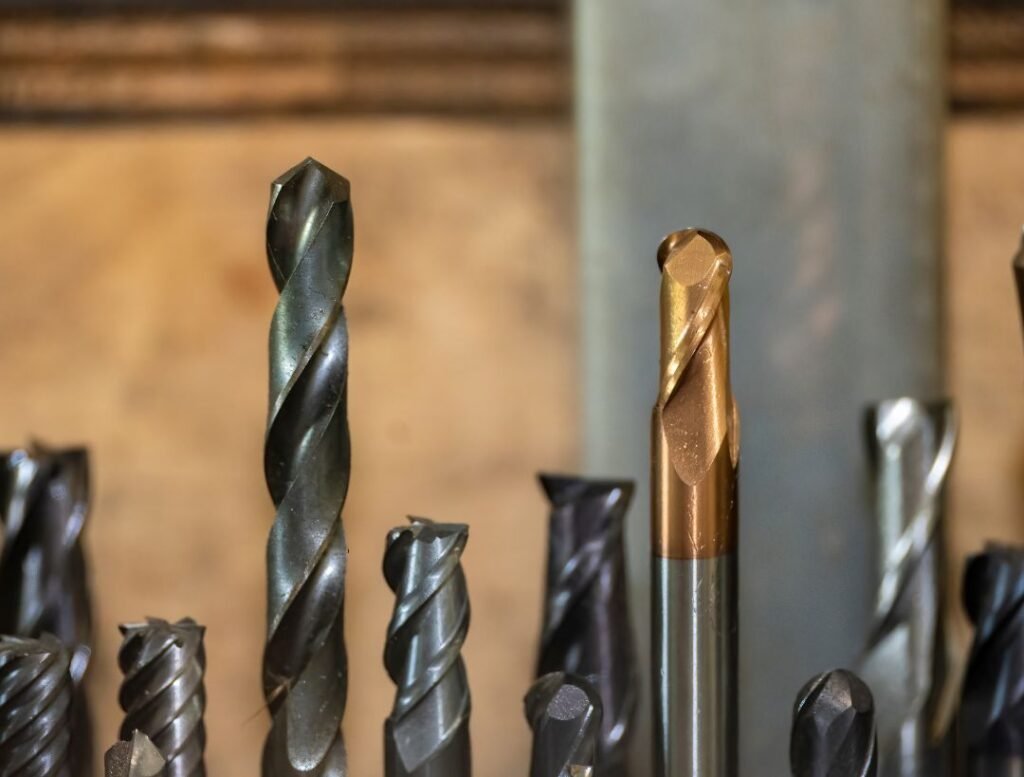
If you’ve ever swapped a “milling cutter end mill” from Brand A to Brand B—same diameter, same flute count, same program—and the cut suddenly felt quieter, cooler, and cleaner… you’re not imagining things. The difference usually isn’t magic carbide. It’s geometry + consistency + application matching.
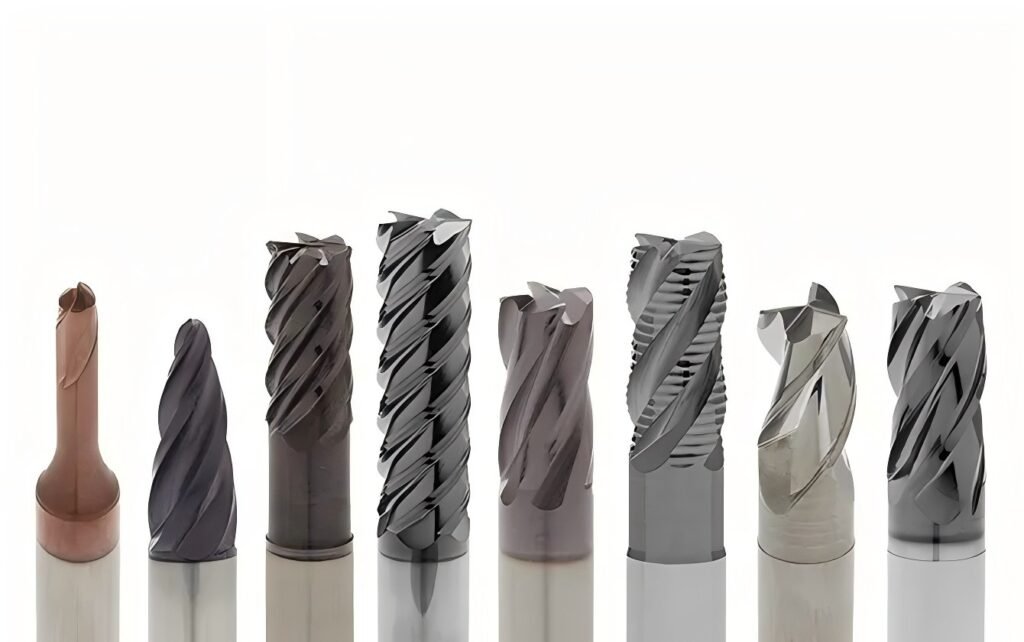
This article breaks down what is end milling cutter design at a practical level, shows an end milling cutter diagram, and compares well-known product families (not just brands) by the details that actually move the needle: helix/pitch strategy, core strength, edge prep, coatings, and runout control.
What is end milling cutter? Basic structure
A milling end mill cutter is a rotary cutting tool designed to remove material by combining cutting edges with chip evacuation space.
The basic parts you’ll evaluate on any end milling cutter:
- Shank: what the holder grips (affects runout and rigidity).
- Flutes: chip channels + cutting edges (affect chip load, evacuation, vibration).
- Cutting edge & corner: where chipping/finish problems start.
- Core: the tool’s backbone (strength, deflection resistance).
- Margin / land(on some designs): influences guidance and finish on walls.
You can think of every end mill as a compromise between:
- Strength (core thickness, edge support)
- Chip space (flute volume)
- Stability (pitch/helix strategy)
That’s why two cutters that “look similar” often behave very differently.
A geometry comparison framework: how to “read” a cutter fast
When you compare end milling cutter geometry, don’t start with “brand.”
Start with these five:
Helix + pitch (stability first)
Many “quiet” cutters use differential pitch / unequal spacing to reduce vibration. For example, Sandvik’s multi-operation concept explicitly calls out differential pitch to reduce vibration.
OSG’s AE-VM/AE-VMS lines are positioned as anti-vibration designs with a unique flute form balancing rigidity and chip evacuation.
Guhring’s RF 100 Speed descriptions also highlight unequal flute spacing for low-vibration, high productivity.
Flute count vs chip space
- 2F–3F: bigger chip space, great for aluminum and gummy materials.
- 4F–5F: more edge engagement, stronger core, better for steels/stainless (if chip evacuation is still adequate).
- 6F–7F+: finishing and stable engagement—ifthe machine and evacuation can support it.
Core thickness & flute depth strategy
Some series vary core geometry along the flute length to keep strength while preserving chip room. (This shows up as “variable flute depth” / “large core for stability” in product feature lists in distribution specs.)
Edge prep (micro-hone) and polish
Edge prep is a tool-life lever: a controlled hone can reduce micro-chipping and stabilize wear. Seco explicitly links edge preparation to increased tool life in its Jabro messaging.
Coating + substrate pairing
Coating choice is not “always better.”
It has to match:
- work material heat behavior
- adhesion tendency
- cutting speed range
- whether you’re running dry/MQL/flood
Mitsubishi highlights its SMART MIRACLE coating + ultra micro-grain carbide approach for wear control in specific applications (including CoCr).
Walter’s MD 340/344 Supreme announcement references a specific milling grade (WK40TP) and a multi-layer coating stack for ISO P machining.
Geometry “cheat sheet”: what changes
Geometry lever | What you’ll feel/see | Typical upside | Common risk |
Differential/unequal pitch | Less whining/chatter | More stable walls and corners | Can behave differently at very low engagement |
Variable helix | Smoother sound across RPM | Wider “stable” RPM window | Can increase axial pull in weak setups |
Thicker core | Less deflection | Better size holding and tool life | Less chip space (packing risk) |
More flutes | Better finish potential | Higher feed at same chipload | Needs evacuation + spindle power |
Strong edge prep | Less edge chipping | More predictable wear | Too much prep can rub in soft materials |
Polished flutes/edge | Cleaner chip flow | Aluminum/sticky materials benefit | May reduce edge strength in hard steels |
Why some series last longer: the real tool life drivers
Tool life differences usually come from how the series manages heat and edge integrity—not just “carbide grade.”
Heat management (where coatings matter)
In steels and stainless, tool life often improves when coatings reduce:
- diffusion wear at high temperatures
- crater wear on the rake face
- edge softening and micro-chipping
That’s why certain families are clearly positioned by material group. For instance, Sandvik’s CoroMill Plura pages break out ranges for steel/stainless, titanium, and nickel-based alloys.
Wear mode matters: you’re not “just wearing out”
Different series can shift the failure mode:
Wear modes you can actually diagnose in the shop
Wear mode | What it looks like | Likely cause | Series features that help |
Adhesion/BUE | smeared edge, torn finish | too low speed, gummy material, poor polish | sharper geometry, polished flutes |
Flank wear | gradual size loss | normal abrasion, long engagement | harder coating/substrate pairing |
Notch wear | groove at DOC line | work-hardening materials, interrupted cut | stable geometry, coating choice, edge prep |
Micro-chipping | “pepper” chips on edge | vibration/runout, too sharp edge | differential pitch, edge prep |
Thermal cracking | crack pattern | coolant shock, unstable heat cycles | consistent strategy (dry vs flood), stable cut |
Mitsubishi’s SMART MIRACLE messaging is a good example of a series engineered to push wear resistance via coating + substrate, emphasizing long life in certain alloys.
Consistency (batch-to-batch) is a hidden tool-life multiplier
Two cutters with the same geometry on paper can differ wildly if:
- runout control is inconsistent
- edge prep varies by batch
- coating thickness varies too much
- OD tolerance floats
This is often why one brand “feels predictable” while another feels like a gamble.
Finish & vibration: what strong series do differently
Surface finish and chatter resistance are where “brand feel” shows up first.
Differential pitch and anti-vibration flute forms
Several product families explicitly market vibration reduction:
- Sandvik’s stable multi-operation concept: differential pitch reduces vibration.
- Seco Jabro: differential pitchand edge preparationfor stability and tool life.
- OSG AE-VM/AE-VMS: positioned as anti-vibrationwith a unique flute form that balances rigidity and chip evacuation.
- Guhring RF 100 Speed: highlights unequal flute spacingfor reduced vibration.
The “finish stack”: runout → edge → pitch → coating
If your milling machine end mill cutter chatters, check in this order:
1.Runout (holder, collet, pull stud, dirt, gauge length)
2.Radial engagement strategy (slotting vs adaptive/trochoidal)
3.Pitch/helix suitability (some tools want lighter radial engagement)
4.Edge prep vs material (too sharp chips; too blunt rubs)
5.Coating vs cutting speed (wrong combo builds heat and ruins finish)
HSS vs solid carbide in real production
A quick, practical line in the sand:
- Choose HSSwhen rigidity and spindle speed are limited, when you need toughness in interrupted cuts, or when cost sensitivity is extreme for low-volume work.
- Choose solid carbide end milling cutterwhen you want higher cutting speed, better wear resistance, better size holding, and repeatable finishes—especially in steels/stainless and harder materials.
Most modern “premium feel” differences people notice are in the solid carbide category, because geometry and coating development there has moved faster.
Mini case table: comparing recognizable product families
This table is meant as a starting point for comparison, not a ranking. It’s focused on what the catalogs and product descriptions emphasize.
Example series comparison
Brand / Series example | Geometry “signature” | Best-fit materials (positioning) | Strength | Risk / watch-out | Notes |
Sandvik Coromant CoroMill Plura (multi-ops / HD / HFS) | Differential pitch; families split by application | Steel/stainless; also titanium & Ni-based ranges | Predictable stability; broad portfolio | Must match the correct sub-family | Multi-ops concept calls out vibration reduction via pitch |
Seco Jabro solid carbide end mills | Differential pitch + edge prep | Wide range; aerospace features highlighted | Stable cut + tool-life focus | Choose coating/geometry by material | Seco explicitly links pitch and edge prep to results |
OSG AE-VM / AE-VMS | “Anti-vibration” flute form; rigidity + chip evacuation | Carbon/alloy steel, stainless, Ti, Ni-based | Strong stability positioning | Don’t over-slot if chips pack | OSG positions it as anti-vibration series |
Guhring RF 100 Speed | Unequal flute spacing; productivity focus | High-productivity milling | High output + stability | Needs evacuation discipline | RF 100 Speed calls out unequal spacing / low vibration |
YG-1 V7 Plus A | Variable pitch / chatter reduction | Stainless and general ferrous (per catalog focus) | Chatter control in HSM/trochoidal | Match to engagement strategy | V7 Plus A catalog emphasizes variable pitch chatter control |
Mitsubishi VQ Endmill / SMART MIRACLE | Variable helix; coating + substrate story | Positioning includes long life in specific alloys | Wear resistance focus | Don’t assume one tool fits all materials | SMART MIRACLE messaging emphasizes wear reduction + long life |
Walter MD 340/344 Supreme | Variable helix + unequal pitch; grade/coating stack | ISO P focus in announcement | Toughness + performance positioning | Verify availability/geometry variants | MD Supreme announcement calls out variable helix/differential pitch + coatings |
Conclusion: compare “geometry + consistency + fit,” not just brand
When people say a cutter “just feels better,” they’re usually describing three things:
1.Geometry that stays stable (differential pitch / anti-vibration flute forms)
2.Consistent manufacturing (runout, edge prep, coating control)
3.Correct matching to material + operation + machine reality
Do that, and you’ll buy fewer “logos” and more predictable outcomes.
FAQ
What is the use of end milling cutter?
The use of end milling cutter tools is to remove material by milling operations such as slotting, profiling, pocketing, helical interpolation, and finishing walls and floors—often with tight tolerance and surface finish requirements.
What is the difference between “end mill” and “milling cutter end mill” terms?
In everyday shop language, they usually refer to the same tool type. “End mill milling cutter” wording often appears in catalogs and searches, but functionally it’s still an end mill: a cutter that can cut with its end and sides.
What matters most in end milling cutter geometry?
For most real production: stability (pitch/helix), then core vs chip space, then edge prep, then coating match. If the tool chatters, even a “perfect” coating won’t save it.
Why does my milling machine end mill cutter chatter?
Most chatter comes from runout, long gauge length, weak workholding, or an unstable engagement strategy—and then gets amplified if the cutter has equal pitch or the wrong geometry for the operation. Switching to a series designed for vibration reduction (differential pitch / anti-vibration designs) often widens your stable RPM window.