Skip to content
CVD Coatings in CNC Cutting Tools: Where Thick CVD, Thin MT-CVD, and PVD Fit
Table of Contents
CVD-coated carbide inserts are often treated as the default choice for long tool life in steel and cast iron. That is partly true, but it is also where many coating mistakes begin. A thick CVD insert that runs all day in continuous 40Cr rough turning can fail quickly in stainless steel, leave a poor finish on a light finishing pass, or chip during unstable milling.
The reason is simple: CVD is not one coating family with one behavior. Traditional high-temperature CVD, thin medium-temperature CVD for stainless turning, and MT-CVD systems designed for milling all solve different problems. They share the same basic idea, a chemically deposited coating on a carbide substrate, but the deposition temperature, layer thickness, alumina content, surface treatment, and edge preparation change the way the insert behaves in the cut.
For production engineers and tooling buyers, the useful question is not “Is CVD better than PVD?” The better question is: “Is this operation stable, hot, abrasive, and continuous enough to benefit from CVD, or does it need the sharper, tougher edge behavior of PVD?”
What Traditional HT-CVD Does Well
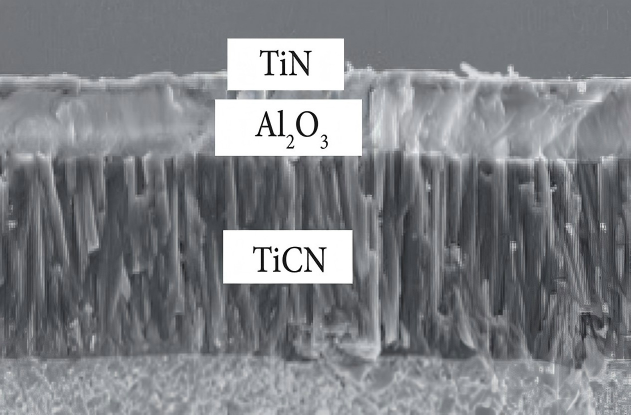
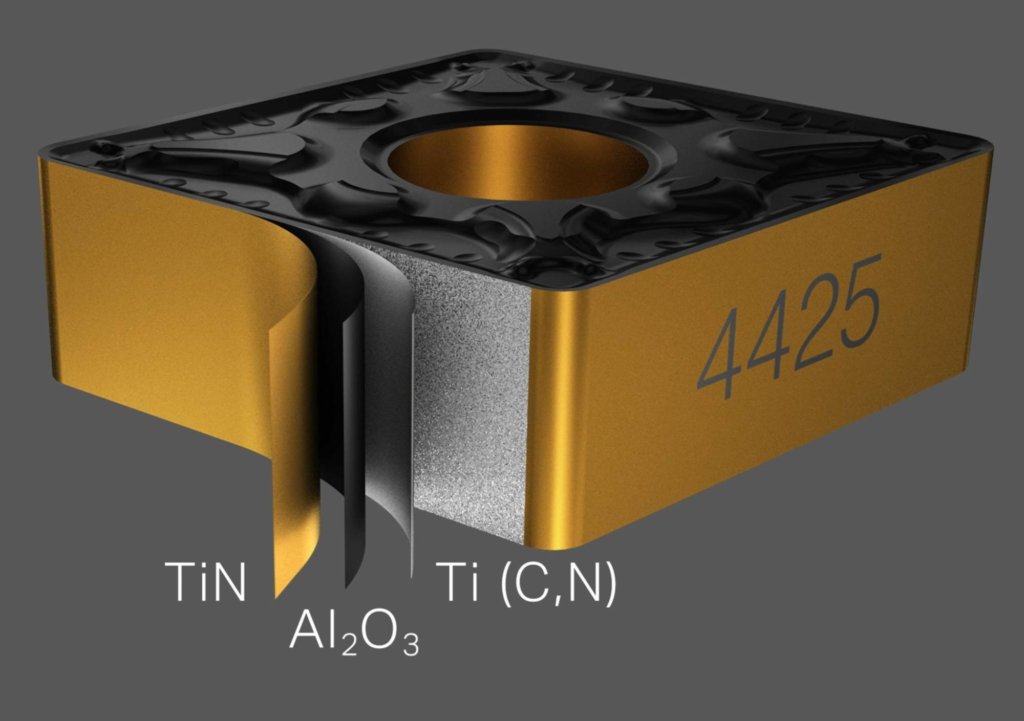
Traditional high-temperature CVD, often called HT-CVD, is deposited at roughly 900 to 1050 degrees C. It builds a relatively thick coating, commonly around 8 to 15 microns, on cemented carbide inserts. A familiar structure is TiCN near the substrate, a thick alpha-alumina layer for heat protection, and a TiN top layer that helps with wear identification and lubricity.
This structure explains the main advantage of CVD. The alumina layer works as a thermal and chemical barrier. During high-speed or heavy continuous turning of steel, the cutting zone can become hot enough for diffusion wear and crater wear to dominate. A thick Al2O3 layer slows that damage and protects the carbide underneath. Kyocera’s descriptions of modern steel-turning CVD grades, for example, highlight alumina orientation and TiCN layer design as central to wear and fracture resistance in steel machining.
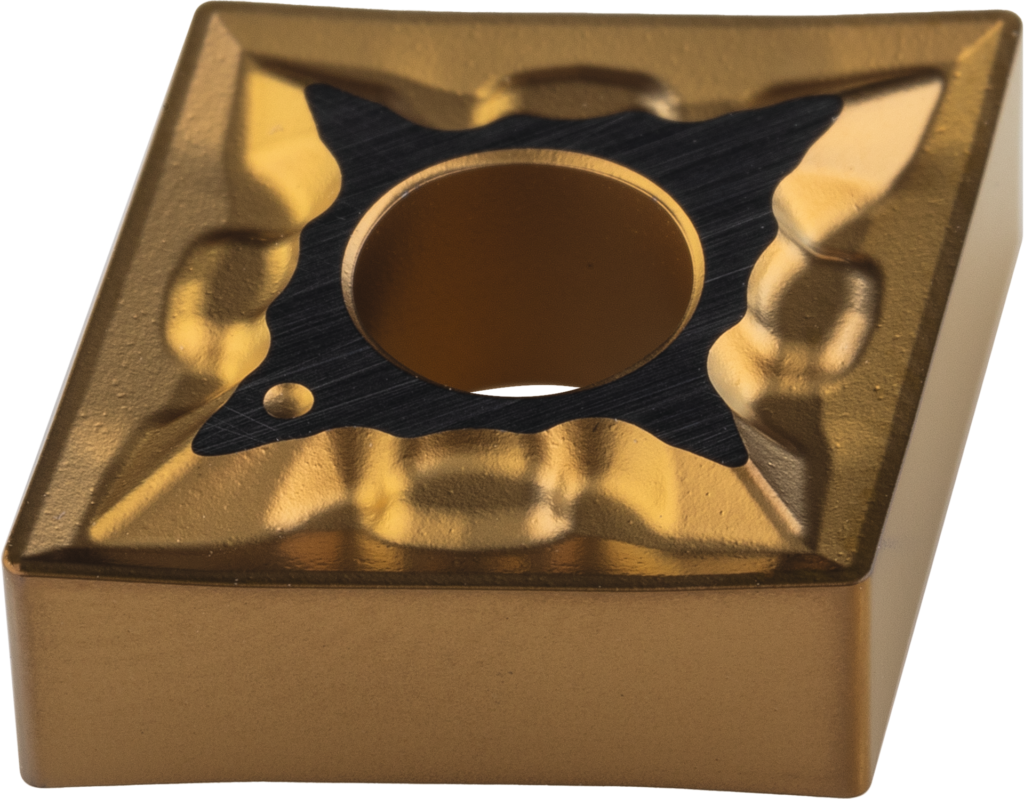
The same thickness that gives CVD its endurance also creates limits. A thick coating requires a stronger edge hone, so the edge is less sharp than a typical PVD-coated finishing insert. HT-CVD also exposes the carbide substrate to high thermal load during deposition. If the substrate and coating process are not well controlled, cobalt migration and brittle eta-phase formation near the surface can reduce toughness. The coating itself can carry tensile stress, so thermal cycling and impact are less forgiving than in lower-temperature PVD systems.
In practical terms, thick HT-CVD is still a strong choice for stable, continuous turning of carbon steel and alloy steel: shaft roughing, automotive steel parts, rings, disks, and other work where the insert is cutting for long periods without severe interruption. It is less attractive when the edge needs to be very sharp, when the cut is heavily interrupted, or when the material tends to weld to the edge.
Why Thick CVD Struggles in Stainless Steel
Stainless steel changes the failure mode. Austenitic grades such as 304 and 316 are sticky, work-harden easily, and keep heat concentrated near the cutting edge. Martensitic stainless such as 1Cr13 can also be abrasive and demanding when run at higher speeds. In these materials, built-up edge and adhesive wear often appear before a thick CVD coating reaches its theoretical wear-life advantage.
A thick HT-CVD insert usually has a honed, less acute edge. That edge can push material before it shears cleanly, especially in semi-finishing or when feed is light. Once stainless begins to smear on the rake face, the coating surface and edge geometry become part of a cycle: adhesion grows, the edge tears it away, the surface finish becomes unstable, and micro-chipping can start.
This is why many shops get mixed results when they choose a “long-life CVD insert” for stainless turning without checking the exact grade family. The coating may be excellent for hot steel turning but too thick, too blunt, or too chemically adhesive for stainless steel. The operator sees poor chip flow, unstable finish, and a built-up edge that looks like a cutting-parameter problem. Sometimes it is a coating and edge-prep problem.
Thin MT-CVD for Stainless Turning
Thin MT-CVD was developed to keep part of CVD’s heat and wear resistance while reducing the edge and toughness penalties of thick HT-CVD. Deposition temperature is lower, commonly around 780 to 880 degrees C, and total coating thickness is often controlled around 3 to 6 microns. The alumina layer is thinner, while the TiN or modified top layer is tuned for lower friction and better chip flow. Some stainless-focused coatings also use chemistry adjustments intended to reduce affinity with stainless work materials.
The result is not a PVD insert in disguise. It still behaves like a CVD-coated carbide grade in long, hot, continuous cuts. The benefit is that the edge can be less heavily rounded, the internal coating stress is lower, and the coating is less likely to peel during moderate thermal changes. For stainless valve bodies, fittings, shafts, and batch turning on automated lines, thin MT-CVD can outlast PVD when the cut is continuous enough and the process can run at productive speed.
The limit is impact. Thin MT-CVD is tougher than traditional thick CVD, but it is still not the first choice for violent interruption, thin-wall chatter, long overhang boring, or mirror-finish passes. In those cases, a PVD grade such as AlTiN, AlCrN, AlCrNbN, or a stainless-specific PVD coating often gives a sharper, more stable edge. Seco’s milling grade guidance makes the same broad distinction: CVD coatings provide thicker heat-resistant layers, while PVD coatings are thinner and better suited to sharper cutting edges.
MT-CVD for Milling: Possible, but Only in the Right Window
Milling is harder on coatings than turning because the insert repeatedly enters and exits the workpiece. Each tooth sees impact, heat, cooling, and unloading in rapid cycles. Traditional thick HT-CVD is poorly matched to that environment; the coating can crack or delaminate, and the rounded edge can raise cutting force.
Milling-grade MT-CVD narrows the gap. It uses lower deposition temperatures, a thinner total layer, gradient TiCN layers to reduce interface stress, and a thinner alumina heat barrier. The target is not universal milling. The target is stable milling where heat and wear are the main enemies, but shock is controlled.
That makes MT-CVD useful in dry or high-speed face milling of gray cast iron and ductile iron, and in stable rough milling of alloy steel with short overhang and strong fixturing. Kyocera’s cast-iron milling grade information describes CVD-coated carbide as a solution for gray and nodular cast iron milling, with Ti-based and ceramic-based coating layers used for wear resistance, thermal stability, and film adhesion.
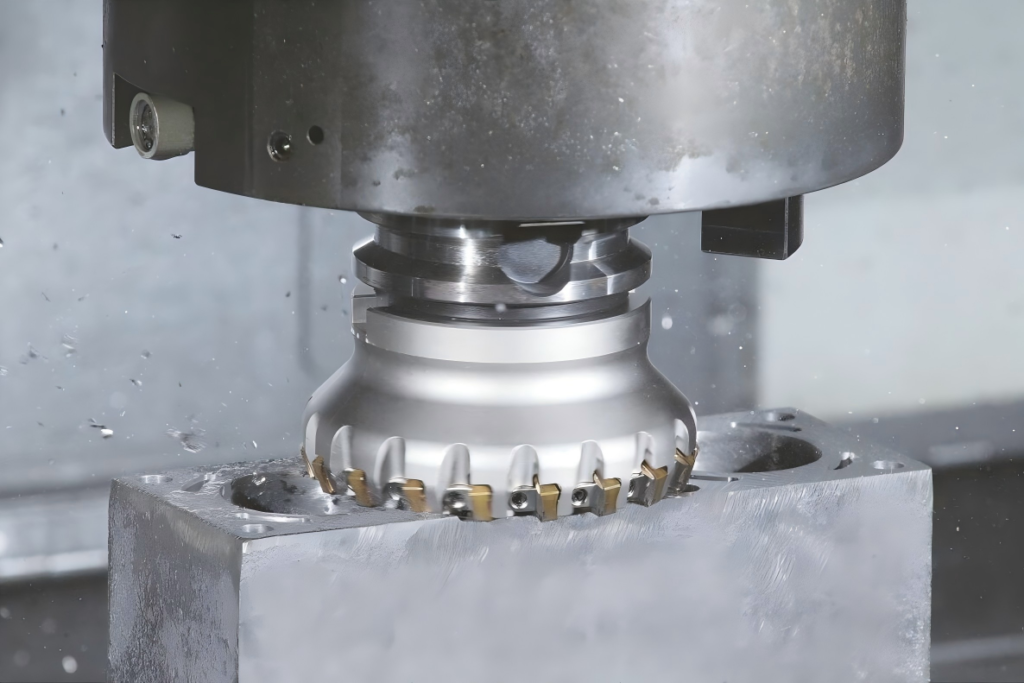
The same grade becomes risky in long-reach pocketing, deep-cavity contouring, thin-wall parts, scale-heavy forgings, and high-feed milling with repeated heavy shock. In those jobs, coating toughness and edge sharpness usually matter more than a thick heat barrier. PVD inserts with positive geometry, a rigid holder, and controlled engagement are usually safer.
CVD and PVD Selection Map
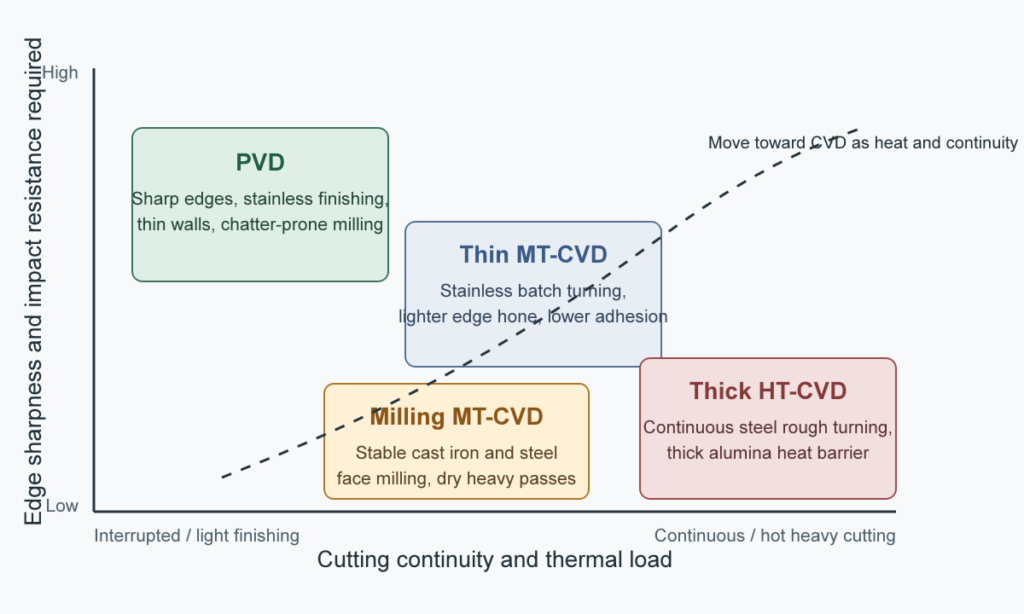
The coating choice should follow the load pattern. CVD moves ahead when the cut is hot, continuous, abrasive, and stable. PVD moves ahead when the cut is interrupted, sticky, thin-walled, or finish-driven.
Coating family | Typical thickness | Main strength | Main weakness | Best-fit operations |
Thick HT-CVD | 8-15 microns | Strong heat barrier and crater-wear resistance | Blunter edge, lower impact tolerance, higher risk of adhesion in stainless | Continuous rough and semi-finish turning of steel and some cast iron |
Thin MT-CVD for stainless | 3-6 microns | Better balance of heat resistance, edge sharpness, and anti-adhesion behavior | Still weaker than PVD under heavy interruption | Batch stainless turning and light interrupted stainless turning |
Milling MT-CVD | 3-6 microns | Better wear life in stable hot milling than many PVD grades | Sensitive to shock, chatter, long overhang, and sticky materials | Stable face milling of cast iron and alloy steel |
PVD | 1-5 microns | Sharp edge, good toughness, lower-friction surfaces | Lower thermal barrier than thick CVD in continuous hot cutting | Stainless finishing, interrupted cuts, thin walls, high-feed milling, small tools |
Application Rules by Workpiece Material
For ordinary carbon steel and alloy steel, start by separating continuous turning from everything else. A 45 steel or 40Cr shaft running in a stable CNC lathe is a classic thick CVD application. If the same material is forged, scaled, slotted, or heavily interrupted, move toward a tougher grade, a lighter edge hone, or PVD depending on the severity of interruption.
For stainless steel, do not assume that all CVD is wrong. Thin MT-CVD can be strong in automated stainless turning when the setup is stable and the goal is longer unattended life. But if the part is thin, the pass is light, the surface requirement is tight, or built-up edge is already the main failure mode, PVD should be evaluated first.
For cast iron, CVD has a natural advantage because abrasive wear and heat resistance matter, especially in stable turning and face milling. Milling-grade MT-CVD can perform well in gray cast iron or ductile iron face milling when the machine is rigid and the tool engagement is predictable.
For titanium, heat-resistant alloys, and difficult stainless milling, PVD is usually the safer starting point. These operations often need sharper positive geometry, lower cutting force, and better resistance to chipping under unstable thermal and mechanical loads.
Workpiece and operation | First coating to evaluate | Why it fits | Watch-out |
45 steel or 40Cr continuous rough turning | Thick HT-CVD | Long hot cut favors alumina heat barrier | Avoid unstable cast skin and heavy interruption |
1Cr13, 304, or 316 stainless batch turning | Thin MT-CVD stainless grade | Better life than PVD when adhesion is controlled and cutting is continuous | Switch to PVD for fine finishing or chatter-prone work |
Gray cast iron face milling | Milling MT-CVD or CVD milling grade | Abrasion and heat resistance help tool life | Needs rigid setup and stable entry |
Deep cavity alloy steel milling | PVD | Tougher edge under vibration and long overhang | Heat may limit speed; manage engagement and coolant |
Thin-wall stainless finishing | PVD | Sharp edge lowers force and reduces built-up edge | Use controlled feed and avoid rubbing |
Shop-Floor Symptoms That Point to the Wrong Coating
Coating selection problems often appear as process problems. Before changing speeds and feeds repeatedly, check whether the coating family fits the failure mode.
Symptom | Likely coating-related cause | Better direction |
Built-up edge in stainless turning | Edge too rounded or surface too adhesive for the material | Try thin MT-CVD stainless grade for stable roughing, or PVD for finishing |
Sudden coating flaking in milling | CVD layer too thick or too stressed for interrupted load | Move to milling MT-CVD only if stable; otherwise use PVD |
Fast crater wear in steel turning | Heat and diffusion wear exceed coating capacity | Evaluate thicker alumina CVD steel grade |
Poor surface finish on light finishing pass | CVD edge hone too strong for low cutting force | Use sharper PVD or cermet/finishing geometry |
Chipping on forged or scaled stock | Coating and substrate lack impact margin | Choose tougher substrate, PVD, or a roughing geometry with stronger edge |
Buying and Process Checklist
When comparing coated carbide inserts, look beyond the coating label printed in a catalog. Ask for the exact intended material group, operation type, edge preparation, chipbreaker range, and whether the grade is optimized for continuous, light interrupted, or heavy interrupted cutting.
For CVD, pay close attention to alumina layer design and coating thickness. A thick Al2O3 layer helps in hot continuous steel turning, but it may hurt sharpness. For stainless, ask whether the grade is a stainless-specific CVD or a general steel CVD grade. For milling, confirm that the grade is actually designed for milling rather than assuming any CVD insert can survive interrupted entry.
For PVD, check the coating chemistry and the edge geometry together. A tough PVD coating on a negative, blunt insert may still fail to solve stainless adhesion or finishing problems. Likewise, a sharp positive insert may fail quickly if the holder is weak or the stock is scaled.
Toolholding also matters. Long overhang, weak ER clamping, worn spindle tapers, and low-rigidity holders can turn a good coating into a bad field test. In heavy milling, BBT, HSK, hydraulic, shrink-fit, or precision collet systems often make coating performance more repeatable because vibration and runout are lower.

Practical Takeaway
Traditional thick CVD still earns its place in continuous heavy turning of steel and cast iron, especially where heat, crater wear, and long cycle time dominate. Thin MT-CVD expands the useful range into stainless batch turning by reducing coating thickness and edge blunting while preserving more high-temperature wear resistance than typical PVD. Milling-grade MT-CVD can work well in stable cast iron and alloy steel face milling, but it should not be treated as a universal milling coating.
PVD remains the better answer when the operation needs a sharp edge, low cutting force, better impact tolerance, or strong resistance to built-up edge in difficult materials. The best choice comes from matching the coating to the cut: continuous and hot favors CVD; interrupted, sticky, thin, or finish-critical favors PVD.
For shops comparing carbide inserts across steel, stainless steel, and cast iron jobs, HNCarbide can help match coating family, substrate toughness, chipbreaker geometry, and holder rigidity to the real cutting condition rather than forcing one coating to cover every operation.