Dry vs. Wet Machining: How to Choose Cutting Tools for the Right Cutting Environment
Table of Contents
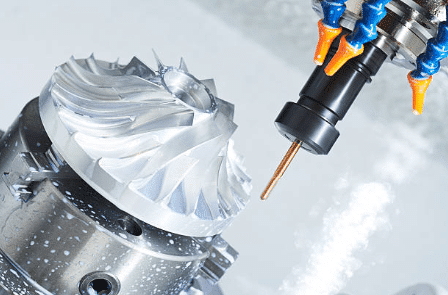
In many CNC shops, the coolant switch looks like a small process detail. In practice, it can decide whether a tool runs steadily for a full shift or fails before the first batch is complete. Wet machining uses cutting fluid for cooling, lubrication, chip flushing, and corrosion control. Dry machining removes that fluid from the cutting zone and asks the tool, coating, holder, and process setup to survive the heat.
Neither method is automatically better. Wet cutting can protect dimensions and chip evacuation, but it can also create thermal shock when a hot cutting edge is hit by coolant again and again. Dry cutting can reduce coolant cost, cleaning work, and environmental burden, but it exposes the edge to higher cutting-zone temperature. Minimum quantity lubrication, or MQL, sits between the two: it uses a small, targeted oil-air mist mainly for lubrication rather than flood cooling.
For engineers, shop owners, and tooling buyers, the useful question is not “dry or wet?” in the abstract. The better question is: what does this workpiece material, operation, tool material, and tolerance requirement need from the cutting environment?
What wet machining does well
Wet machining remains common because it solves several practical problems at once. Cutting fluid removes heat from the workpiece and tool, reduces friction at the tool-chip interface, helps prevent built-up edge, washes chips away, and protects machine components from corrosion when the coolant is properly maintained.
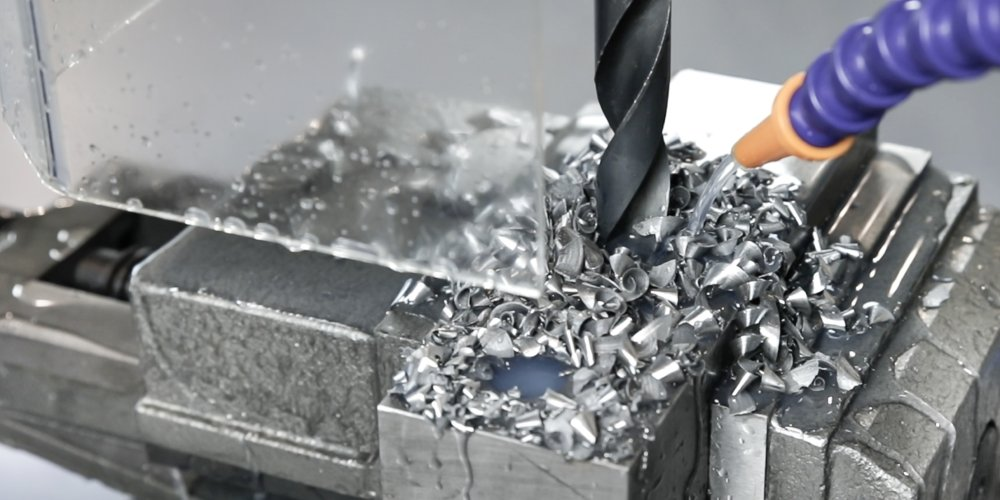
This matters in high-volume production and tight-tolerance work. A part that runs too hot can grow dimensionally, distort after machining, or show poor surface finish. In gummy materials, lubrication can reduce welding at the cutting edge. In drilling, coolant often does more than cool the tool; it carries chips out of the hole. Without chip evacuation, the drill can pack, rub, seize, or leave a rougher hole.
The drawback is that wet machining is not gentle on every tool. A cutting edge heats rapidly while engaged in the cut, then cools when it exits or when coolant reaches the edge. Repeated heating and cooling can create thermal stress. In interrupted operations such as milling, this cycling can encourage microcracks in brittle tool materials or coatings. Shops sometimes blame “bad inserts” when the real problem is a combination of interrupted cutting, coolant delivery, edge geometry, and grade selection.
Wet machining also brings management cost. Coolant needs concentration control, filtration, sump maintenance, tramp oil removal, disposal planning, and operator exposure management. In many shops, these indirect costs are large enough that near-dry or dry strategies deserve serious review.
What a wet-cutting tool needs
For wet machining, toughness and thermal-shock resistance matter as much as hardness. A hard but brittle grade may look attractive on paper, yet chip quickly if the edge is repeatedly hit by coolant during interrupted engagement. Carbide grades with a tougher substrate, stable edge preparation, and a coating system with good adhesion are usually safer for wet cutting than a grade optimized only for hot hardness.
Coating choice also matters. In wet cutting, the coating must resist flaking, cracking, and erosion from coolant flow and chips. CVD coatings are often chosen for heavy turning and steel applications where wear resistance and coating thickness help. PVD coatings can be useful where a sharper edge and lower cutting forces are needed. The right choice depends on the operation, not only on the coating name.
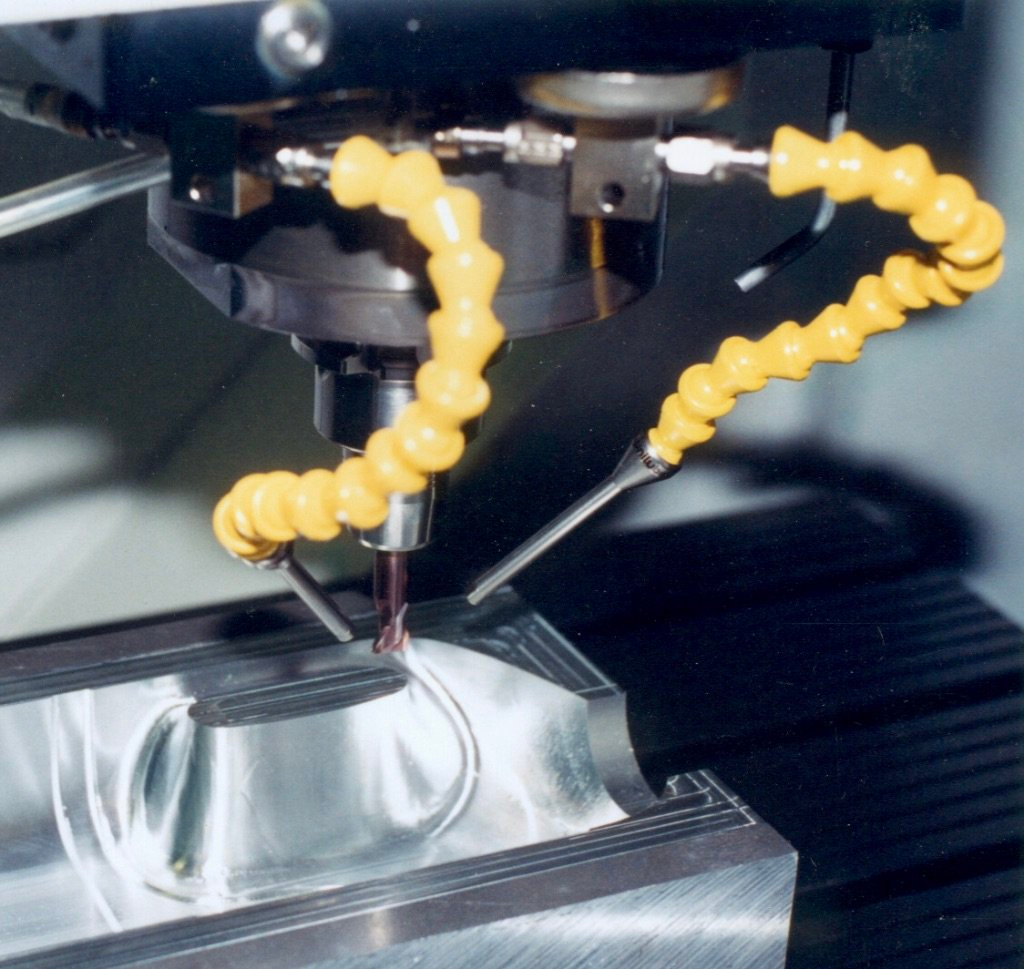
Coolant delivery should be consistent. A weak stream that intermittently reaches the edge can be worse than a controlled strategy, because it creates unstable temperature cycling. Through-tool coolant, high-pressure coolant, or properly aimed nozzles can improve chip evacuation and temperature control, especially in drilling, grooving, and deep pockets.
Wet-machining concern | Why it matters | Tool selection response |
Thermal shock | Rapid heating and cooling can start edge cracks. | Use tougher carbide grades, stable edge prep, and coatings with good adhesion. |
Built-up edge | Stainless steel, aluminum, and gummy alloys can weld to the edge. | Choose sharper geometry, suitable coating, and enough lubrication at the interface. |
Chip evacuation | Packed chips damage holes, pockets, and finished surfaces. | Use through-coolant tools, open flute geometry, and coolant pressure matched to the cut. |
Coating erosion or peeling | Coolant and chips can attack weak coating systems. | Verify coating grade for wet service, not just nominal hardness. |
What dry machining does well
Dry machining removes flood coolant from the process. That can reduce coolant purchase, handling, filtration, cleaning, and disposal. It can also keep chips dry, simplify downstream cleaning, and avoid some health and environmental concerns tied to mist and contaminated fluids.
Dry cutting is not simply “turning coolant off.” The process must be designed so the heat leaves with the chip, the coating protects the substrate, the tool material keeps hardness at temperature, and the machine remains stable. When those conditions are met, dry machining can be productive in cast iron, many hardened steels, some high-speed milling operations, and selected non-ferrous work with the right geometry.
The tool sees a harsher thermal environment. A dry-cutting tool needs hot hardness, wear resistance, chemical stability, low friction, and enough toughness for the load. Coated carbide, ceramic, PCBN, and PCD tools each have a place, but they do not behave the same way.
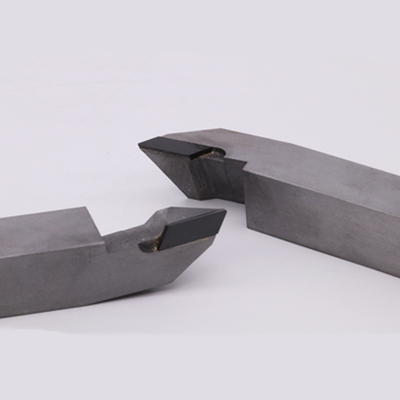
Tool materials for dry cutting
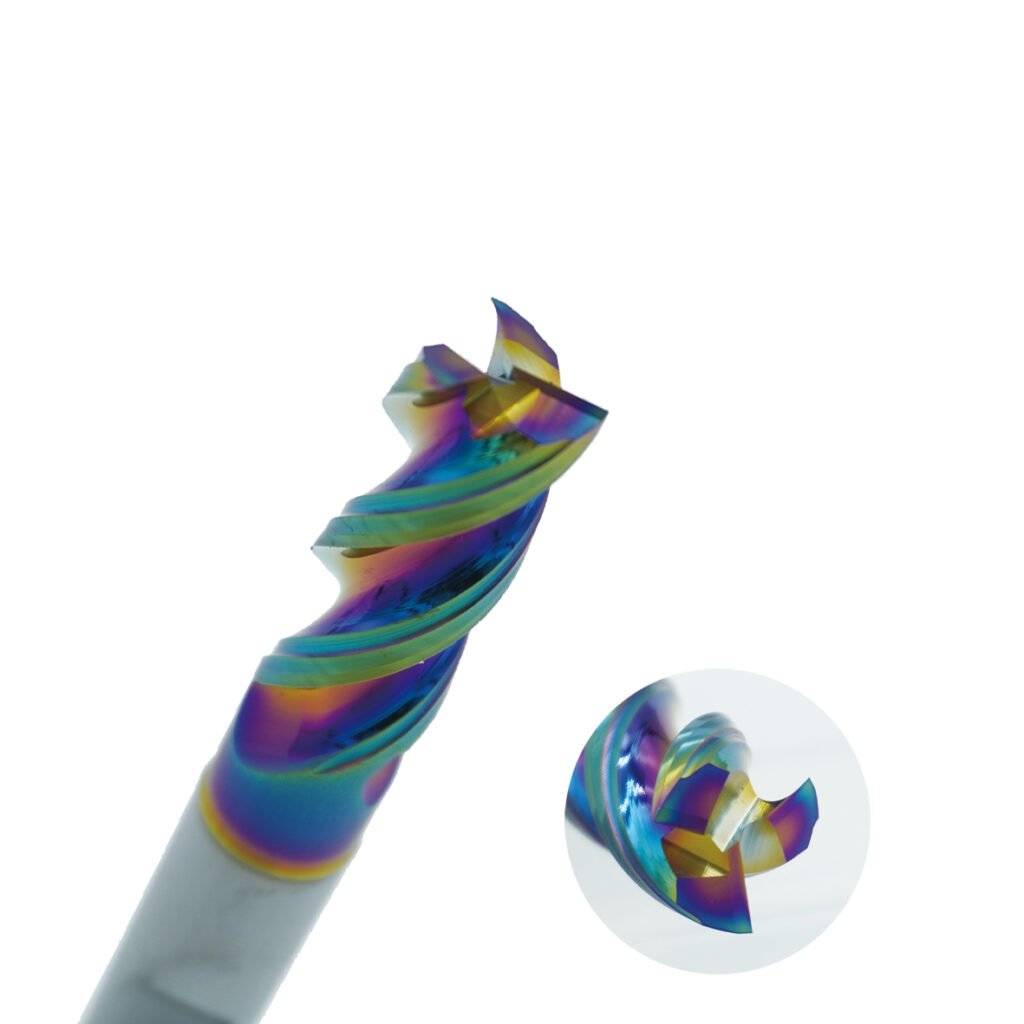
Coated carbide is the broadest dry-machining option. It is used in milling, turning, drilling, and finishing when the grade, coating, and geometry match the workpiece. TiAlN and AlTiN-type PVD coatings are common in high-temperature dry or near-dry milling because they form protective oxides and reduce heat transfer into the substrate. Coated carbide still needs enough toughness for interrupted cuts; a dry process with chatter will not be rescued by coating alone.
Ceramic tools offer excellent hot hardness and can run at high cutting speeds in suitable continuous operations. They are used for cast iron, hardened materials, and certain heat-resistant alloys. Their weakness is brittleness. A ceramic insert may perform well in stable turning but fail quickly in heavy interrupted milling or unstable setups.
PCBN is a strong candidate for hard turning and cast iron machining, especially where dry cutting is preferred. It resists high temperature and abrasion, and it often performs best when the process is stable and coolant is avoided. In many hard-turning applications, adding coolant can increase thermal cycling or create chemical and thermal problems at the cutting zone. The exact recommendation should come from the PCBN grade supplier, because binder system and edge preparation vary.
PCD is different. It is mainly used for non-ferrous and abrasive non-metallic materials such as aluminum-silicon alloys, copper alloys, graphite, composites, and some plastics. Its high thermal conductivity helps move heat away from the edge, and it can give excellent surface finish in aluminum production. It is generally not used for cutting ferrous steels because diamond reacts poorly with iron at high temperature.
Tool material | Best-fit dry or near-dry applications | Watch-outs |
Coated carbide | General milling and turning, steels, cast iron, stainless with correct grade | Needs stable setup and coating matched to heat and material. |
Ceramic | High-speed continuous turning, cast iron, some hardened materials | Brittle; poor choice for many interrupted or unstable cuts. |
PCBN | Hardened steel, hard turning, cast iron, selected ferrous materials | Usually prefers dry cutting, but grade-specific guidance matters. |
PCD | Aluminum alloys, copper, graphite, composites, abrasive non-ferrous work | Avoid ferrous steel cutting at high temperature. |
The operation often decides more than the material
The same workpiece can call for different coolant strategies in different operations. Milling is interrupted by nature. Each insert or flute enters and exits the work repeatedly, which creates thermal cycling. In many milling jobs, dry or MQL cutting can reduce thermal shock, especially with modern coated carbide. Flood coolant may still help in gummy materials, deep pockets, or where chips must be flushed, but it should be applied deliberately.
Turning is usually more continuous. A steady coolant stream can stabilize temperature, improve chip control, and support surface finish. Hard turning with PCBN is a common exception where dry cutting is often preferred. For finishing passes where surface roughness is the main concern, wet cutting may still produce a more forgiving process, provided the tool material allows it.
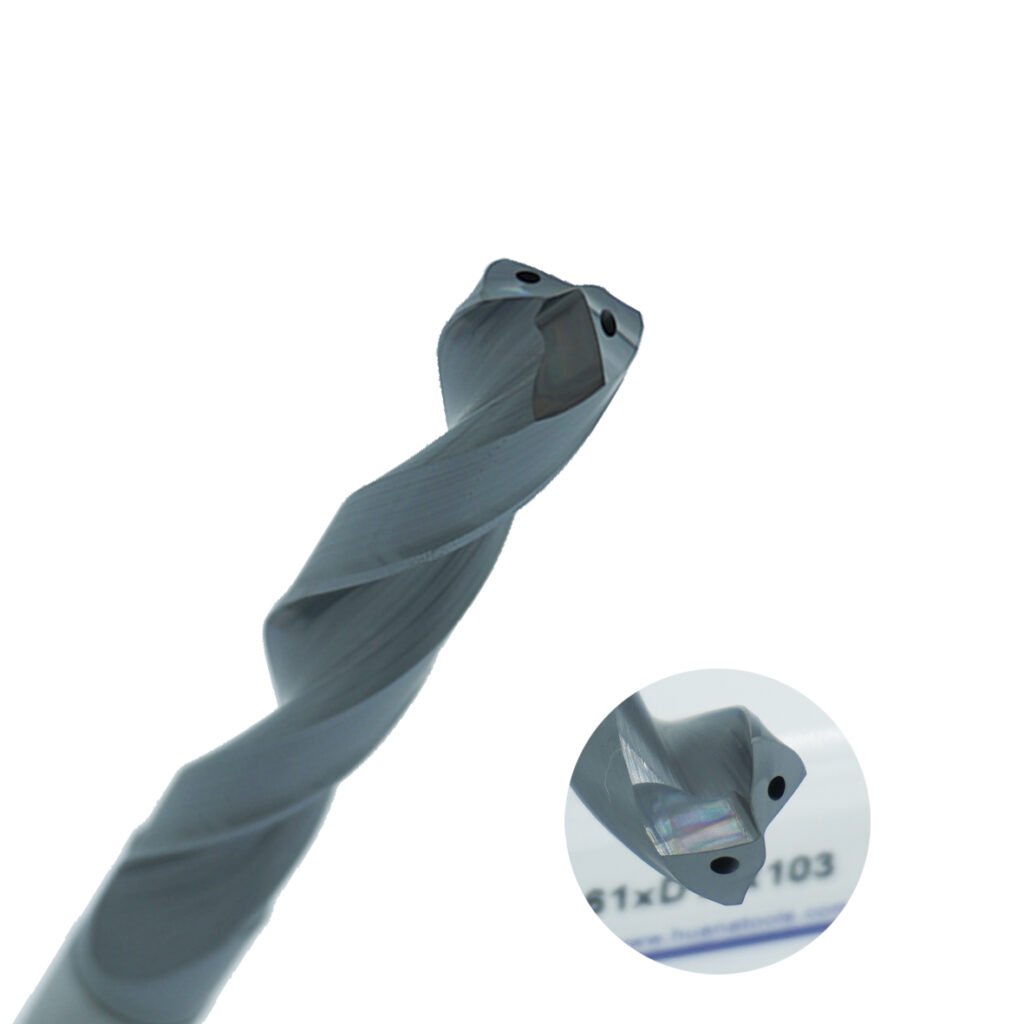
Drilling is the operation where “just run dry” most often causes trouble. A drill works inside a hole, so chips have fewer ways to escape. Coolant or oil may be needed to lubricate margins, cool the cutting lips, and carry chips out through the flutes. Through-coolant carbide drills are common for a reason: they deliver fluid where external nozzles cannot reach.
MQL: the practical middle ground
MQL uses a very small amount of lubricant carried by air and aimed at the tool-workpiece interface. It does not cool like flood coolant. Instead, it reduces friction so less heat is generated in the first place. The chips often look nearly dry, and downstream washing can be reduced.
MQL can be attractive when flood coolant creates thermal shock, cleaning cost, or disposal work, but the cut still needs lubrication. It is used in aluminum machining, some milling and drilling operations, and production environments that want cleaner parts and lower fluid consumption. It requires proper equipment, nozzle position, air control, lubricant selection, and operator discipline. A poorly aimed MQL nozzle is just another unreliable process variable.
A practical selection workflow
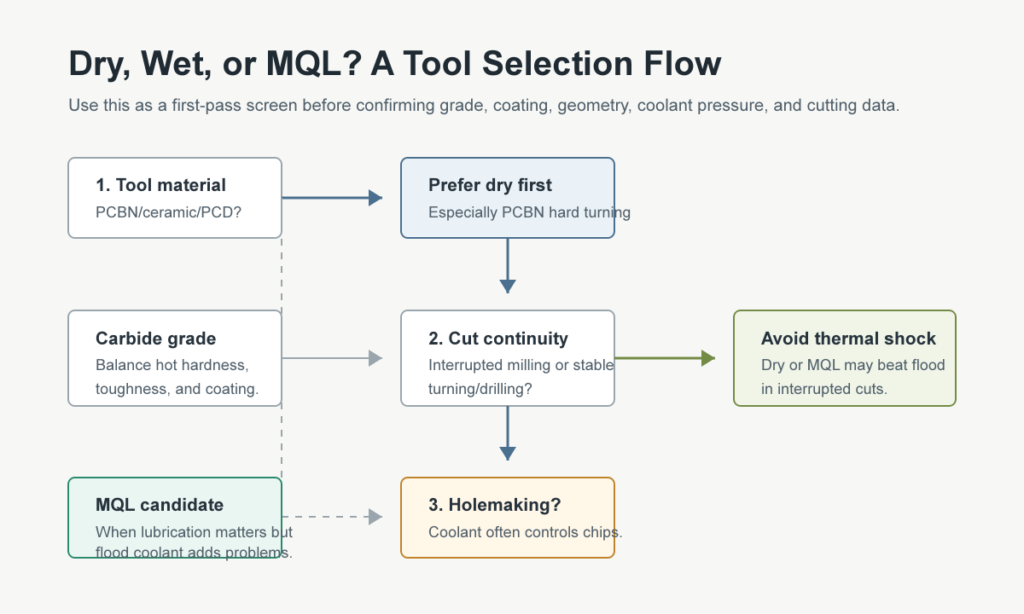
Start with tool material. If the job uses PCBN for hardened steel, begin by evaluating dry cutting unless the tool supplier recommends otherwise. If the job uses PCD for aluminum, copper, graphite, or composites, focus on sharp geometry, chip evacuation, and avoiding built-up edge. For carbide, keep both dry and wet options open until the operation and material narrow the choice.
Then look at engagement. Interrupted cuts, especially milling, often punish wet strategies through thermal shock. Continuous turning may benefit from controlled coolant. Deep drilling and small-hole work usually need coolant or at least a well-designed lubrication and chip evacuation strategy.
Next, check the quality target. If surface finish, burr control, or size stability is the limiting factor, coolant may help. If tool life is failing because of edge cracking in interrupted milling, dry or MQL may help. If the problem is chip packing, turning off coolant is unlikely to solve it.
Finally, evaluate cost per finished part, not fluid or tool price alone. Coolant management cost, tool life, scrap, cycle time, cleaning, operator safety, and machine downtime all belong in the calculation.
Process situation | Likely starting strategy | Reason |
High-speed carbide milling of steel | Dry or MQL trial | Reduces thermal shock in interrupted engagement. |
Stainless steel turning with chip-control issues | Wet cutting with directed coolant | Lubrication and chip control can stabilize the process. |
Hard turning with PCBN | Dry cutting trial | PCBN often performs best without coolant in stable hard turning. |
Deep-hole carbide drilling | Wet or through-tool coolant | Chip evacuation and margin lubrication are critical. |
Aluminum production milling | MQL or wet, depending on chip flow | Lubrication helps prevent built-up edge; chip evacuation decides the method. |
Cast iron machining | Often dry, with dust control | Cast iron is frequently machined dry, but shop hygiene matters. |
Common mistakes to avoid
Do not choose dry machining only to save coolant cost. If the tool grade, coating, holder, spindle, chip evacuation, and fixture are not ready for heat, the saving disappears in broken tools and scrap.
Do not flood every operation by habit. In interrupted milling, poorly controlled coolant can shorten tool life through thermal cycling. A dry or MQL test may reveal a more stable window.
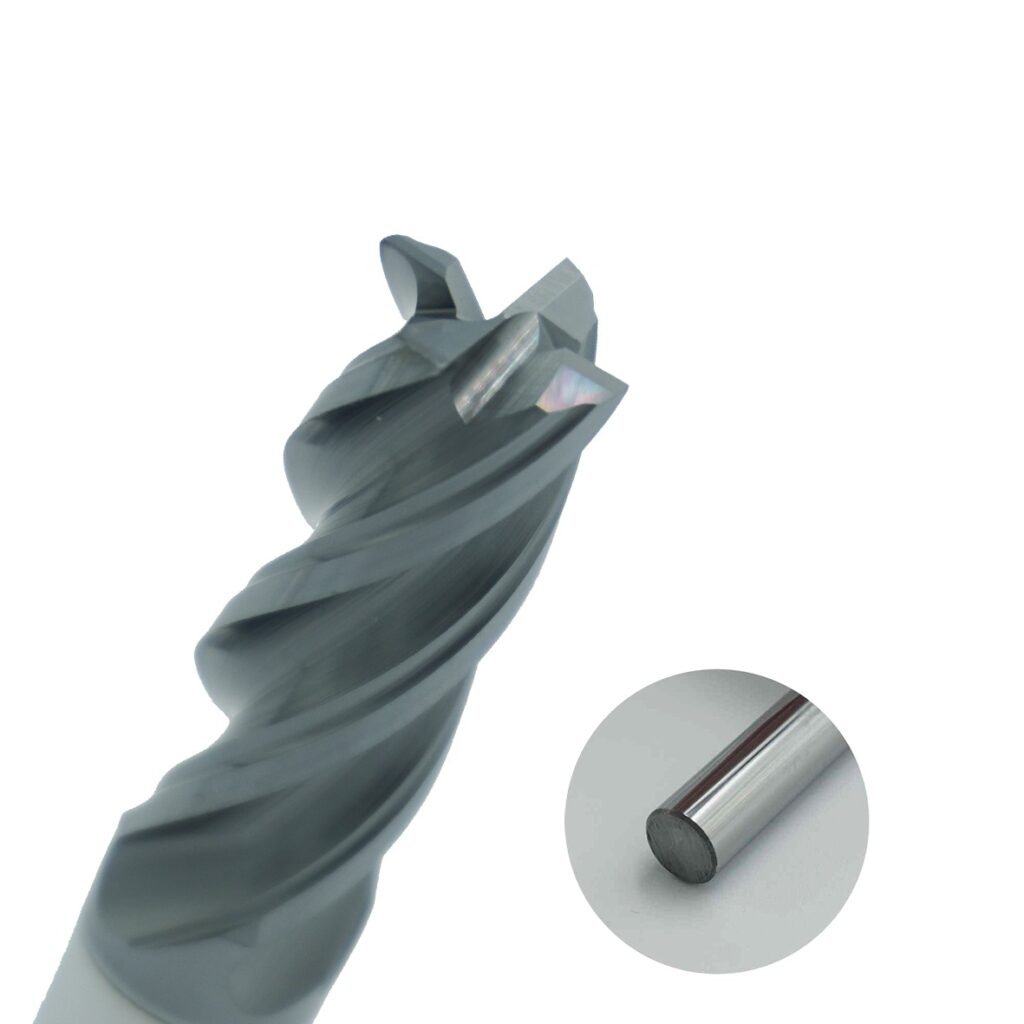
Do not treat all carbide tools as interchangeable. A carbide drill, a finishing end mill, and a turning insert may all use carbide substrates, but their grade, coating, edge prep, and flute or chipbreaker design are built for different problems.
Do not ignore the coolant system itself. Concentration, cleanliness, pressure, nozzle position, filtration, and bacterial control affect machining results. A good tool can look bad in a neglected coolant system.

Conclusion
Dry and wet machining are not competing slogans. They are process environments, and each one changes what the cutting tool must survive. Wet cutting supports cooling, lubrication, and chip flushing, but the tool needs thermal-shock resistance and coating stability. Dry cutting can reduce coolant-related cost and avoid some thermal cycling, but the tool must handle higher heat. MQL gives shops a useful middle route when lubrication matters more than bulk cooling.
For tooling buyers, the best approach is to connect the decision to the workpiece material, operation type, tool material, surface requirement, and real cost per part. HNCarbide can support this kind of selection with carbide grades, coatings, and tool geometries matched to the actual machining environment rather than a one-size-fits-all recommendation.