Skip to content
How to choose the helix angle of a solid carbide end mill
Table of Contents
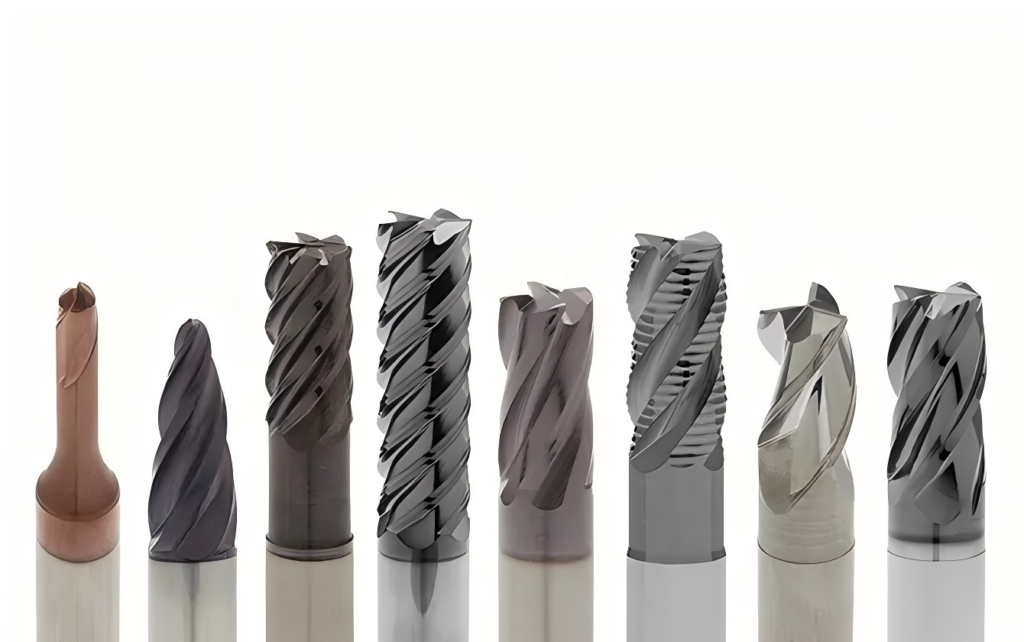
Helix angle is easy to overlook when a shop is busy. A buyer may ask for a four-flute carbide end mill, the programmer may focus on diameter and coating, and the operator may only see the problem after the first parts come off the machine: chatter marks on a side wall, a small step between tool passes, a thin rib pushed out of tolerance, or an end mill that chips long before its expected life.
The helix angle is part of the tool geometry that decides how the cutting edge enters the workpiece. It changes the balance between tool rigidity, cutting smoothness, radial force, axial pull, chip flow, and surface finish. That is why two carbide end mills with the same diameter, flute count, coating, and carbide grade can behave very differently in the same CNC program.
This guide explains how to choose between low, medium, high, and variable helix solid carbide end mills in common milling situations. The goal is practical: reduce trial cutting, choose a safer first tool, and understand when the helix angle is probably the hidden reason behind a machining problem.
What helix angle changes in the cut
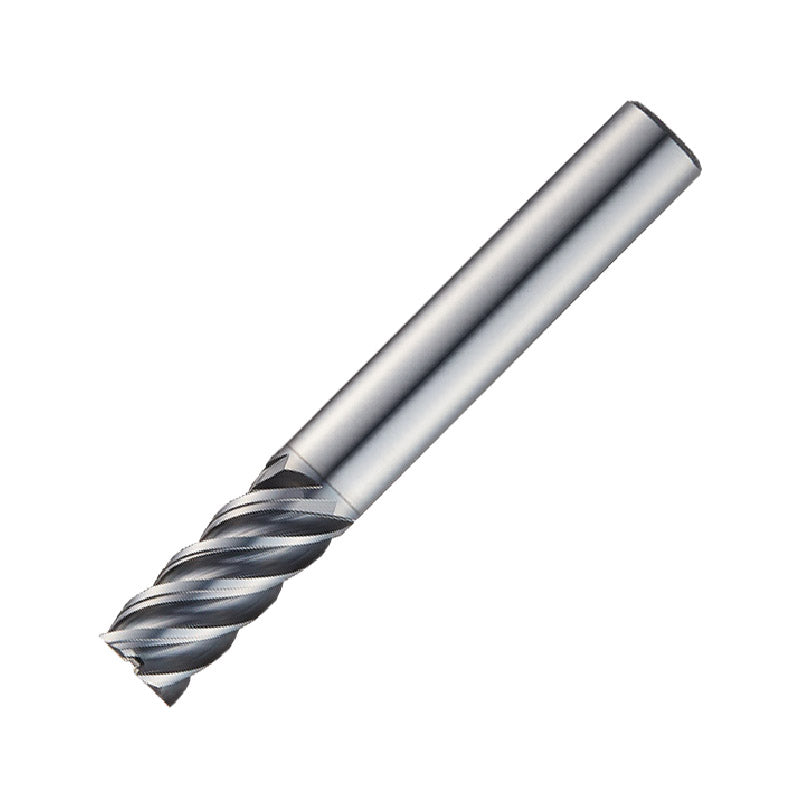
On an end mill, the helix angle describes how steeply the flute winds around the tool axis. A smaller angle gives the tool a straighter, more compact flute path. A larger angle wraps the flute more aggressively around the cutter.
That geometric difference changes several things at once.
Low helix tools usually have a stronger core and a thicker cutting edge section. They feel more rigid in heavy, interrupted, or unstable cuts. The tradeoff is a more abrupt tooth entry and higher radial force, especially in side milling. High helix tools enter the cut more gradually. They spread the load along a longer cutting edge, reduce radial force, and often leave a cleaner wall, but they also create more axial pulling force and have thinner edge sections.
Medium helix tools sit between those two behaviors. They are common because they are forgiving. A 35 to 45 degree tool may not be perfect for every job, but it will handle a wide range of slots, shoulders, profiles, and semi-finishing passes without demanding extreme setup conditions.
Low helix end mills: rigidity first
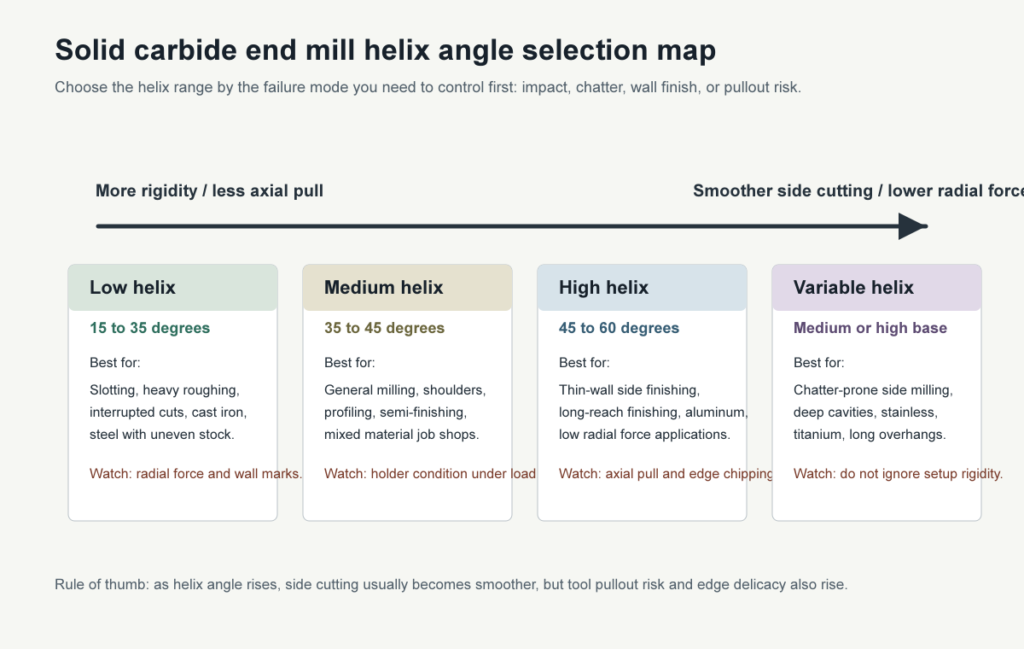
A low helix carbide end mill is usually in the 15 to 35 degree range. The flute is less steep, the tool core remains stronger, and the edge section can resist impact better than a thin high-helix edge. In the cut, axial force stays lower while radial force becomes more dominant.
That combination works well when the cutting load is not gentle.
Low helix tools are a sensible first choice for slotting, rough shoulder milling, interrupted cutting, castings with uneven stock, and heavy stock removal in steel, cast iron, and some hardened or difficult materials. If the operation has repeated entry shocks, scale, keyways, weld interruptions, or inconsistent allowance, the extra rigidity can save the edge.
The weakness shows up during precision side finishing. Because the cutting action is less overlapped, each tooth engagement can feel more like a pulse. On a stable machine this may only show as a slightly rougher texture. On a long tool, weak fixture, or thin wall, the same radial load can turn into vibration, wall deflection, and visible chatter lines.
Use a low helix tool when the question is, “Can this edge survive the load?” Be more cautious when the question is, “Can this wall look good at final size?”
Helix range | Main strength | Best-fit operations | Main caution |
15 to 35 degrees | Strong core, good impact resistance, low axial pull | Slotting, roughing, interrupted cuts, cast iron, steels with heavy stock | Higher radial force can mark walls or excite chatter |
35 to 45 degrees | Balanced rigidity and smooth cutting | General milling, shoulder milling, profiling, semi-finishing | Clamp quality matters when cutting load rises |
45 to 60 degrees | Smooth side cutting, low radial force, good finish | Thin walls, long reach side milling, aluminum finishing, fine profiling | Higher axial pull and thinner edge section |
Variable helix | Reduced harmonic vibration | Long overhangs, deep cavities, difficult materials, chatter-prone finishing | Still needs the right base helix range for the job |
Medium helix end mills: the shop-floor default
Most general-purpose solid carbide end mills fall around 35 to 45 degrees. This is not accidental. In this range, the tool keeps enough core strength for normal roughing and semi-finishing, while the flute angle is high enough to make the cut smoother than a low-helix design.
For many shops, medium helix end mills are the right inventory backbone. They can side mill, bottom mill, contour, and finish ordinary features without forcing the programmer into a narrow parameter window. They also adapt well across carbon steel, alloy steel, stainless steel, cast iron, and many non-ferrous materials when the coating, flute count, and edge prep are chosen correctly.
Medium helix tools are especially useful when the production mix changes often. A job shop may cut a 4140 bracket in the morning and a stainless fixture plate in the afternoon. Keeping every specialized helix angle in stock is expensive. A good 40 degree carbide end mill gives the team a dependable first tool for many of those jobs.
There is one setup detail worth taking seriously: axial force increases compared with low helix tools. In heavy side milling, a worn collet, dirty holder bore, weak clamping torque, or long tool projection can allow the cutter to creep out of the holder. If the cut suddenly goes deeper than programmed, do not blame the tool geometry first. Check toolholding cleanliness, clamping method, runout, and pullout risk.
High helix end mills: smoother side walls and lower radial force
High helix carbide end mills usually sit above 45 degrees, and some tools for aluminum or non-ferrous finishing reach about 55 degrees. The higher helix creates a longer, more gradual cutting contact. Instead of one abrupt impact, the edge enters progressively and shares the load over more of the flute.
That matters in side milling.
When radial cutting force drops, the workpiece is less likely to push away from the cutter. Thin walls, ribs, long unsupported sections, and deep-cavity walls often respond well to a high helix tool. The surface finish improves because the tool cuts more smoothly and excites less vibration. In aluminum and other non-ferrous materials, a sharp high-helix geometry can also help chip evacuation and produce a bright wall finish when the flute polish and coolant strategy support it.
High helix is not a free upgrade. The edge section becomes thinner, so impact resistance drops. The axial component of cutting force rises, which increases the chance of tool pullout. A high helix tool used for heavy slotting in steel, with a marginal collet and deep engagement, can fail quickly. Even when it does not break, chips may pack in deep slots because the flute path is longer and the tool spends more of its time pulling material upward along the helix.
Choose high helix for side finishing, thin-wall work, long overhang finishing, and non-ferrous applications where finish matters. Avoid treating it like a roughing tool for every slot.
Variable helix end mills: when chatter is the real enemy
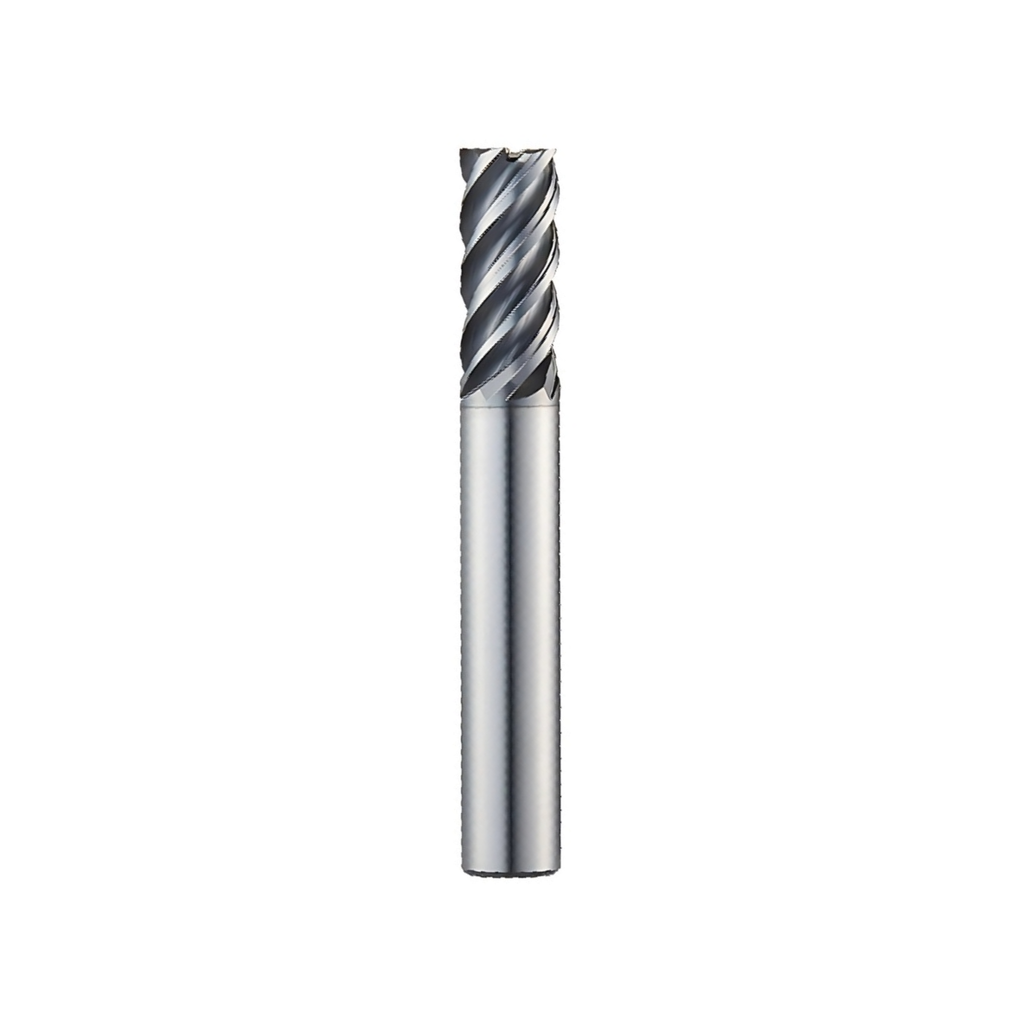
Variable helix end mills use different helix angles or lead patterns across the cutting teeth. The point is not only chip evacuation or edge sharpness. The design changes the timing of tooth engagement so the cutter does not hit the workpiece with the same repeated frequency on every flute.
That helps with regenerative chatter.
In a conventional equal-helix tool, the cutting forces repeat in a regular pattern. If that pattern matches the natural frequency of the machine, spindle, holder, tool, or workpiece, the system can start to sing. The sound is only the warning. The actual damage appears as a wavy wall, chipped cutting edges, poor size control, and shorter tool life.
A variable helix design breaks up that regular excitation. It does not make an unstable setup magically rigid, but it can widen the stable machining window. This is why variable helix end mills are popular for long overhangs, deep cavities, stainless steel, titanium alloys, and thin-wall finishing.
There are two common ways to think about variable helix selection.
Medium-range variable helix tools keep much of the rigidity and material flexibility of a 35 to 45 degree design, then add chatter resistance. They fit roughing and semi-finishing in tougher materials where vibration is present but the tool still needs edge strength. High-range variable helix tools lean toward smooth side cutting and fine surface quality. They fit deep-wall finishing, thin ribs, and long-reach work where radial force and chatter control matter more than heavy stock removal.
Match helix angle to the machining scenario
The best helix angle depends on which failure mode matters most. For roughing, edge survival and rigidity may decide the choice. For side finishing, radial force and vibration often matter more. For thin walls, the tool may need to cut gently even if the material itself is not difficult.
Machining scenario | Recommended helix direction | Why it fits | Setup notes |
Full slotting in steel or cast iron | Low to medium helix | Stronger core and better shock resistance | Keep chip evacuation under control; avoid excessive radial engagement on weak setups |
Heavy roughing with interrupted stock | Low helix | Lower axial pull and stronger edge section | Use stable workholding and conservative entry strategy |
General shoulder milling | Medium helix | Balanced cutting force and good tool life | Check runout and holder condition before increasing depth of cut |
Thin-wall side finishing | High or high-range variable helix | Lower radial force reduces wall push-off | Use light radial stepovers and avoid aggressive spring passes |
Deep cavity side milling with long overhang | Variable helix, often medium or high range | Helps disrupt chatter frequency | Shorten overhang wherever possible; holder quality matters |
Aluminum wall finishing | High helix | Sharp gradual cutting and smoother chip flow | Use polished flutes, adequate chip evacuation, and secure clamping |
Stainless or titanium semi-finishing | Medium variable helix | Better vibration control without giving up too much edge strength | Watch heat, chip thickness, and coolant strategy |
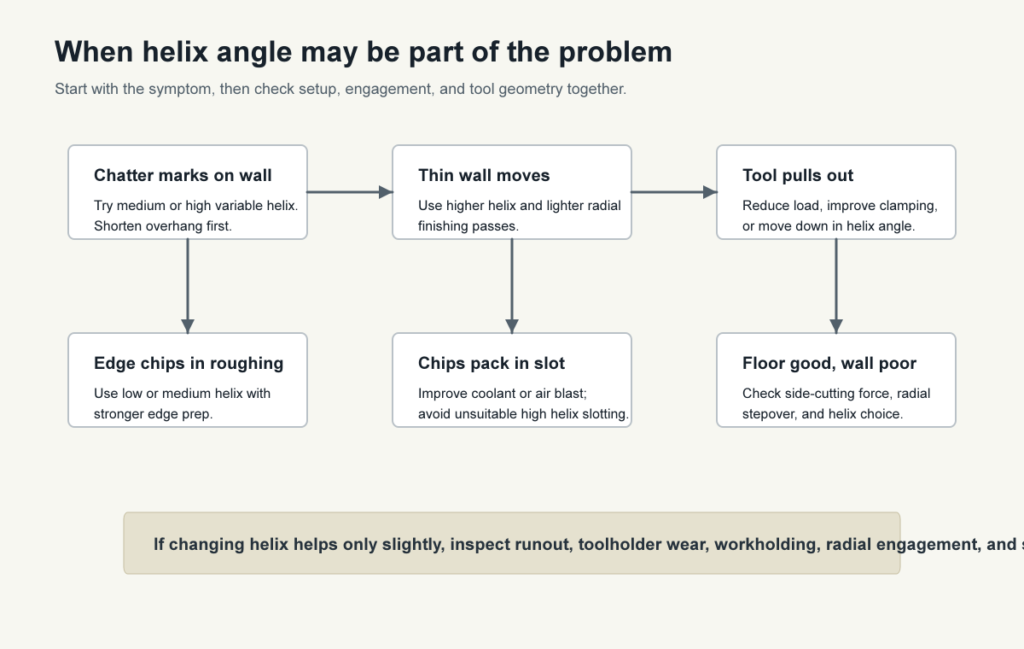
Troubleshooting: when helix angle may be part of the problem
Helix angle is rarely the only cause of a machining issue. Tool runout, toolholder condition, workholding, programmed engagement, coolant, and material variation all matter. Still, certain symptoms point strongly toward a helix mismatch.
If the side wall has regular chatter marks, a low helix tool may be putting too much radial load into a weak setup. A medium or high variable helix tool can help, especially if tool overhang is long. If a thin wall measures oversize or springs back after cutting, radial force is probably moving the part. Try a higher helix, lighter radial stepovers, and a finishing path that leaves uniform stock.
If the cutter pulls out of the holder, the helix may be too high for the current clamping condition, or the cut may be too aggressive for that holder. Clean the holder bore and shank, verify torque, reduce axial depth or radial engagement, and consider a lower helix or stronger clamping system. If edges chip during interrupted roughing, the tool may be too sharp or too high-helix for the shock load. A low or medium helix design with suitable edge prep usually survives better.
Symptom on the machine | Possible helix-related cause | Practical correction |
Regular chatter marks on a side wall | Radial force too high or tooth timing too uniform | Move from low helix to medium/high variable helix; shorten overhang; reduce radial engagement |
Thin wall bends or measures out of tolerance | Cutter is pushing the wall away | Use high helix, light radial passes, sharp edge geometry, and stable finishing allowance |
Tool creeps out of the holder | Axial pull too high for the clamping setup | Improve holder cleanliness and clamping; reduce load; consider medium helix |
Edge chips in interrupted roughing | Edge section too thin or too sharp for impact | Use low or medium helix with stronger edge prep |
Chips pack in a deep slot | High helix flute path and engagement trap chips | Use better coolant/air blast, reduce slot depth per pass, or choose a more suitable slotting geometry |
Finish is acceptable on floors but poor on walls | Tool works in bottom cutting but side cutting force is unstable | Select a smoother side-cutting helix and check radial stepdown strategy |
Buyer checklist for carbide end mill helix selection
For B2B tooling buyers, helix angle should be part of the tool specification, not a detail left to the catalog thumbnail. Before ordering, ask what the tool is expected to do most often: rough slots, finish side walls, cut stainless, machine aluminum, reach deep pockets, or control chatter on thin parts.
Then match helix angle with the rest of the geometry. A high helix tool with the wrong flute count may still clog in aluminum. A low helix tool with the wrong coating may still fail in heat. A variable helix tool with excessive runout will not solve chatter by itself. The full tool package includes carbide grade, coating, flute count, core diameter, corner radius, edge prep, shank tolerance, and recommended cutting data.
For production work, it is worth standardizing a small, deliberate tool set:
– Low or medium helix roughing tools for heavy stock and unstable cutting.
– Medium helix general-purpose tools for everyday steel, stainless, and mixed-material jobs.
– High helix tools for non-ferrous finishing and low-force side cutting.
– Variable helix tools for long overhangs, difficult materials, and chatter-prone features.
That inventory is easier to manage than buying a new cutter for every job, and it gives programmers clear choices when a process has to be adjusted on the machine.

Conclusion
Helix angle is not a catalog detail. It changes how the cutter loads the spindle, holder, workpiece, and cutting edge. Low helix end mills are built for rigidity and impact resistance. Medium helix tools cover the widest range of daily milling work. High helix tools improve side-wall finish and reduce radial force, but they need better clamping and lighter judgment in heavy cuts. Variable helix designs help when chatter, long overhang, or weak part stiffness becomes the limiting factor.
For most CNC shops, the right answer is not one universal helix angle. It is a small set of tools matched to the real work: roughing, semi-finishing, side finishing, thin-wall milling, deep cavities, and difficult materials. HNCarbide can support that selection process with solid carbide end mills built around the application, material, and stability of the setup, so the tool choice starts closer to the process that will actually run on the machine.