How to Choose the Right Carbide End Mill Geometry: Square, Ball Nose, or Corner Radius?
Table of Contents
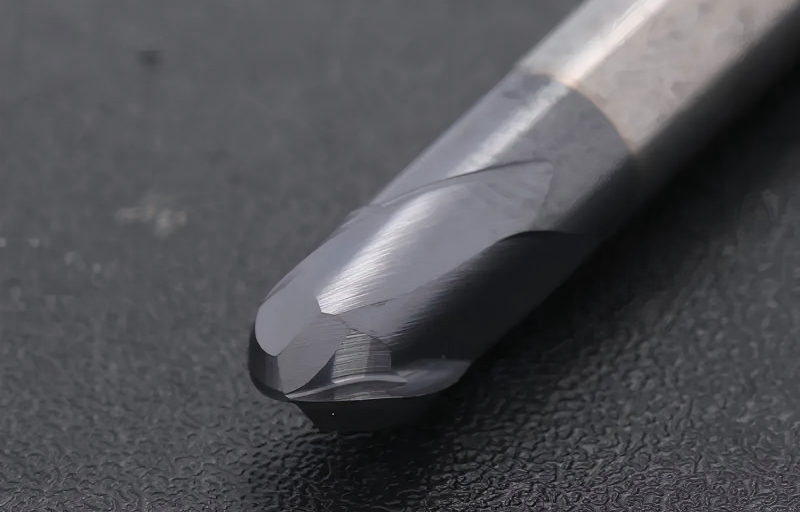
Selecting the correct carbide end mill is one of the most critical decisions in CNC machining. Why do some tools last longer while others chip prematurely? Why does surface finish vary even when cutting parameters remain the same? The answer often lies in end mill geometry — especially head shape, flute count, helix angle, and structural design.
Modern machining applications, especially mold manufacturing, aerospace, automotive, and precision parts production, demand tools that can deliver both high efficiency and exceptional surface quality. Choosing the wrong end mill geometry can reduce tool life by 30–50%, increase vibration, and negatively affect machining accuracy.
This guide explains how to choose the correct end mill geometry based on cutting mechanics, material behavior, and real industrial machining requirements.
What Are the Main Types of Carbide End Mill Head Shapes?
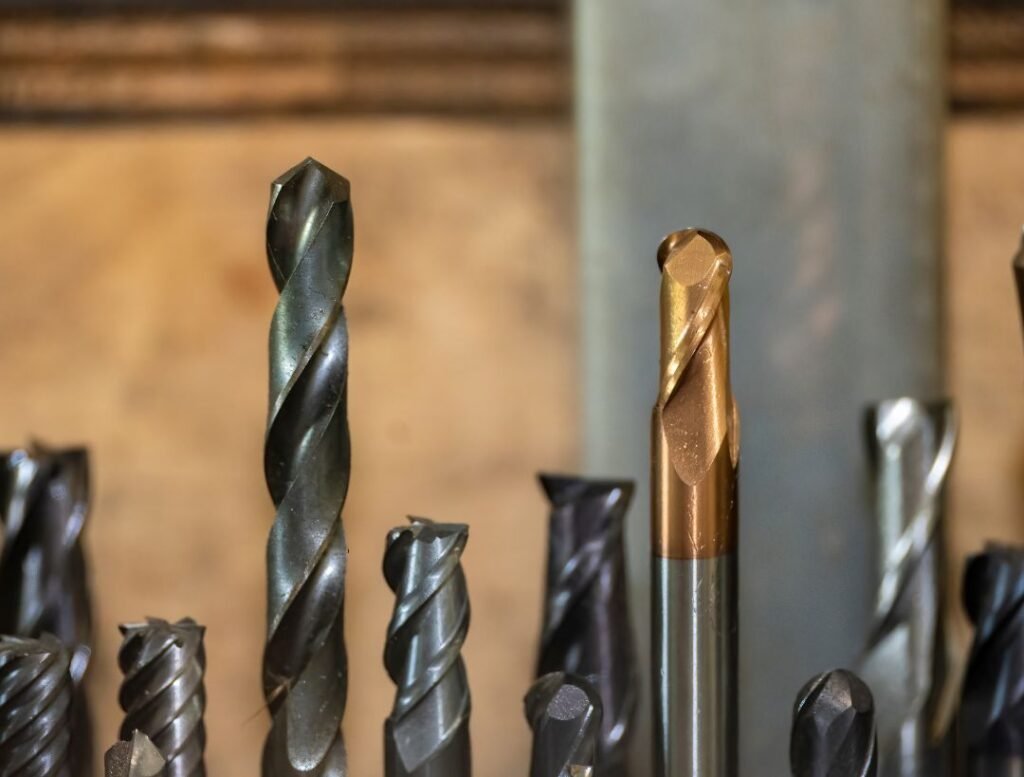
Carbide end mills are primarily classified into three head geometries:
- Square End Mill
- Ball Nose End Mill
- Corner Radius End Mill
Each geometry affects cutting force distribution, edge strength, and machining performance.
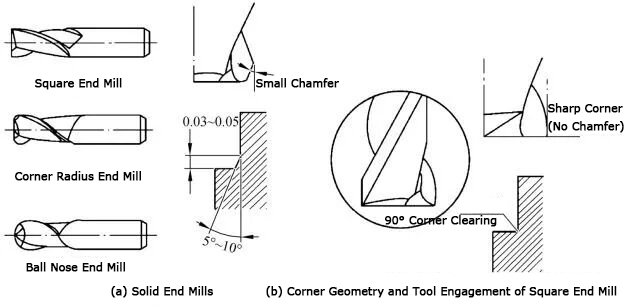
Square End Mills: Why Are They Still the Most Widely Used?
Square end mills feature a flat cutting tip with sharp 90° corners. This design allows precise machining of flat surfaces, slots, and shoulders.
Typical applications include:
- Slot milling
- Step machining
- Profile machining
- Side wall machining
- Keyway cutting
Square end mills provide excellent dimensional accuracy because their sharp corners produce well-defined edges. However, this sharp geometry also concentrates stress at the corners, making them more susceptible to chipping when machining hardened steel or under unstable conditions.
To improve durability, modern carbide square end mills often include micro-chamfers or edge preparation to reduce edge stress concentration.
Ball Nose End Mills: Why Are They Essential for Mold and 3D Surface Machining?
Ball nose end mills feature a hemispherical cutting tip. This geometry provides continuous contact between the cutting edge and the workpiece surface, enabling smooth contour machining.
Ball nose end mills are essential for:
- Mold and die machining
- 3D surface machining
- Curved surfaces
- Aerospace component machining
- Semi-finishing and finishing operations
The absence of sharp corners reduces stress concentration and improves surface finish quality.
High-precision carbide ball nose end mills can achieve dimensional tolerances within ±5 μm, significantly reducing the need for polishing in mold manufacturing.
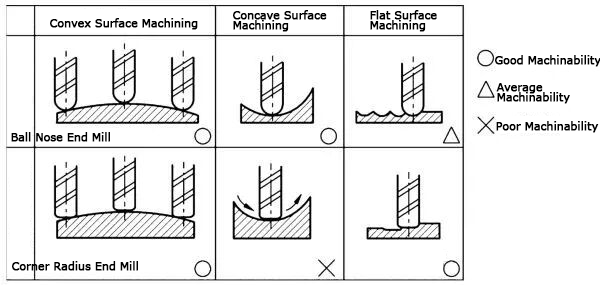
Corner Radius End Mills: Why Do They Offer the Best Balance Between Strength and Precision?
Corner radius end mills combine the advantages of square and ball nose designs. Instead of sharp corners, they feature a small radius at the cutting edge intersection.
This seemingly minor modification dramatically improves tool durability.
Corner radius end mills provide:
- Higher edge strength
- Reduced chipping risk
- Improved cutting stability
- Longer tool life
- Better performance in hardened steel
They are widely used in high-speed machining and hardened material machining.
Comparison of End Mill Head Geometries
The table below summarizes the performance differences:
End Mill Type | Edge Strength | Surface Finish | Tool Life | Best Applications |
Square End Mill | Medium | Good | Medium | Slotting, profiling |
Ball Nose End Mill | High | Excellent | High | Mold finishing, contouring |
Corner Radius End Mill | Very High | Excellent | Very High | Hardened steel, high-speed machining |
Corner radius end mills often provide the best balance between strength and finishing capability.
Peripheral Milling vs End Milling: How Do End Mills Actually Cut?
End mills cut using two main cutting regions:
- Peripheral cutting edges (side cutting)
- End cutting edges (face cutting)
Peripheral Milling: Why Is It Critical for Surface Accuracy?
Peripheral milling uses cutting edges along the cylindrical surface of the end mill.
This method produces flat surfaces, and surface accuracy depends on the cylindrical accuracy of the tool.
Peripheral milling offers:
- Excellent dimensional accuracy
- Reduced vibration
- Better surface consistency
This is commonly used for side milling and slotting operations.
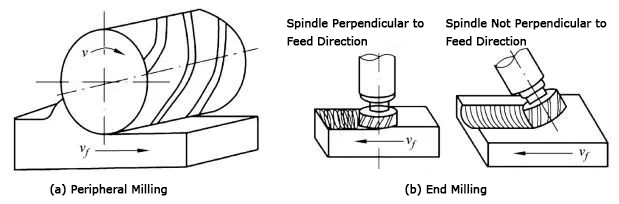
End Milling: Why Does Machine Alignment Matter?
End milling uses cutting edges on the bottom of the tool.
Surface quality depends heavily on machine alignment. If spindle alignment is incorrect, uneven surfaces and tool marks may occur.
Proper machine rigidity and alignment are essential for optimal performance.
How Does Flute Count Affect Cutting Performance?
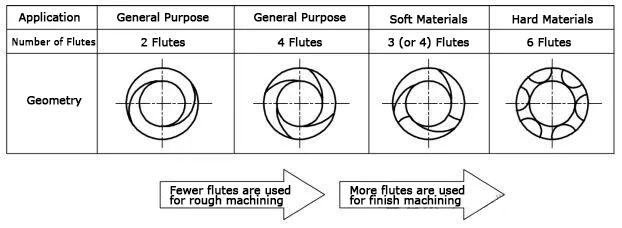
Flute count directly affects chip evacuation, cutting stability, and surface finish.
Flute Count Comparison Table
Flute Count | Chip Evacuation | Tool Strength | Surface Finish | Recommended Materials |
2 Flutes | Excellent | Medium | Good | Aluminum, plastics |
3 Flutes | Very Good | Good | Very Good | General machining |
4 Flutes | Good | High | Excellent | Steel, stainless steel |
5–6 Flutes | Moderate | Very High | Superior | Hardened steel finishing |
Fewer flutes improve chip evacuation, while more flutes improve tool strength and surface finish.
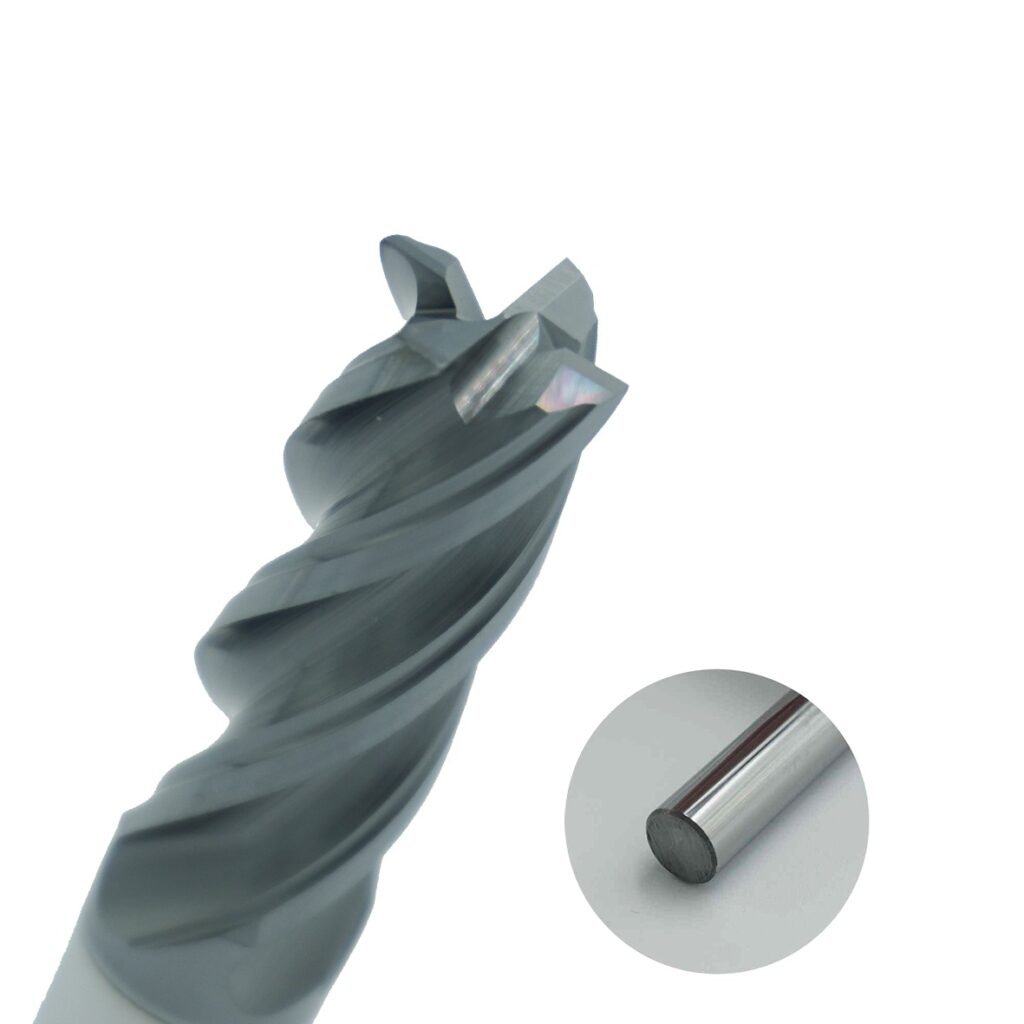
3-flute carbide end mills have become increasingly popular because they offer an optimal balance.
Why Is Helix Angle Critical for Stability and Surface Finish?
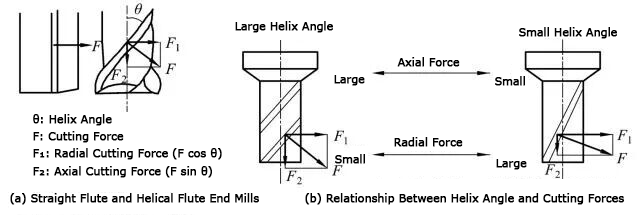
Helix angle determines how cutting forces are distributed during machining.
Helix angle typically ranges between:
- 30° for general machining
- 35°–45° for steel and stainless steel
- 45°+ for aluminum machining
Higher helix angles provide:
- Reduced vibration
- Improved chip evacuation
- Better surface finish
- Lower cutting forces
Helix Angle Performance Comparison
Helix Angle | Cutting Force | Chip Removal | Surface Finish | Best Applications |
30° | Medium | Good | Good | General machining |
35° | Lower | Very Good | Very Good | Steel machining |
45° | Low | Excellent | Excellent | Stainless steel |
45°+ | Very Low | Superior | Excellent | Aluminum |
Higher helix angles improve machining stability and efficiency.
Why Do Chipbreaker Grooves Improve Machining Efficiency?
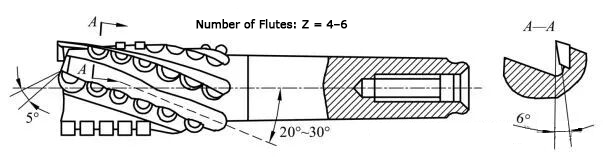
Chipbreaker grooves divide chips into smaller segments.
This provides several benefits:
- Improved chip evacuation
- Reduced heat buildup
- Lower cutting resistance
- Extended tool life
Chipbreaker end mills are widely used in roughing operations.
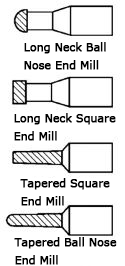
How Do Specialized End Mill Structures Improve Deep Cavity Machining?
Certain applications require special tool designs.
These include:
- Reduced neck end mills
- Long reach end mills
- Mold machining end mills
These designs allow machining of deep cavities and complex geometries while maintaining rigidity.
How Does Carbide Material and Coating Affect End Mill Performance?
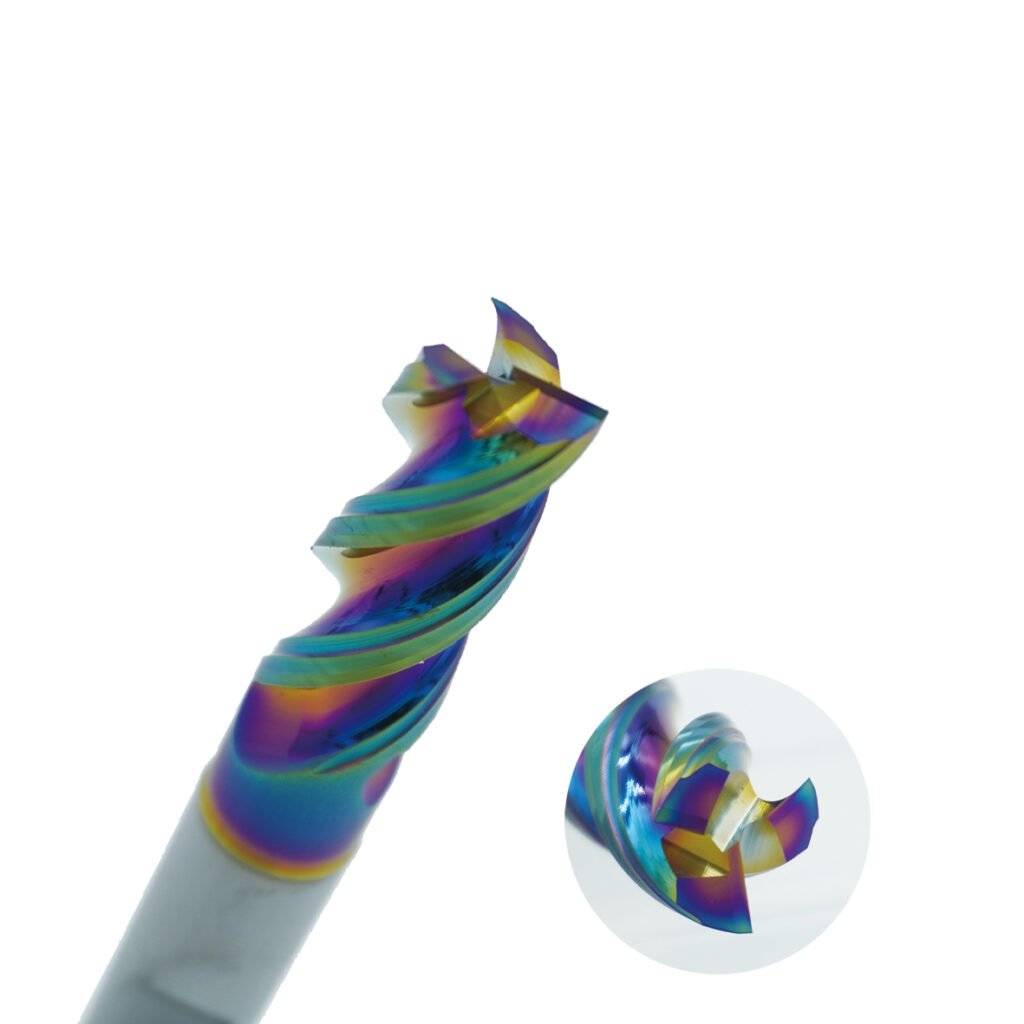
Modern carbide end mills use ultra-fine grain carbide substrates combined with advanced coatings such as:
- AlCrN coating
- TiAlN coating
- Nano coatings
These coatings improve:
- Wear resistance
- Heat resistance
- Tool life
For example, AlCrN-coated carbide end mills can operate at temperatures exceeding 900°C.
Practical Selection Guide: How to Choose the Best Carbide End Mill?
Use this table as a quick reference:
Application | Recommended End Mill Type | Flutes | Helix Angle |
Aluminum machining | Square or corner radius | 2–3 | 45°+ |
Steel machining | Corner radius | 4 | 35° |
Hardened steel machining | Corner radius | 4–6 | 35° |
Mold finishing | Ball nose | 2–4 | 30° |
High-speed machining | Corner radius | 4 | 35–40° |
Corner radius carbide end mills provide the best overall performance for most modern machining applications.
Why High-Quality Carbide End Mill Geometry Matters More Than Ever?
As machining speeds increase and materials become harder, tool geometry becomes increasingly important.
Optimized carbide end mill geometry provides:
- Higher productivity
- Better surface finish
- Longer tool life
- Reduced machining cost
Choosing the correct end mill geometry is essential for achieving consistent and reliable machining performance.
High-performance carbide end mills with optimized flute geometry, helix angle, and coating can significantly improve machining efficiency in modern CNC environments.

Conclusion: Geometry Is the Key to End Mill Performance
End mill performance is not determined by diameter alone. Geometry plays a decisive role in machining efficiency, accuracy, and durability.
Understanding the relationship between head shape, flute count, helix angle, and structural design allows manufacturers to optimize machining processes and reduce tool wear.
Whether machining aluminum, steel, or hardened materials, selecting the correct carbide end mill geometry ensures superior performance and long tool life.