Skip to content
Drilling Hardened Steel with Solid Carbide: A Practical Playbook for HRC40–65
Table of Contents

Hardened steel is unforgiving. It doesn’t “warn you” the way mild steel does—one small setup mistake and the drill chips on entry, squeals, or snaps mid-hole. The good news: consistent success is absolutely repeatable when you treat hardened drilling as a system: tool + grade/coating + geometry + runout control + chip evacuation.
This guide is written for real shop decisions—how to pick a solid carbide drill for hardened steel, how to start speeds & feeds safely, and how to troubleshoot the common failures without guessing.
What counts as “hardened steel” for drilling?
In milling, people argue about definitions. In drilling, the practical definition is simpler: once you’re above ~HRC40, everything gets harder to drill cleanly, and above ~HRC50 the window gets narrow.
Practical hardened-steel ranges for drilling
Hardness | Typical parts you’ll see | What changes in drilling |
HRC 35–40 | Pre-hard mold steel, some shafts | Tool still survives mistakes; heat rises fast |
HRC 40–48 | Heat-treated alloy steels, dies | Entry chipping risk increases; hole size control gets harder |
HRC 48–55 | Die components, hardened wear parts | Carbide becomes “required”; runout and spotting quality dominate |
HRC 55–65 | Tool steels / hardened inserts / punches | Very small process window; chip evacuation + rigidity are everything |
If you’re unsure, treat any steel that’s heat-treated + above ~HRC40 as “hardened” for the purpose of tool choice and setup.
Why carbide is required (and why it still fails)
Rigidity + hot hardness
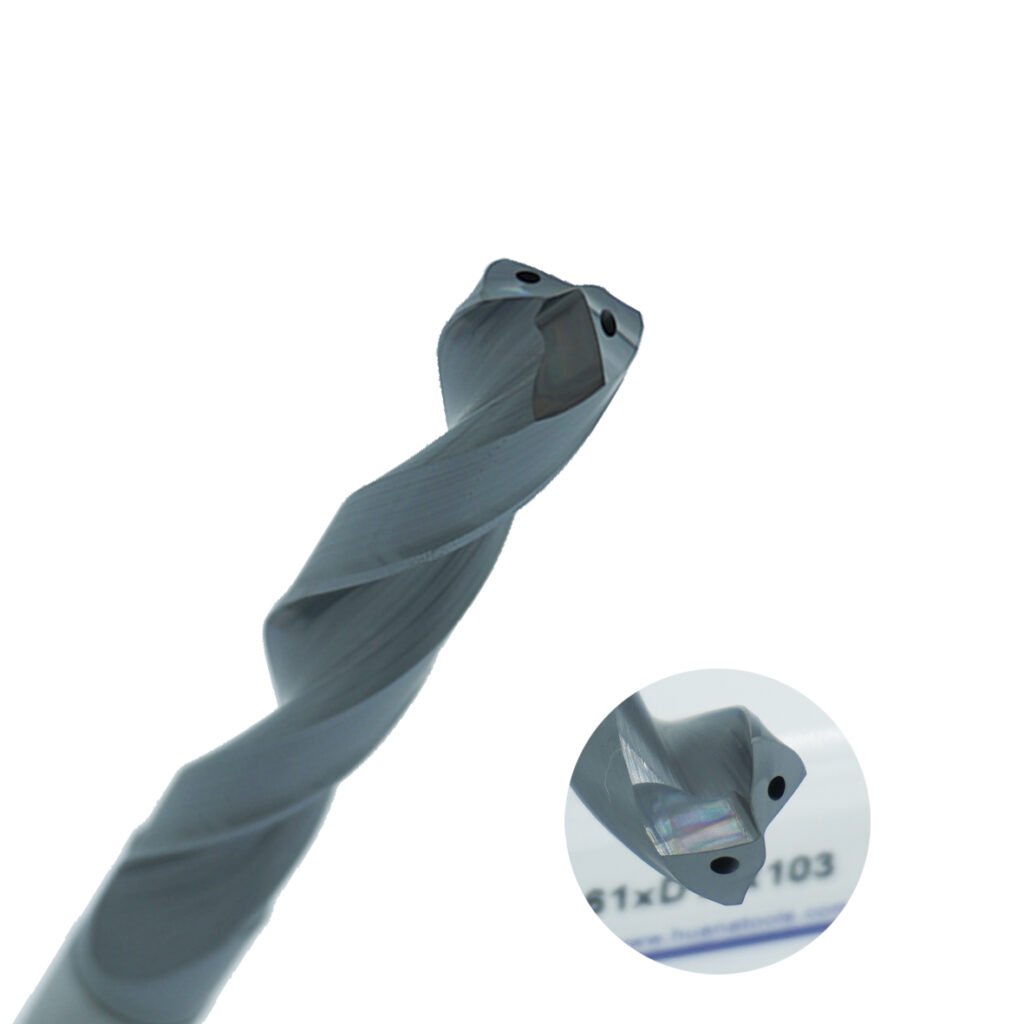
Solid carbide drills hold cutting geometry under heat far better than HSS or cobalt. That’s why most shops move to carbide once hardness climbs.
The trade-off: brittleness
Carbide’s strength comes with brittleness. In hardened steel, edge chipping is the #1 early failure mode—often caused by runout, poor spotting, interrupted entry, or chip packing.
Runout matters more than people think. A commonly cited target for solid-carbide drilling is ≤ 0.0002 in TIR (and the measurement setup matters).
Grade selection: what “industrial grade” should deliver
Tool catalogs love vague words (“premium micrograin”). For hardened steel drilling, “industrial grade” should show up in repeatability, not marketing:
- Consistent edge prep(not random sharp vs honed tools within the same lot)
- Stable geometry control(point + web thinning + margins)
- Predictable coating quality(no flaky edges, no patchy color/buildup)
- Traceability(batch marking + inspection record that matches the batch)
If a supplier can’t answer these clearly—or can’t provide a recent inspection report—assume you’re buying variability.
Coatings: what helps in hardened steel
In hardened drilling, coatings are mostly about heat management + wear resistance and reducing the chance the edge degrades before it stabilizes.
What coatings do (in plain terms)
- Heat barrier / oxidation resistance:helps the cutting edge survive high temperatures (common with TiAlN/AlTiN families).
- Adhesion + wear resistance:helps coating stay on under abrasion and heat cycling.
- Lubricity:can help in some materials, but hardened steel drilling is usually dominated by heat + edge integrity more than “slipperiness.”
Coating selection logic for hardened steel drilling
Coating family (common naming) | Where it tends to shine | What to watch |
TiAlN / AlTiN (high-temp PVD) | General hardened steels; heat-heavy drilling; dry/MQL capable setups | Needs stable runout; overheats if chip evacuation is poor |
AlCrN | Very wear-resistant; strong in abrasive / difficult cutting conditions | Often benefits from stable coolant strategy and rigid setup |
TiSiN / AlTiSiN / “nano” variants (varies by maker) | High heat + wear; some “hardened series” drills use these families | Quality varies a lot by supplier—judge by results, not the label |
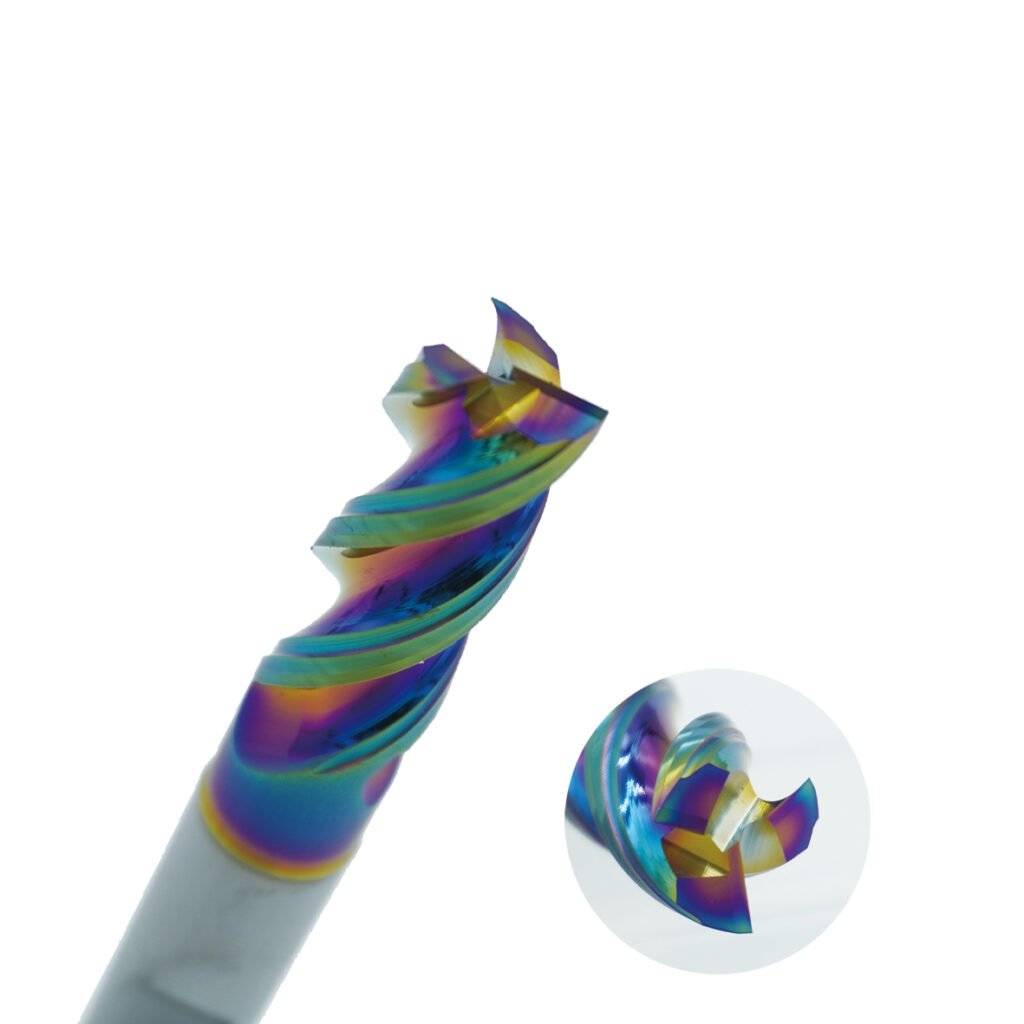
DLC | Not a hardened-steel coating (more for non-ferrous / low adhesion cases) | Wrong choice can worsen performance |
Coating failure symptoms (fast diagnosis)
- Chipping on the first 0.5–1D:usually setup/entry instability, not coating
- Rapid flank wear + blue/brown heat tint:speed too high, chips recutting, or coolant not reaching edge
- “Peeling” or patchy coating near cutting edge:coating adhesion/process quality issue (or severe thermal shock)
Geometry choices that matter most
For hardened steel, your drill geometry must balance entry stability + core strength + chip flow.
Point design (entry stability)
A stable point design reduces the initial shock that chips edges. If you see consistent entry chipping, focus on:
- Better spotting strategy (next section)
- Lower initial feed for the first ~0.5D (gentle engagement)
- Lower runout and more rigid holder
Web thickness / core strength
A stronger core resists breakage, but too much web thickness raises thrust and heat. Hardened-steel drills often use web-thinning strategies to keep thrust manageable.
Flute volume vs strength
More flute volume evacuates chips better—but weakens the body. In hardened steel, chips are smaller and hotter; you want reliable evacuation without weakening the drill. This is where “hardened series” geometries differ from general-purpose drills.
This is where most failures come from
1) Control runout (don’t skip this)
Aim for very low TIR and measure it in a meaningful way (gauge length + holder type). Even “acceptable” runout values can slash tool life in carbide drilling.
Practical tips
- Prefer high-quality collet chucks or hydraulic holders for best runout control (and keep them clean)
- Minimize stickout
- Verify runout at the same gauge length you actually cut with
2) Rigid holding + short stack
Hardened drilling punishes flex. If the stack is long (spindle → holder → extension → drill), expect chipping and oversize holes.
3) Spotting strategy
A good spot is not optional when accuracy matters in hard materials.
- Spot drill angle should support entry without forcing the carbide drill to “skate.”
- Avoid overly deep spotting that causes a hard interruption at the spot edge.
4) Coolant method (pick one and do it well)
- Through-coolant (TSC)is ideal for deeper holes and consistency.
- Flood coolant can work for shallow holes if chip evacuation is clean.
- Thermal shock can chip carbide if coolant delivery is inconsistent.
Speeds & feeds: safe starting logic
Every brand has its own charts, but the safest approach is:
1.Start conservative based on hardness
2.Prove stable chip evacuation
3.Increase feed before speed (most of the time) to avoid rubbing
One useful reference point: Haas published cutting values for carbide drills including a hardened-steel group around HRC ~55 with cutting speeds around ~98 SFM as a starting value.
Another drill feed/speed reference (older but practical) lists surface speeds and feed-per-rev ranges for hardened steel 40 HRC+.
Conservative starting points
Hardness | Starting cutting speed (SFM) | Starting cutting speed (m/min) | Feed per rev (ipr) small drills | Feed per rev (ipr) mid drills |
HRC 40–45 | 120–160 | 37–49 | 0.0006–0.0012 | 0.0012–0.0020 |
HRC 45–55 | 80–120 | 24–37 | 0.0005–0.0010 | 0.0010–0.0018 |
HRC 55–65 | 50–90 | 15–27 | 0.0004–0.0008 | 0.0008–0.0015 |
These ranges align with common published starting recommendations for carbide drilling in harder groups (use your maker’s chart when available, then tune from there).
Turning SFM into RPM (quick math)
- RPM = (SFM × 3.82) / Drill diameter (inches)
Then: - Feed (IPM) = RPM × IPR
If you’re metric:
- RPM = (1000 × Vc) / (π × D(mm))
Pecking vs no-pecking
This depends on coolant delivery and depth. Many modern carbide drilling guides recommend no peck in stable deep-hole conditions (especially with proper coolant and chip evacuation), because pecking can increase rubbing and thermal cycling.
Other application guides recommend step feeding/pecking beyond ~3×D, especially without ideal evacuation.
Practical rule
- 0–3×D:try no-peck first (if chips clear cleanly)
- 3–5×D:no-peck if TSC is strong and chips evacuate; otherwise light pecks
- 5×D+:plan a deep-hole strategy (TSC + parameters designed for evacuation)
Deep hole strategy (what actually works)
- Keep chips short and moving
- Reduce risk at breakthrough (many guides reduce speed/feed near breakthrough to prevent edge damage
- Don’t let the drill rub during retracts

FAQ
1) Can I drill HRC60 with carbide on a light machine?
Sometimes, but success depends more on rigidity + runout + evacuation than spindle power. If you can’t hold low runout and stable feed, tool life will be unpredictable.
2) Do I always need through-coolant?
Not always for shallow holes, but it becomes a big advantage as depth increases and when chips start recutting.
3) Should I peck hardened steel?
Pecking is not automatically “safer.” In many carbide drilling guides, stable no-peck drilling is preferred when evacuation is strong. Use pecking mainly when evacuation is not reliable.
4) What’s the single best way to prevent entry chipping?
Control runout and stabilize entry (spotting + gentle engagement).
5) Why does my drill wear fast but never chips?
Often excessive heat: speed too high, chips recutting, or coolant not reaching the edge consistently.
6) Is AlCrN “better” than AlTiN for hardened steel?
It can be, depending on the application and coating process. Published studies and maker data often show differences in wear resistance and performance under certain conditions. The right answer is: match coating + geometry to your heat and wear mode—and validate with a controlled test.
7) What runout should I target for solid carbide drills?
A commonly cited target is ≤ 0.0002 in TIR, measured with a meaningful setup (gauge length + holder type).
8) My holes are accurate but tool life is poor—what next?
Look at chip shape/evacuation and thermal load (speed vs feed balance), then validate coating/grade consistency by testing multiple drills from the same batch.