Solid Carbide End Mills for CNC Machining: DIN-Standard Precision You Can Trust
Table of Contents
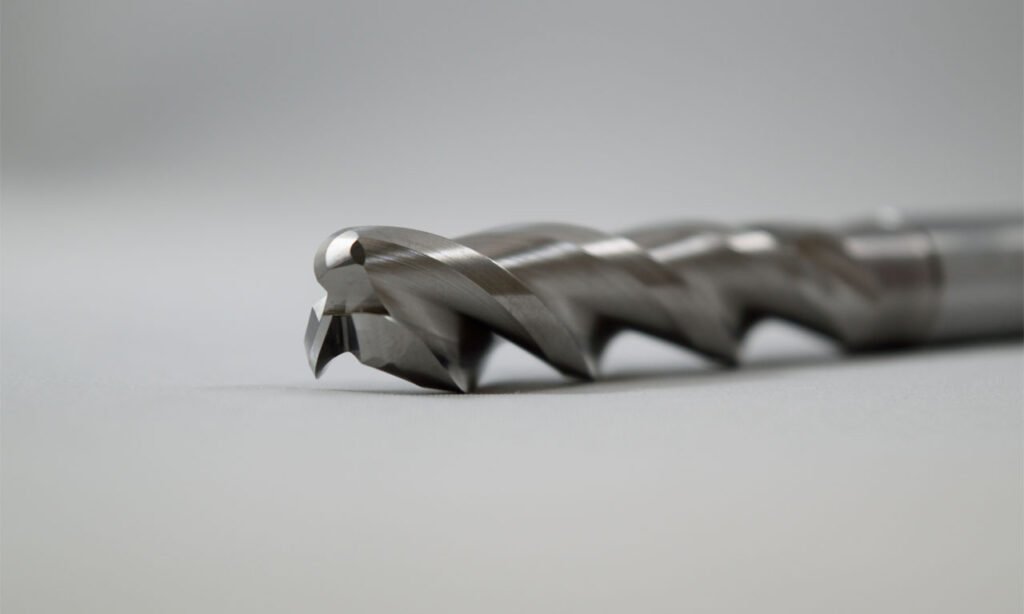
In modern CNC machining, the end mill is no longer “just another cutter.” For many shops, the choice between a basic HSS end mill and a high-performance solid carbide end mill is the difference between fighting chatter all day… and running lights-out with predictable tool life.
This article walks through how solid carbide end mills work, why DIN-standard geometry matters, and how to pick speeds, feeds, coatings, and flute counts for real-world jobs. It’s written for machinists, manufacturing engineers and CNC programmers who care about both surface finish and cost per part.
Throughout the article, we’ll reference HNCarbide’s DIN-standard solid carbide end mill series, designed to meet standards such as DIN 6527 / DIN 844 commonly used by leading German toolmakers.
What Is a Solid Carbide End Mill?
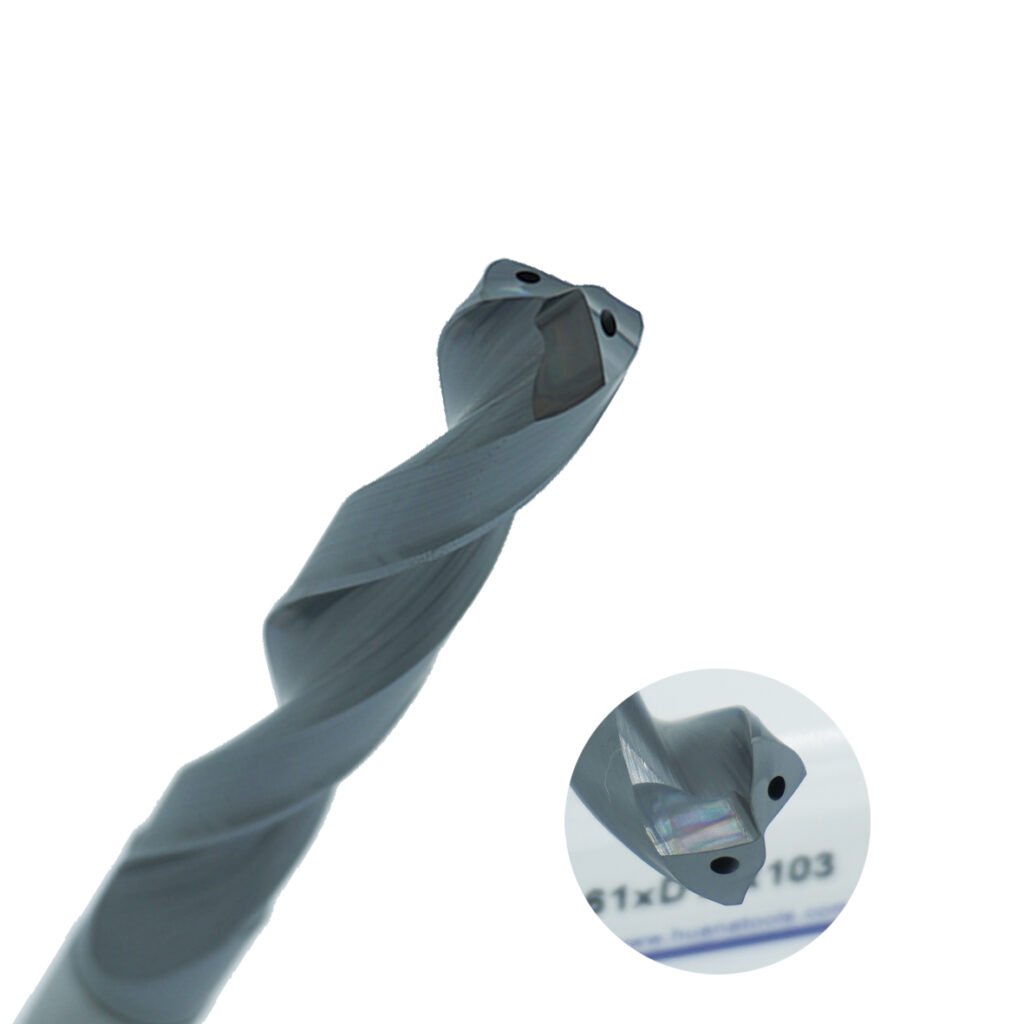
A solid carbide end mill is a rotary cutting tool made from cemented carbide (usually tungsten carbide particles in a cobalt binder).
This composite has:
- Very high hardness(typically > 1600–1800 HV, much higher than HSS)
- High hot hardness– it keeps its strength at temperatures where HSS has already softened
- Excellent wear resistance, especially when combined with modern PVD coatings
Compared with HSS or basic coated steel tools, solid carbide end mills:
- Run at 2–3× higher cutting speedsin many materials
- Hold tighter tolerances for longer
- Are stiffer (important for small-diameter end milling)
- Offer better tool life in abrasive or hard materials (stainless, tool steels, high-temp alloys)
“End mill carbide” vs. “end mill bit”
Online, you’ll see terms like end mill bits, end mill carbide, solid carbide end mill bits, etc. In professional machining:
- End mill= the proper term for the cutter
- Bitis more common in woodworking and hobby CNC, but buyers still search for “1/4 end mill bit”or “1/2 inch end mill bit” when they really mean a metal-cutting end mill.
On your product page, it’s smart to mention both:
“1/2 carbide end mill (also known as a 1/2 inch end mill bit)”
This way, customers using either term will find the correct end mill milling cutter.
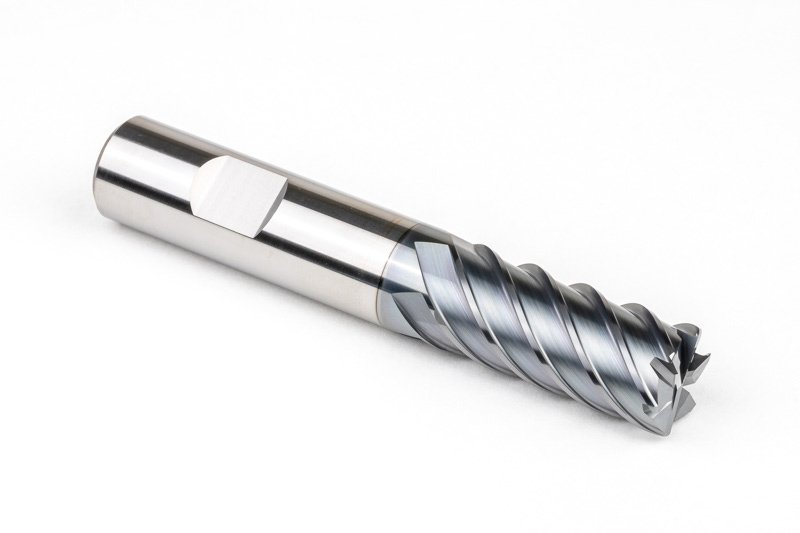
Basic structure of a solid carbide end mill
Key elements:
- Shank– clamped in the tool holder (DIN 6535 HA/HB for cylindrical shanks).
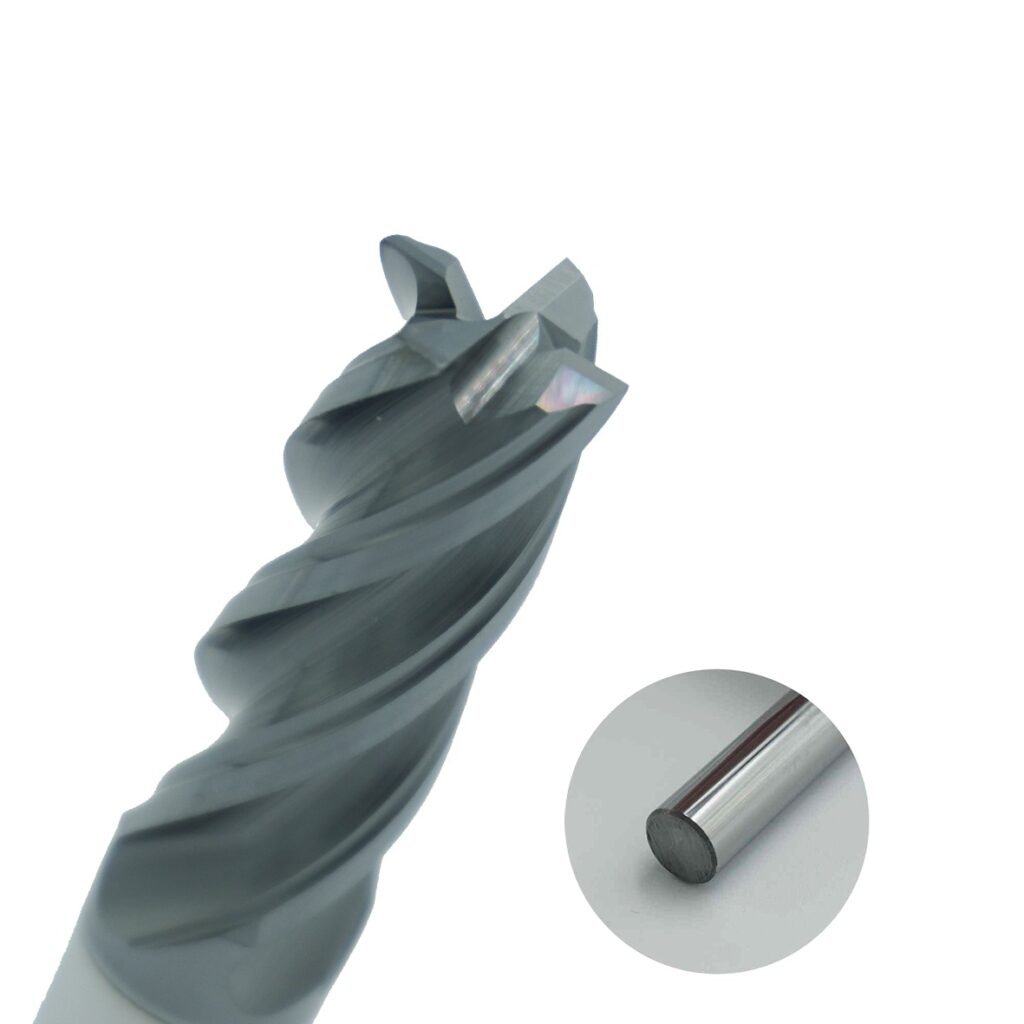
- Flutes– helical grooves that form the cutting edges and evacuate chips
- Cutting edges– rake and relief angles tuned to the material (e.g. high-shear geometry for aluminum)
- End geometry– square end mill, corner radius, ball nose, center cutting end mill, etc.
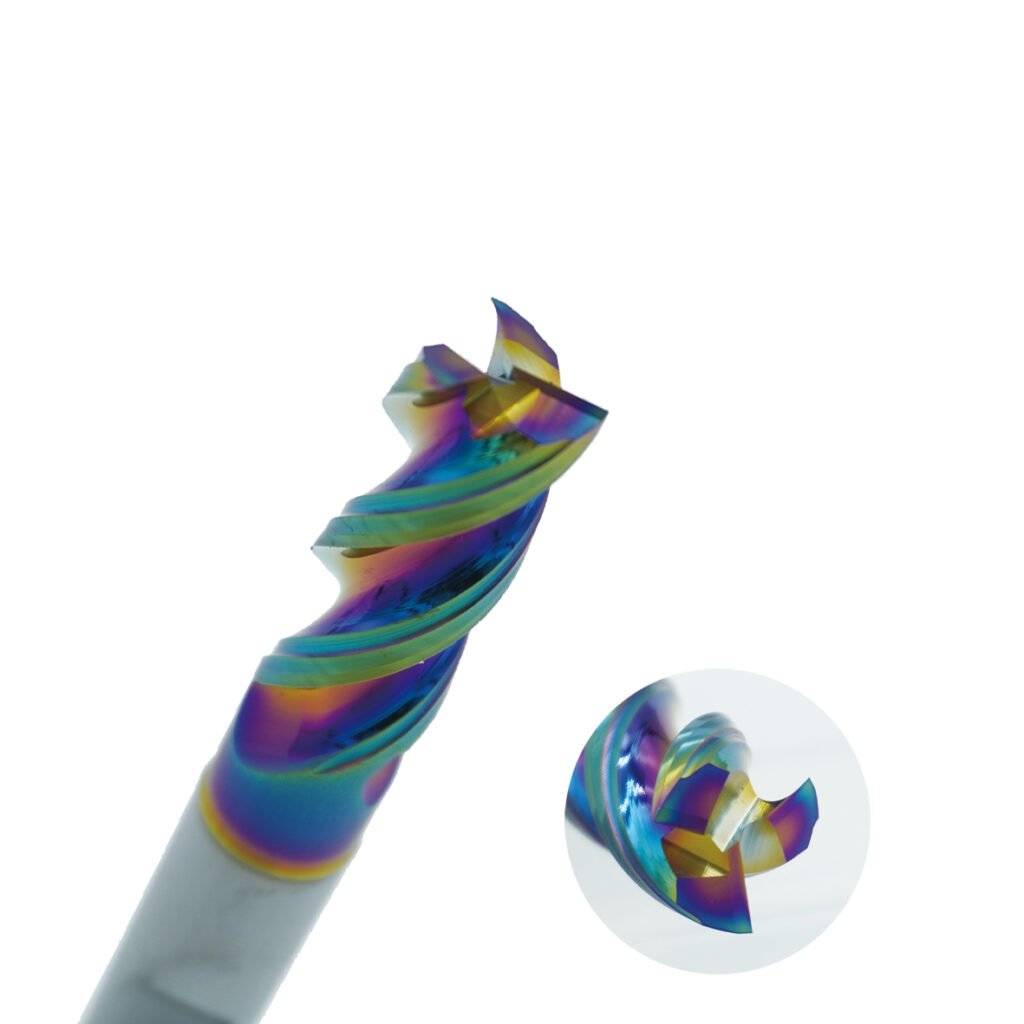
- Coating– thin PVD layer (e.g. TiAlN, TiSiN, DLC, AlTiCrN) that boosts wear and heat resistance
HNCarbide’s DIN-standard solid carbide range follows DIN 6527 (short/long versions, Type N) and DIN 844 geometries, ensuring compatibility with European and global CNC standards.
Geometry and Types of Solid Carbide End Mills
Choosing geometry is where many shops unlock major performance gains. Below are the most common types used in CNC machining.
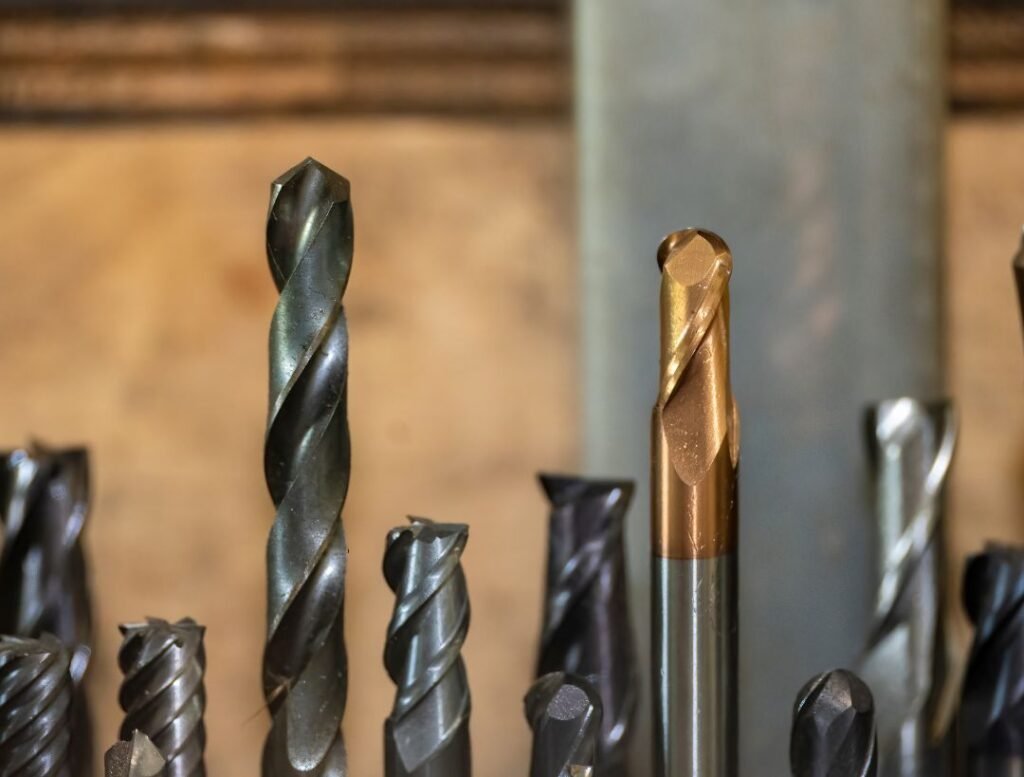
- Flat / Square End Mill– flat tip, ideal for slotting, facing, pocketing and general purpose milling
- Ball End Mill– hemispherical tip for 3D surfaces, molds, fillets
- Roughing End Mill– serrated cutting edge for high metal removal rate (MRR); often called “corn cob” or “hogging” end mills
- Tapered End Mills– conical profile used for deep cavities, electrodes, and mold walls
Role of helical end mills
Most modern tools are helical end mills rather than straight-flute. The helix angle (e.g. 35–45° on many DIN 6527 tools) helps:
- Smooth chip evacuation
- Reduce peak cutting forces
- Improve surface finish
- Lower vibration in high-speed machining
Specialized geometries like helical solutions end mills (high-performance families optimized for specific materials) use variable helix and variable flute spacing to further suppress chatter.
Flute count: 2, 3, or 4 flutes?
2 flute carbide end mill
Larger chip space
Best for soft, gummy materials (e.g. aluminum, plastics)
Typical choice for a 2 flute end mill for aluminum
3 flute end mill
Good compromise between chip space and strength
Common for high-speed machining in aluminum and stainless
4 flute end mill(and 5 flutes in high-performance tools)
Higher feed rate potential (more teeth in the cut)
Smaller chip space – better for steels, where chips are short and brittle
On product pages, it’s helpful to clearly label “2 flute or 4 flute end mill?” usage guidelines so buyers select the correct tool.
Common Solid Carbide End Mill Geometries
Geometry | Typical Use | Best Workpiece Materials | Finish Quality | Typical Feed Range (mm/min)* |
Flat / Square end mill | Slotting, facing, pockets | Mild steel, alloy steel, aluminum | Medium–High | 800–2,000 |
Ball end mill | 3D contouring, molds, fillets | Mold steel, tool steel, hardened alloys | High | 600–1,800 |
Roughing end mill | Heavy stock removal, roughing | Stainless steel, tool steel, cast iron | Low–Medium | 1,200–3,000 |
Tapered end mill | Deep walls, electrodes, 3D mold walls | Aluminum, mold steel | High | 800–2,200 |
*Assumes a typical 3–4 flute solid carbide end mill at moderate radial/axial engagement on a stable machining center, with properly chosen speeds & feeds. Data is consistent with modern carbide recommendations from European tool catalogs.
HNCarbide’s DIN-6527 square end mills and roughing end mills can be positioned in your catalog using a table similar to this, so users know exactly where each series fits.


Coating Technologies for Carbide End Mills
Uncoated carbide still works well in soft materials, but coatings turn a good tool into a production tool.
Modern PVD coatings increase:
- Surface hardness
- Oxidation resistance (hot hardness)
- Abrasion and crater wear resistance
- Lubricity (lower friction and built-up edge)
Common coatings on solid carbide end mills:
- TiAlN (Titanium Aluminum Nitride)– classic high-temperature coating for steels and stainless; great at high cutting speeds
- TiSiN (Titanium Silicon Nitride / TiAlSiN variants)– even higher hot hardness, particularly suited for hard steels and high-speed machining
- DLC (Diamond-Like Carbon)– ultra-low friction, ideal for aluminum, copper, and non-ferrous materials
- AlTiCrN (Aluminum Titanium Chromium Nitride)– advanced coating with excellent wear resistance in hardened steels and high-temp alloys
Typical Coatings Used on HNCarbide-Style Solid Carbide End Mills
Coating | Approx. Hardness (HV) | Typical Max Working Temp (°C) | Best For | Key Benefit in End Milling |
TiAlN | ~3000–3300 | ~800–900 | Alloy steels, stainless, tool steels | High hot hardness, great for dry or MQL |
TiSiN / TiAlSiN | ~3300–3600 | ~1,000+ | Hardened steels (>50 HRC), high-speed machining | Outstanding wear resistance at high speed |
DLC | ~2500–3000 | ~250–350 (limited by substrate temp) | Aluminum, copper, non-ferrous | Very low friction, minimizes built-up edge |
AlTiCrN | ~3200–3500 | ~1,000+ | Hardened steels, high-temp alloys, Inconel | Excellent abrasion and fatigue resistance |
Values are representative of modern commercial coatings from European and Asian coating suppliers and are consistent with published technical data.
On your website, you can highlight HNCarbide series as for example:
- HNCarbide “UNI TiAlN” DIN 6527– universal square end mill for steel and stainless
- HNCarbide “ALU DLC” high-helix series– optimized 2 flute end mill for aluminumwith polished flutes and DLC coating
- HNCarbide “INOX TiSiN” series – 4 flute end mill for stainless and high-temp alloys
Speeds and Feeds for Solid Carbide End Mills
The fastest way to destroy a premium solid carbide tool is to guess speeds and feeds. Let’s quickly define the key terms and show a practical example.
Key definitions
- Cutting speed (Vc)– surface speed at the tool’s cutting edge, in m/min
- Spindle speed (n, RPM)– revolutions per minute
- Feed per tooth (fz)– how far the tool advances per tooth per revolution (mm/tooth)
- Feed rate (Vf)– table feed, in mm/min
- Depth of cut– axial depth (ap) and radial engagement (ae)
Most CAM systems include an end mill speeds and feeds calculator or end mill rpm calculator based on these formulas. Online tools (such as manufacturer charts or independent calculators) use the same logic.
Recommended cutting speeds for solid carbide
Modern references for carbide give higher Vc than older HSS charts. Typical recommended ranges for a 10 mm solid carbide end mill:
Example Speeds & Feeds (Ø10 mm solid carbide end mill)
Material | Surface Speed Vc (m/min) | fz per Tooth (mm) | Approx. RPM (Ø10 mm) | Typical Feed Rate (mm/min, 3 flutes) |
Aluminum alloys | 250–450 | 0.05–0.15 | 8,000–14,000 | 1,200–6,300 |
Mild steel (C45, etc.) | 150–220 | 0.04–0.10 | 4,800–7,000 | 600–2,100 |
Stainless steel (304, 316) | 80–150 | 0.03–0.08 | 2,500–4,800 | 230–1,100 |
Values are starting points with TiAlN or similar coatings on a rigid machining center, flood or MQL coolant as appropriate.
Real-World Applications and Market Trends
Where solid carbide end mills dominate
Aerospace
High-speed aluminum machining with 2 flute end mill aluminum and DLC coatings
Trochoidal roughing of titanium and Inconel with AlTiCrN-coated 4–5 flute tools
Automotive and e-mobility
High-volume machining of cast irons and steels using multi-flute square end mills
Precise pockets and slots in transmission and motor housings
Die & mold
Ball end mills for hardened mold steels (50–60 HRC) with TiSiN coatings
Tapered end mills for deep cavities and electrodes
Precision parts & micro-machining
Micro tools like 1mm end mill, 1/32 end mill, or 1/16 end mill for medical and electronics applications
Larger tools such as 1/4 ball end mill, 1/4 flat end mill, or 1-1/16 end mill for heavy milling operations
HNCarbide can structure its catalog to clearly cover this full range—from micro 1/8 end mill tools up to heavy-duty 1 inch end mill sizes, all under consistent DIN geometries.
Solid carbide vs. indexable end mills
Where does a solid carbide end mill stop and an indexable end mill start?
- Solid carbide
Best for diameters up to ~20–25 mm
Ideal for high-speed finishing, tight tolerances, and small features
Excellent tool-to-tool repeatability (DIN shanks, ground tolerances)
- Indexable end mill
Economical for large diameters and heavy roughing
Replaceable inserts, but lower runout accuracy and more prone to chatter in small features
For many CNC users, a mix of both is optimal: solid carbide DIN-standard cutters for finishing and precision work, indexable tools for “hogging.”
Why DIN-Standard Solid Carbide End Mills (Like HNCarbide’s) Matter
European and German manufacturers widely follow DIN 6527 and DIN 844 standards for end mills. These specify:
- Shank tolerances and lengths (short “S” and long “L” versions)
- Cutting edge lengths and overall lengths
- Helix angles and geometry types (Type N, W, etc.)
For the user, DIN-standard tools offer:
- Interchangeability– swapping between brands without re-programming tool lengths
- Predictable performance– geometry behaves as expected across machines and setups
- Easier inventory management– clear naming and repeatable fit in standard holders
HNCarbide’s positioning as a German-standard precision supplier means your customers can mix HNCarbide tools with existing European brands without surprises. Articles like “DIN-Precision End Mills vs. Global Alternatives – What Machinists Gain” already highlight these benefits for your audience.

Conclusion: Turning Data Into Better Parts
Solid carbide end mills are the workhorse of CNC milling—but performance isn’t just about buying any “carbide end mill bit.” It’s about:
- Choosing the right geometry(square, ball, roughing, tapered) for your operation
- Matching flute countand helixto the material and chip load
- Using modern coatingslike TiAlN, TiSiN, DLC or AlTiCrN to maximize tool life
- Setting realistic speeds and feedsbased on cutting speed, flute count and diameter
- Relying on DIN-standardtools to keep programs and setups consistent across machines
If you want predictable surface finish, longer tool life and lower cost per part, the practical recommendation is simple:
Use DIN-standard solid carbide end mills as your default choice, and reserve HSS or non-standard tools for special cases only.